
CENTCOM says 35 commercial vessels have been redirected under its maritime blockade of Iran
Aug 2, 2026
The US Central Command (CENTCOM) said it has redirected 35 commercial vessels, disabled two ships and boarded two others under its maritime blockade of Iran. The figures were updated in a post CENTCOM published on 2 August 2026 and, according to the command, are current as of that date.
A day earlier, CENTCOM had reported diverting 30 commercial ships, disabling two vessels and inspecting two others, meaning the number of redirected ships rose by five in a single day.
The US military resumed the blockade on 14 July 2026, targeting vessels travelling to and from Iranian ports and coastal areas. Washington has described the measure as a response to Iranian attacks on ships transiting the Strait of Hormuz. The strait is the main export route for Persian Gulf oil, and any disruption there feeds directly into the global energy market.
Media
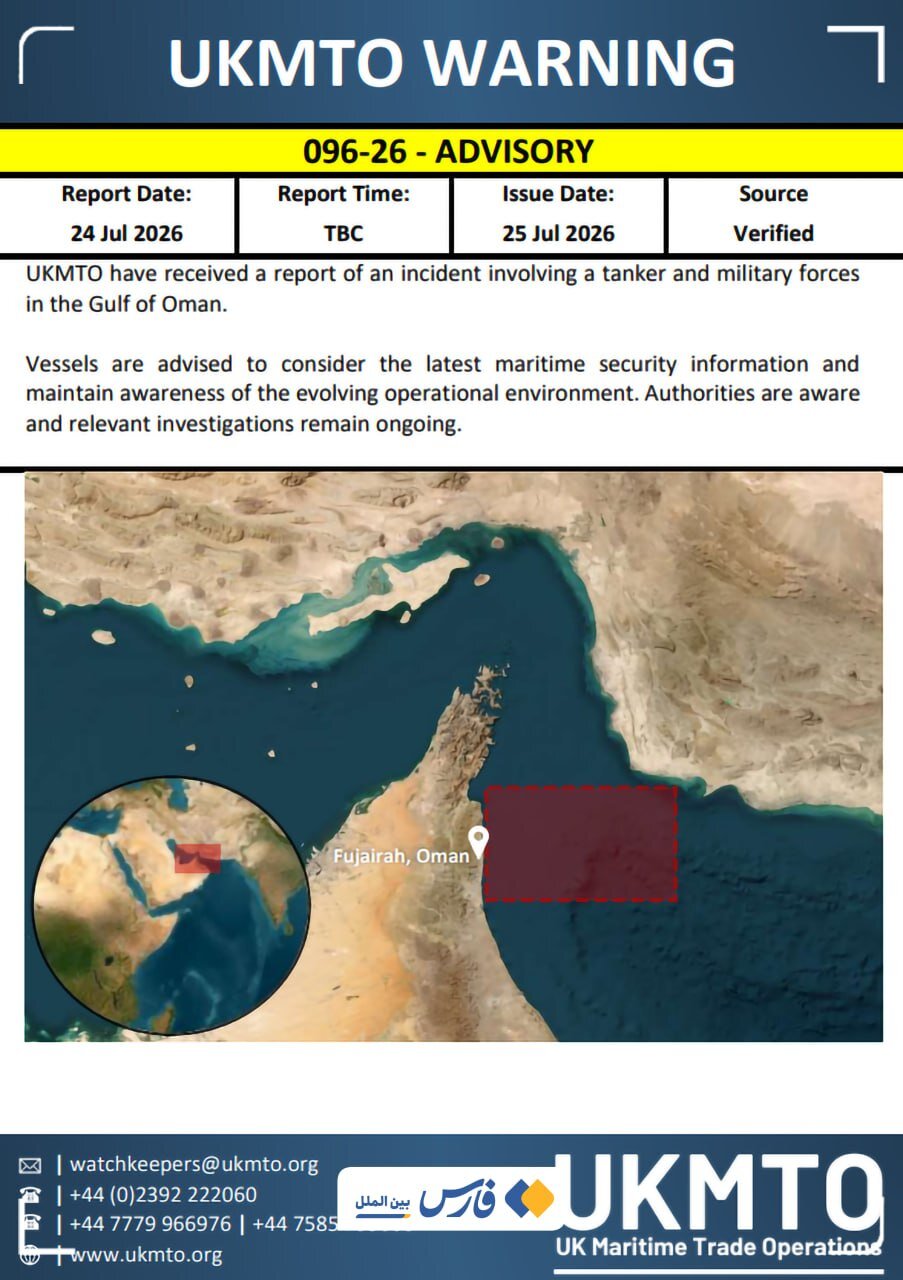
A maritime incident off the Omani coast, 25 July 2026. CENTCOM resumed its maritime blockade of Iran on 14 July 2026.
Source: ISNA
Source
Shafaq News
Related news
Iran's cabinet hears a fuel savings report and approves war damage compensation credits
Iran's cabinet met on the evening of Sunday 2 August 2026 chaired by President Masoud Pezeshkian. The interior minister, who heads the working group on energy consumption management, reported that natural gas consumption from the start of the Iranian year to the beginning of Mordad was down 11.9 percent on the same period of the previous year, that total fuel consumption fell 10.2 percent over the same window, and that gasoil consumption fell 65.4 percent. According to the report, the absolute reduction in fuel use is estimated to be equivalent to the output of two power plants. The figures were presented at a time when refinery capacity and petroleum product storage infrastructure have been damaged in the recent strikes. The cabinet also approved, on a proposal from the Planning and Budget Organisation, credits to compensate medical sciences universities, health and treatment centres and relief and rescue bodies damaged in the recent war. On a proposal from the central bank, it approved activation of the "Iranian wallet" for staff of executive bodies, along with an update to the rules on violations and penalties in the rail transport network.
اقتصاد آنلاین (به نقل از ایرنا) · Aug 2, 2026
Saudi crown prince presses Trump to prioritise dialogue in the war with Iran
The Saudi Press Agency reported on Sunday 2 August 2026 that Crown Prince Mohammed bin Salman, in a telephone call with Donald Trump, stressed the need to prioritise dialogue in order to reduce escalation and the importance of making every possible effort to achieve calm that opens the way to diplomatic solutions. According to the report, the crown prince also underlined preserving the security and stability of the Persian Gulf region and preventing the conflict from widening. The call took place hours before Trump announced that he was halting a fresh attack on Iran. On Saturday he had struck a far harder tone, saying the United States was ready to act. Saudi Arabia has in recent weeks intercepted drones launched towards oil facilities in its east and towards Riyadh. A calmer Persian Gulf front matters directly for the global oil market and for Iran's markets.
Al Jazeera · Aug 2, 2026
Araghchi tells the cabinet that Iran's talks with Oman are in their final stages
Iran's foreign minister Seyed Abbas Araghchi presented a report on the state of negotiations between Iran and Oman at the start of the cabinet session on the evening of Sunday 2 August 2026, saying the talks are on course to be finalised and are going through their final stages. The session was chaired by President Masoud Pezeshkian. The negotiations concern the mechanism for maritime traffic through the Strait of Hormuz. The same evening, foreign ministry spokesperson Esmaeil Baqaei said that an understanding on a new route does not by itself mean the strait will reopen and does not amount to a sufficient condition. The Strait of Hormuz carries roughly a fifth of the world's oil and gas trade, and any sign of progress or stalling in these talks bears directly on global oil prices and on Iran's domestic currency and gold markets.
خبرآنلاین · Aug 2, 2026
Iran's foreign ministry says an Oman route understanding does not mean the Strait of Hormuz reopens
Esmaeil Baqaei, spokesperson for Iran's foreign ministry, said on the evening of Sunday 2 August 2026 in an interview with the state Khabar channel that talks between Iran and Oman on a shipping route through the Strait of Hormuz began the day after the ceasefire memorandum of 8 April and have been running for seven to eight days in their current phase. He said the two sides are working towards a new traffic separation scheme that would be neither the former northern route nor the southern one. Baqaei stressed that such an understanding is "a necessary but not a sufficient condition" and has no bearing on whether the Strait of Hormuz reopens or stays closed. He said the strait would not return to its pre 28 February status, added that maps prepared by Iranian bodies had been shared with the Omani side, and described the negotiations so far as moving forward. He said the route approved by the International Maritime Organisation from 1968 ran entirely through Omani territorial waters. The Strait of Hormuz carries roughly a fifth of the world's oil and gas trade, and its status bears directly on global oil prices and on Iran's currency and gold markets.
خبرآنلاین (به نقل از ایرنا) · Aug 2, 2026