
Iran Mercantile Exchange floors offered 354,000 tonnes of products on Saturday 1 August
Aug 1, 2026
The Iran Mercantile Exchange said its trading floors offered 354,467 tonnes of products on Saturday 1 August 2026 (10 Mordad 1405), the first trading day of the Iranian week.
The largest share, 221,865 tonnes, went to the Kish export hall, comprising 122,250 tonnes of cement, 75,000 tonnes of clinker, 15,000 tonnes of steel billet and bloom, 9,565 tonnes of bitumen and 50 tonnes of moisture insulation. The industrial hall listed 112,626 tonnes of steel sections.
The petrochemical and oil products hall offered 13,824 tonnes, including 12,250 tonnes of chemicals, 1,024 tonnes of polymers and 550 tonnes of bitumen, while the side hall offered 6,152 tonnes of polymers, chemicals, scrap and steel.
Media
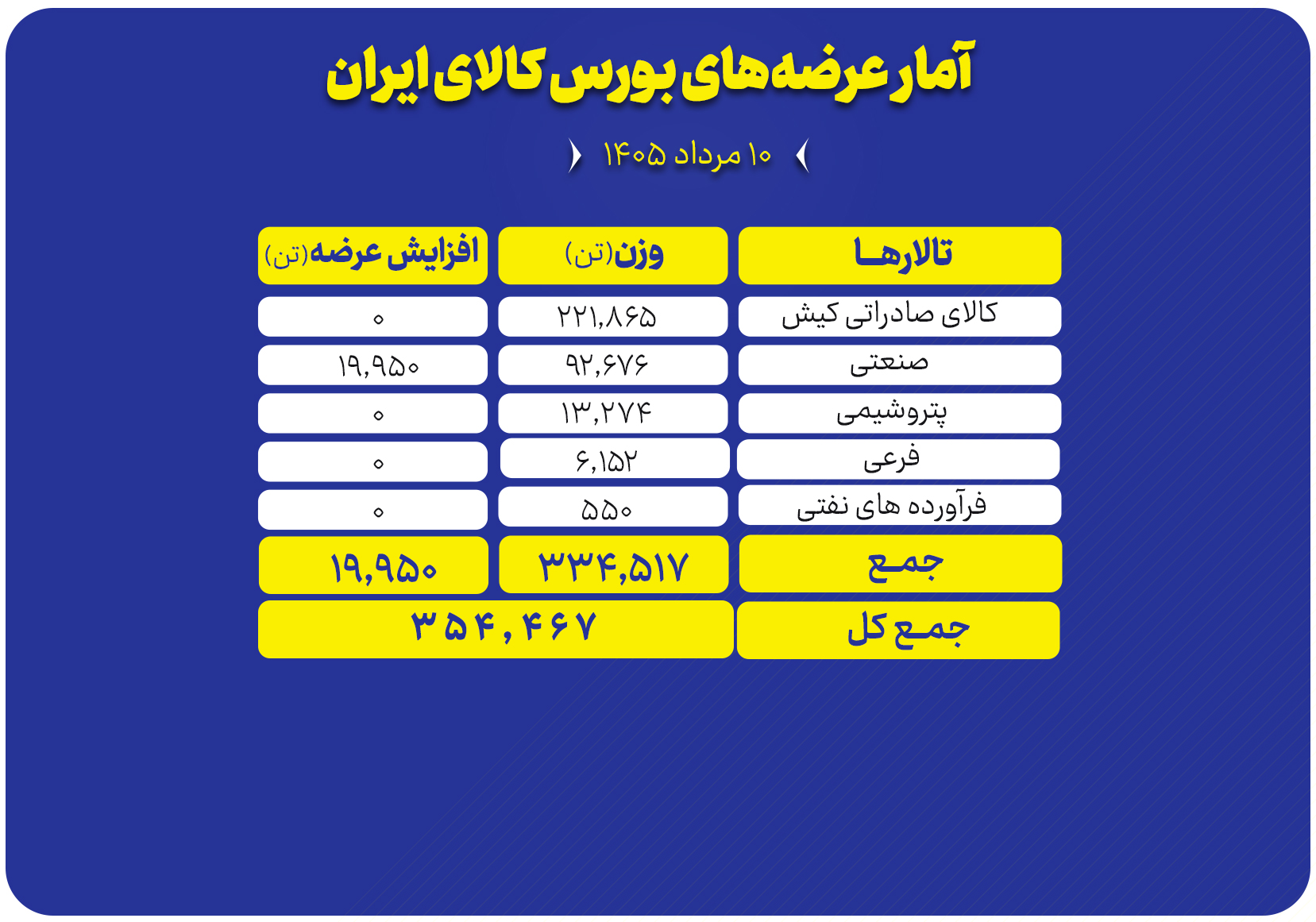
Iran Mercantile Exchange floors offered 354,000 tonnes on 1 August 2026
Source: سنا
Source
کالاخبر (بورس کالای ایران)
Related news
Explosion at a copper mine in Delijan kills two workers
An explosion at a copper mine in the village of Mohammadabad in Delijan, Markazi province, killed two workers on the evening of Saturday 1 August 2026. Behrouz Irannejad, head of pre hospital emergency and disaster services 115 at Arak University of Medical Sciences, said one worker died at the scene, while a second worker who still had vital signs when rescuers arrived was taken to Imam Sadegh hospital in Delijan and died there from the severity of his injuries. According to the report, published by the IRNA news agency, the 115 emergency service in Markazi province operates 34 urban emergency stations, 48 road stations, 2 women's stations, one air ambulance station and four ambulance buses.
اقتصاد آنلاین · Aug 1, 2026
Iraq and Turkiye sign pipeline deal to ship at least 750,000 barrels per day to Ceyhan
Iraqi Prime Minister Ali Falih Al Zaidi announced on Saturday 1 August 2026 that Iraqi and Turkish companies will begin operations under a new agreement to transport crude oil exports through the Iraq to Turkiye pipeline to the Port of Ceyhan. He called the deal a strategic milestone for restoring Iraqi crude flows through the pipeline and expanding economic cooperation with Turkiye. Earlier the same day, Oil Minister Bassem Mohammed Khudair Al Abadi signed the one year agreement with the Turkish side. It sets a minimum Iraqi crude transport rate of 750,000 barrels per day through the pipeline, pending completion of a wider framework. According to Al Zaidi, Baghdad and Ankara are finalising that broader framework, covering oil, electricity, water resources and other areas of mutual interest. The return of this export route matters for the West Asian oil market because it adds regional export capacity along a path that does not pass through the Strait of Hormuz.
Shafaq News · Aug 1, 2026
Shell posts best quarterly profit in four years with $9.84 billion adjusted earnings in Q2 2026
Britain's Shell reported on Thursday 30 July 2026 that its adjusted second quarter earnings reached $9.84 billion, above the $8.79 billion analyst consensus compiled by LSEG. That compares with $4.26 billion in the second quarter of 2025 and $6.92 billion in the first quarter of 2026, and is Shell's best quarterly result since the second quarter of 2022, when the company posted $11.47 billion. According to Shell's report, cash flow from operations reached $21.4 billion in the second quarter of 2026, while net debt fell to $41.75 billion from $52.6 billion at the end of the first quarter. Shell said it would maintain the pace of its share buyback programme at $3 billion over the next quarter and left its 2026 capital expenditure outlook unchanged at $24 billion to $26 billion. Chief Executive Wael Sawan said volatility had become the new normal and that high commodity prices provided a tailwind for the results. The jump in oil and gas prices during the regional war has lifted profits at the energy majors, which matters for Iran's market through the global oil price channel.
CNBC · Aug 1, 2026
South Korea to start importing Argentine crude next year with an initial cargo of about 880,000 barrels
Wi Sung-lac, South Korea's national security adviser, said on Friday, 31 July 2026 (9 Mordad 1405), that the country plans to begin importing crude oil from Argentina next year in order to diversify its energy sources beyond West Asia. He said that after a trial import by a South Korean company this year, an initial purchase of about 880,000 barrels is planned. The announcement came during a visit to Buenos Aires by South Korean President Lee Jae-myung. Lee and Argentine President Javier Milei agreed on Friday that their governments would support a durable start to crude oil trade. Wi said the volume is not yet large but is a suitable start, and could grow as Argentina raises oil and gas output and expands its export capacity. The two sides also agreed to explore wider cooperation on natural gas, nuclear energy and critical minerals including lithium and copper. Seoul has described the agreement as part of a broader effort to reduce the geopolitical risk of its heavy dependence on West Asian crude.
شانا · Aug 1, 2026