
Physical market volume on the Iran Mercantile Exchange rose 24.4 percent in the week to 9 Mordad
Aug 2, 2026
In the week to 9 Mordad 1405 (31 July 2026), the physical market of the Iran Mercantile Exchange traded 3,670,001 tonnes of goods worth 97.8 trillion toman. According to the Iran Capital Market News Agency (SENA), that volume was up 24.4 percent, or 721,000 tonnes, on the previous week.
By composition, base metals and the steel chain took the bulk of turnover, with copper, rebar and bloom billet topping the weekly value table. By volume, cement, iron ore pellet and iron ore concentrate led the trading, and pellet returned to the list of most traded products after several weeks away.
The value traded by the exchange's top ten companies in the same week exceeded 39.9 trillion toman, about 41 percent of the total physical market turnover. The concentration in the steel chain and building materials indicates that demand from Iran's basic industries has held up despite energy restrictions and wartime conditions.
Media
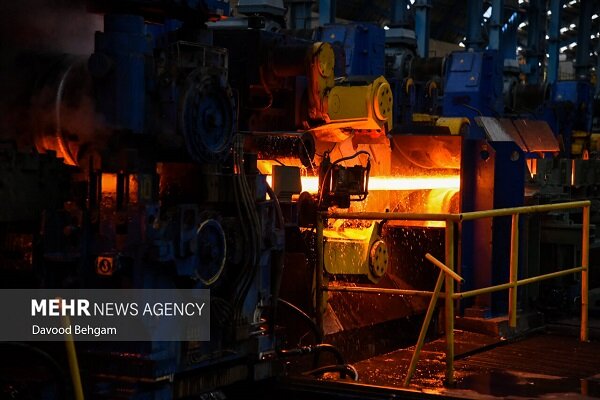
A steel and iron ore production line in Iran. Base metals and the steel chain topped Iran Mercantile Exchange turnover in the week to 9 Mordad 1405 (file photo)
Archive photo · Source: Mehr News
Source
پایگاه خبری بازار سرمایه ایران (سنا)
Related news
Iran Mercantile Exchange offers 3.21 million tonnes of goods across its trading halls today
The trading halls of the Iran Mercantile Exchange are hosting offerings of 3,214,797 tonnes of goods on Sunday 2 August 2026 (11 Mordad 1405). According to the Iran Capital Market News Agency (SENA) and the exchange's own news service the same day, today's offerings are concentrated in iron ore and cement. The day's offering volume is large relative to the whole of last week. In the week to 9 Mordad 1405 (31 July 2026), a total of 3,670,000 tonnes of goods changed hands on the exchange's physical market, meaning a single Sunday's offering is close to the volume actually traded across a full week. On the same day, the hydrocarbon physical market of the Iran Energy Exchange is offering a total of 38,428 tonnes of hydrocarbon products. The commodity and energy exchanges are the official price discovery route for the raw materials of Iranian industry, from steel and cement to petroleum products, so offering volumes feed directly into production chain costs.
پایگاه خبری بازار سرمایه ایران (سنا) · Aug 2, 2026
Qatari mediators held separate talks with Araghchi and Witkoff on Saturday over reopening the Strait of Hormuz
According to a report by the news site Axios, republished by the newspaper Donya-e Eqtesad on Sunday, 2 August 2026 (11 Mordad 1405), Qatari mediators held separate talks on Saturday, 1 August 2026, with Iranian Foreign Minister Abbas Araghchi, White House special envoy Steve Witkoff and Omani officials, to prepare the ground for a deal on reopening the Strait of Hormuz. A source familiar with the matter said the talks had made progress, but that it was not yet clear whether it would be enough to contain the crisis. In the same report, Axios, citing two US officials and a source familiar with the call, said Saudi Crown Prince Mohammed bin Salman had telephoned Donald Trump to urge de-escalation and to refrain from striking Iran's energy targets. One of the officials said Riyadh had asked for clarity on Washington's operational plan. The White House and the Saudi embassy in Washington declined to comment on the call. Trump had met Saudi Defence Minister Prince Khalid bin Salman on Wednesday, a meeting a source said was added to the schedule after the prince met US Vice President JD Vance. According to the same report, alongside Saudi Arabia, Qatar, the United Arab Emirates, Türkiye and Pakistan are pressing both sides to de-escalate. Araghchi spoke on Saturday with Field Marshal Asim Munir, Pakistan's army chief, and with the Turkish and Saudi foreign ministers, telling his Saudi counterpart that any hostile action by the United States or Israel, or participation in it by regional states, would meet a "decisive and proportionate response". The Strait of Hormuz is the main export route for Persian Gulf crude, and its status bears directly on global oil prices and on freight and insurance costs.
روزنامه دنیای اقتصاد (به نقل از آکسیوس) · Aug 2, 2026
Power restrictions on Iran's industrial estates cut from two days to one a week, with full removal expected within three to four weeks
Mostafa Rajabi Mashhadi, deputy minister for electricity and energy at Iran's Energy Ministry, said in remarks published on Saturday, 1 August 2026, that since the middle of the previous week the weekly power restriction on industrial estates had been cut from two days to one. He said the restriction on steel producers running slab production on the night shift had also been lifted. Rajabi Mashhadi added that, with arrangements made for some industries such as cement and rolling mills to move to night shifts, power restrictions are expected to be removed entirely within the next three to four weeks. Pointing to the role of the private sector in the power industry, he said more than 60 percent of the country's electricity generation and all maintenance work on transmission lines and substations is carried out by private operators. He described the "green and free electricity board" mechanism as a market with firm demand for power from both thermal and renewable plants.
شانا · Aug 2, 2026
Hungary to shut its only nuclear power plant as the Danube falls to a record low
Hungarian Prime Minister Peter Magyar said the Paks Nuclear Power Plant in central Hungary would be powered down on Sunday, 2 August 2026, the first full shutdown in its 44 year history. Paks supplies nearly half of Hungary's electricity and draws cooling water for its reactors from the Danube River. Magyar said output had fallen to 965 megawatts on Friday, 31 July 2026, and to 240 megawatts overnight, far below the normal 2,000 megawatts. Low river levels have limited the ability of the plant's pumps to draw in enough water. A river level of minus 134cm at Paks forces a full shutdown, and the level is expected to fall as low as minus 144cm, far below the previous record of minus 98cm set in 2018. Months of heat and drought have lowered levels on several European rivers, and Hungary has placed more than 100 cities and villages under water use restrictions. The government has asked companies that use large volumes of water to cut consumption voluntarily. The event has also disrupted shipping, tourism, agriculture and industry in the country. Slovakia's Prime Minister Robert Fico said his country was closely monitoring the energy situation and was ready to help.
Al Jazeera · Aug 2, 2026