
Red meat supplied by Iran's official abattoirs reached 41,208 tonnes in Khordad 1405
Aug 3, 2026
According to the results of the livestock slaughter survey of Iran's official abattoirs, published by the Statistical Centre of Iran and reported by the Mehr news agency on Sunday 2 August 2026 (11 Mordad 1405), the weight of red meat supplied from animals slaughtered in the country's official abattoirs reached 41,208 tonnes in Khordad 1405 (May and June 2026).
Beef and veal accounted for 23,639 tonnes, or 57.3 percent of the total red meat supplied. Mutton and lamb came to 13,790 tonnes, a share of 33.5 percent, goat and kid meat to 2,893 tonnes, or 7 percent, and other livestock types to 886 tonnes, or 2.2 percent.
Compared with Khordad 1404, red meat supplied through official abattoirs fell 3 percent. By category, mutton and lamb was down 5 percent, goat and kid 1 percent, beef and veal 2 percent and buffalo and buffalo calf 27 percent, while camel and camel calf meat rose 3 percent. Against Ordibehesht 1405, however, supply was about 11 percent higher. The Statistical Centre of Iran stressed that part of livestock slaughter, particularly of small livestock, takes place outside official abattoirs and is not captured in this survey.
Media
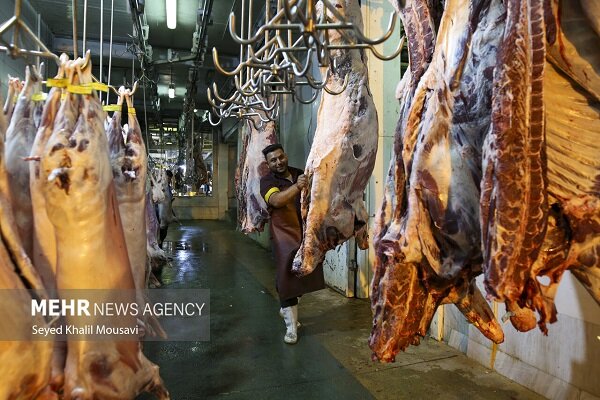
File photo of red meat supply. The Khordad 1405 livestock slaughter data were published on 2 August 2026
Archive photo · Source: Mehr News
Source
خبرگزاری مهر (به نقل از مرکز آمار ایران)
Related news
Iran begins a Tehran pilot moving the petrol subsidy quota from fuel cards to bank cards
Morteza Zamanian, deputy for economic policy at Iran's Ministry of Economic Affairs and Finance, announced the start of a scheme moving the petrol subsidy quota from fuel cards to bank cards. According to a report by EcoIran citing the Mehr news agency, published on Monday 3 August 2026 (12 Mordad 1405), the scheme has begun on a pilot basis in Tehran and is due to be rolled out nationwide by the end of the year. Zamanian said the measure was implemented in cooperation with the oil and communications ministries and the Central Bank, in line with parliamentary approvals. He added that the plan, held up for years by a lack of coordination between agencies, is now being carried out to identify fuel subsidy beneficiaries precisely and to prevent smuggling and leakage of consumption. Under the scheme, the fuel subsidy is calculated on the basis of the user's own bank card, which he said minimises the scope for abuse even where a station's fuel card or someone else's card is used. Zamanian stressed that the scheme requires no change to station equipment, imposes no new financial burden on the public, and has no connection to any increase in petrol prices or change in quotas.
اکوایران (به نقل از خبرگزاری مهر) · Aug 3, 2026
A sharp drop in sulfur shipments through the Strait of Hormuz lifts global prices
Shafaq News reported on Sunday 2 August 2026 (11 Mordad 1405) that sulfur prices have risen 134 percent since the outbreak of the US and Iran war on 28 February. The outlet attributed that figure to the media outlet Bull Theory. Sulfur is a key input in fertiliser manufacturing, so a higher price raises food production costs worldwide. The Strait of Hormuz is a vital route for the global seaborne sulfur trade, handling about half of worldwide shipments. According to figures Shafaq News attributed to Reuters, only 80,000 metric tons of sulfur passed through the strait during three and a half months of conflict, compared with 640,000 metric tons after a de-escalation agreement was reached. In Iran, sulfur is produced mainly as a by-product of the oil, gas and petrochemical industries. Both the global price level and the ability to move cargoes through the Strait of Hormuz therefore bear on export earnings from that sector.
Shafaq News · Aug 3, 2026
An explosion is reported near a tanker 20 nautical miles northeast of Oman's Khasab port
The United Kingdom Maritime Trade Operations (UKMTO) reported a maritime incident northeast of the port of Khasab in Oman's Musandam province. According to the centre's advisory, relayed by Iranian media in the early hours of Monday 3 August 2026 (12 Mordad 1405), a tanker 20 nautical miles northeast of the port experienced an explosion in very close proximity to its hull. The vessel's master confirmed hearing the explosion nearby and reported the ship and all crew safe, saying the incident had caused no casualties and no physical damage to the vessel. Investigations by the competent authorities have begun to establish the cause and nature of the blast. UKMTO issued a maritime warning asking all vessels operating in the area to exercise caution, raise their readiness level, and immediately report any suspicious movement, object or activity. Khasab sits at the mouth of the Strait of Hormuz, and security incidents in this area feed through to war risk insurance premiums and tanker freight rates.
روزنامه دنیای اقتصاد (به نقل از خبرگزاری ایسنا و UKMTO) · Aug 3, 2026
Oil slumps on positive signals from the Iran and United States talks
Global oil markets fell in the opening hours of the week's trading, early on Monday 3 August 2026 (12 Mordad 1405), as hopes strengthened that talks between Iran and the United States would be concluded. According to the newspaper Donya-e-Eqtesad, Brent fell more than 6 percent during those hours, retreating into the $80s. Price provider data from the same early morning gives a more precise reading of the market level. Trading Economics reported Brent at $83.77 a barrel, a fall of 4.73 percent from the previous close of $87.93. OilPrice put Brent at $83.87, down 4.62 percent, and West Texas Intermediate at $80.64, down 4.76 percent. The gap between these readings and the figure of more than 6 percent reflects the moment of measurement during overnight swings. The driver was the US president's announcement that he had cancelled a planned military strike and that a new round of talks with Tehran would begin. Despite the drop, Brent remains 16.37 percent higher than a month ago and 21.83 percent higher than at the same time last year, on Trading Economics data.
روزنامه دنیای اقتصاد · Aug 3, 2026