
Iran's wartime command warns over reported US plans to strike energy infrastructure
Aug 1, 2026
Major General Ali Abdollahi, head of Iran's wartime military command, said in a statement on Saturday 1 August 2026 that the United States is moving at an accelerating pace to fan the flames of a full scale regional war, and urged countries in the region to reconsider their cooperation and alignment with Washington. The statement followed reports by major US media outlets that the United States and Israel may launch an extensive wave of attacks on Iran's civilian infrastructure, including power plants and petrochemical producers.
According to Al Jazeera, Donald Trump has not yet given final authorisation for such an operation. Israel's Defence Minister Israel Katz said on Tuesday that Israel wants to strike Iran's energy targets but that the United States is not approving it at present, out of concern that Iran would hit neighbouring countries and trigger a global oil crisis.
On Saturday Kuwait's army said its air defences destroyed several Iranian drones in Kuwaiti airspace, with damage to some government facilities and civilian vehicles. Western maritime authorities also reported that at least two vessels were hit off the coast of Oman, one of them suffering engine room damage. Iran said four other ships were turned back and that the Strait of Hormuz remains closed to traffic not approved by the Islamic Revolutionary Guard Corps.
Media
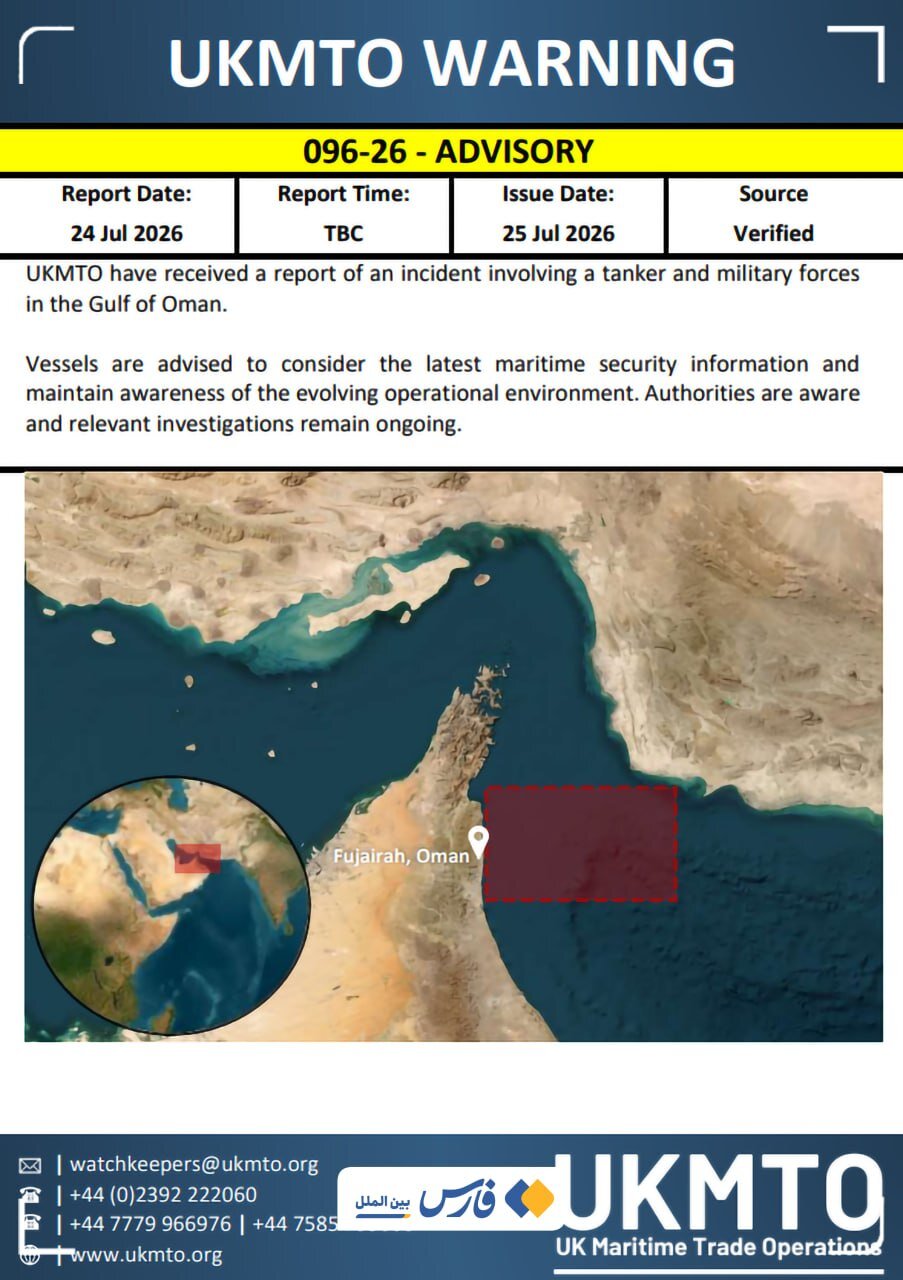
A maritime incident off the Omani coast, 25 July 2026
Source: ISNA
Iran's gas transmission infrastructure
Archive photo · Source: Mehr News
Source
Al Jazeera
Related news
Russia extends its gasoline and diesel export ban to 31 January 2027
The Russian government said in a statement on Thursday, 30 July 2026 (8 Mordad 1405), that it has extended its ban on gasoline and diesel exports until 31 January 2027 (11 Dey 1405). The diesel ban had originally covered 8 to 31 July 2026 (17 Tir to 9 Mordad 1405), and the new scope also takes in marine fuel and gasoil. Under the decision, producers will be exempt from the diesel, marine fuel and gasoil restrictions from 1 September 2026 (10 Shahrivar 1405), while some fuel exports will continue under intergovernmental agreements and as humanitarian aid. The government also adopted a temporary procedure running to 1 November 2026 (10 Aban 1405) to secure fuel for farmers during the harvest season, plus a separate measure on stable motor fuel supply for provincial and local bodies. Repeated Ukrainian drone attacks on Russian refineries over recent months have caused fuel shortages and price increases in the country's domestic market.
خبرگزاری مهر · Aug 1, 2026
Iran Mercantile Exchange floors offered 354,000 tonnes of products on Saturday 1 August
The Iran Mercantile Exchange said its trading floors offered 354,467 tonnes of products on Saturday 1 August 2026 (10 Mordad 1405), the first trading day of the Iranian week. The largest share, 221,865 tonnes, went to the Kish export hall, comprising 122,250 tonnes of cement, 75,000 tonnes of clinker, 15,000 tonnes of steel billet and bloom, 9,565 tonnes of bitumen and 50 tonnes of moisture insulation. The industrial hall listed 112,626 tonnes of steel sections. The petrochemical and oil products hall offered 13,824 tonnes, including 12,250 tonnes of chemicals, 1,024 tonnes of polymers and 550 tonnes of bitumen, while the side hall offered 6,152 tonnes of polymers, chemicals, scrap and steel.
کالاخبر (بورس کالای ایران) · Aug 1, 2026
Basrah Heavy crude fell 14.6 percent over the week to 56.21 dollars a barrel
Basrah crude grades posted steep losses in the week ending 1 August 2026 (10 Mordad 1405). Basrah Heavy fell 1.89 dollars, or 3.25 percent, in the final trading session of the week to settle at 56.21 dollars a barrel, a weekly loss of 9.61 dollars or 14.60 percent. Basrah Medium slipped by the same 1.89 dollars, or 3.13 percent, in that session to close at 58.51 dollars a barrel, a weekly loss of 9.61 dollars or 14.11 percent. Notably, the decline came in a week when global oil futures finished higher, meaning the discount on Basrah grades relative to international benchmarks widened. Basrah grades compete directly with Iranian crude in the Asian market, so shifts in their discount feed through to regional pricing.
Shafaq News · Aug 1, 2026
Iraq and Turkiye discuss a one year deal setting minimum crude exports of 750,000 barrels per day via the Ceyhan pipeline
Iraq and Turkiye held talks on Saturday 1 August 2026 on a one year agreement that would set a minimum Iraqi crude export volume of 750,000 barrels per day through the Iraq to Turkiye pipeline to the port of Ceyhan. The Ankara talks were led by Iraqi Oil Minister Basim Al-Abbadi and Turkish Energy and Natural Resources Minister Alparslan Bayraktar. Iraq's Oil Ministry said the temporary deal would remain in force while both sides develop a broader framework covering oil, electricity and water resources. The previous bilateral framework expired on 27 July 2026. The pipeline is Iraq's only active crude export outlet outside its southern terminals. It reopened in September 2025 after a shutdown of about two and a half years linked to an international arbitration dispute over Kurdistan Region crude exports. Volumes on the route affect how much West Asian crude reaches global markets.
Shafaq News · Aug 1, 2026