
Iran approves a six point emergency package for mining explosives as ANFO climbs from 33,000 to 192,000 tomans a kilo in a year
Aug 1, 2026
The mining committee of Iran's Production Facilitation and Obstacle Removal Headquarters has drawn up a six point package to manage the crisis in the supply of mining explosives. Mehr News Agency reported on Saturday, 1 August 2026 (10 Mordad 1405), citing the Iran Chamber of Commerce, that the committee's first specialist session was held at the House of Mines of Iran with representatives of the Ministry of Industry, Mine and Trade, the Ministry of Defence, the House of Mines, IMIDRO, industry associations and delegates from large and small mines.
According to a report by the House of Mines of Iran presented at the session, the price of the explosive ANFO has risen over the past year from about 33,000 tomans to close to 192,000 tomans per kilogram. Technical assessments presented at the same meeting indicate that importing ammonium nitrate works out, in some scenarios, between 40 and more than 60 percent cheaper than the domestic price even after freight, insurance, customs and processing costs. Committee members stressed that the shortage of supply is more worrying than the price increase itself, and warned that if the situation persists it could halt mining operations, particularly at small and medium sized mines, cut employment, reduce feedstock for mineral industries and lower exports.
The main provisions of the approved package are the immediate supply of explosives through imports using the capacity of large mines under Ministry of Defence supervision; the removal of obstacles to order registration, foreign currency allocation and customs clearance within a maximum of 15 days; the creation of strategic reserves; the formation of a joint working group to reform the pricing structure with the industry and defence ministries, the Consumer and Producer Protection Organization and the House of Mines; the reorganisation of existing explosives depots in coordination with provincial security councils; and a review of new production capacity for raw materials. The package has been referred to the Production Facilitation Headquarters for final approval.
Media
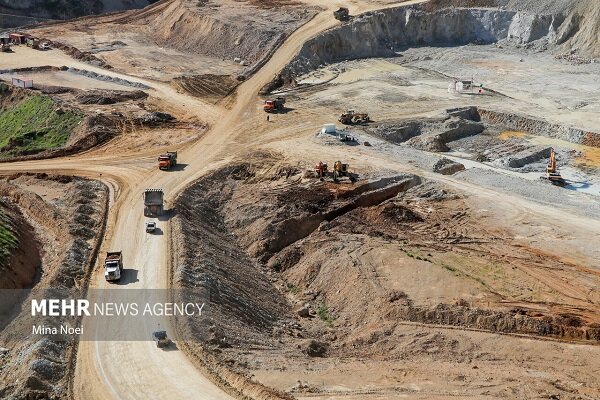
A mine in Iran. On 1 August 2026 the mining committee approved a six point package on explosives supply (archive photo)
Archive photo · Source: Mehr News
Source
خبرگزاری مهر (به نقل از اتاق بازرگانی ایران و خانه معدن ایران)
Related news
ExxonMobil and Chevron chiefs say spare refining capacity is at its lowest and US fuel prices are set to rise
Mehr news agency, citing Politico, reported that the chief executives of ExxonMobil and Chevron said on Friday 31 July 2026 that fuel producing refineries are running at maximum capacity and that there is effectively no room for a significant increase in output to cover the global shortfalls caused by the war in Iran and other areas of tension. They warned that this is likely to push consumer fuel prices higher in the coming months. Darren Woods, ExxonMobil's chief executive, said spare refining capacity is now lower than at any point he has seen and that the industry needs time to work its way out of the position. He said the closure of the Strait of Hormuz has taken 3 million barrels a day of refining capacity out of the system, while export restrictions on refined products from China and Russia have together removed at least 5 million barrels a day of global capacity. The American Automobile Association puts the average US petrol price at 4.10 dollars a gallon, close to one dollar more than the same period last year. The US Energy Information Administration has said American refineries have run at about 97 percent of operating capacity this month.
خبرگزاری مهر · Aug 1, 2026
Iran's wartime command warns over reported US plans to strike energy infrastructure
Major General Ali Abdollahi, head of Iran's wartime military command, said in a statement on Saturday 1 August 2026 that the United States is moving at an accelerating pace to fan the flames of a full scale regional war, and urged countries in the region to reconsider their cooperation and alignment with Washington. The statement followed reports by major US media outlets that the United States and Israel may launch an extensive wave of attacks on Iran's civilian infrastructure, including power plants and petrochemical producers. According to Al Jazeera, Donald Trump has not yet given final authorisation for such an operation. Israel's Defence Minister Israel Katz said on Tuesday that Israel wants to strike Iran's energy targets but that the United States is not approving it at present, out of concern that Iran would hit neighbouring countries and trigger a global oil crisis. On Saturday Kuwait's army said its air defences destroyed several Iranian drones in Kuwaiti airspace, with damage to some government facilities and civilian vehicles. Western maritime authorities also reported that at least two vessels were hit off the coast of Oman, one of them suffering engine room damage. Iran said four other ships were turned back and that the Strait of Hormuz remains closed to traffic not approved by the Islamic Revolutionary Guard Corps.
Al Jazeera · Aug 1, 2026
Iran's parliament begins reviewing a Strait of Hormuz management bill in its national security commission
Hassan Ghashghavi, spokesperson for the national security and foreign policy commission of Iran's parliament, told the Fars news agency on Saturday 1 August 2026 that a preliminary session on a Strait of Hormuz management bill had been held, attended by members of the commission together with representatives of parliament's legal affairs department and of the parliamentary research centre. He said some government bodies have already submitted their views and that the government will shortly present a single consolidated position through its legal department. After a detailed review, the bill will be approved in the national security commission as the lead commission and then put to the floor of parliament for a vote. Ghashghavi said the review is centred on protecting national interests and national security, and, citing the change of circumstances principle in international law and the rules of the law of the sea, said that revising the legal regime of straits and waterways in particular circumstances, including wartime, is recognised. The Strait of Hormuz carries a large share of the region's crude and product exports, so any change to its legal regime bears on the global oil market and on freight and insurance costs.
اقتصاد آنلاین · Aug 1, 2026
Iran's agriculture ministry says red meat imports from Brazil have stopped, with Pakistan the main replacement
Rouhollah Zahmatkesh, deputy for livestock production at Iran's Ministry of Agriculture Jihad, said on Saturday 1 August 2026, on the sidelines of the second specialised livestock, poultry and dairy industries exhibition at the Shahr-e Aftab site in Tehran, that Iran is currently not importing meat from Brazil and that neighbouring and regional countries will be the first choice of supply where imports are needed. He said red meat imports from Pakistan are continuing without difficulty, describing it as one of the region's centres of large livestock production, and noted that quarantine, slaughter and import infrastructure has been built in Sistan and Baluchestan province. He added that supply is not limited to Pakistan and that capacity in countries to Iran's north can be brought in if required. According to Eghtesad Online, concern over microbial load in some Brazilian shipments, alongside reduced buying by other customers of that market, lies behind the shift in sourcing. Zahmatkesh put Iranian red meat consumption at about 11 kilograms per person and said he was satisfied with domestic production this year thanks to favourable rainfall.
اقتصاد آنلاین · Aug 1, 2026