

Up to 53% offSee the plans
Back to articles

Educational

Compound Interest in an Inflationary Economy: Why a 23% Deposit Against 61.4% Inflation Returns Minus 24%

Compound interest is not a financial trick but a mathematical property that works in both directions. At 20 percent, 100 million tomans becomes about 3,834 million over 20 years, while simple interest yields only 600 million. But inflation compounds too: at the 61.4 percent annual inflation of Tir 1405 (July 2026), the purchasing power of cash halv...

Sahmino editorial· 29 July· 8 min read· General

Related video

Watch onSahmino
Watch the full video

An old riddle: if the leaves of a water lily double every day and cover the whole pond on the thirtieth day, on which day was half the pond covered? The answer is not day fifteen. It is day twenty nine. This is not a motivational line; it is precisely what compound interest does to money. For a long stretch almost nothing happens, and then, suddenly, everything happens.

And that same property works in reverse in an economy with high inflation. According to the Statistical Center of Iran, year on year inflation in Tir 1405 (July 2026) was about 83.9 percent, and annual inflation (the average of the twelve months ending in Tir 1405) about 61.4 percent. Those two figures turn the very mathematics that can be a saver's greatest ally into its most merciless opponent.

Simple interest versus compound interest

Suppose you hold 100 million tomans and earn 20 percent a year. Simple interest means the return is calculated on the principal only: 20 million tomans every year, no more and no less. Compound interest means each year's return is added to the principal, so the following year's return is calculated on the larger total. Interest earning interest.

In year one the difference is zero. But the totals then diverge like this:

YearSimple interest (million tomans)Compound interest (million tomans)
1120120
5200about 249
10300about 619
20500about 3,834

By year ten, compounding is slightly more than double simple interest. By year twenty, more than seven times. The key point: most of the growth happens in the final years. That is why time is the most important variable in this equation, more important even than the rate. Ten years at an average return usually beats three years at an excellent one.

The Rule of 72: a three second mental calculation

To find how many years your money needs to double, divide 72 by the annual rate:

  • At 6 percent: 72 divided by 6 equals 12 years
  • At 12 percent: 72 divided by 12 equals 6 years
  • At 24 percent: 72 divided by 24 equals 3 years

The rule is an approximation, but accurate enough for a quick mental estimate. And it is exactly this rule that paints a far bleaker picture when you apply it to the inflation rate instead of the interest rate.

The other side of the coin: inflation compounds too

That sentence deserves a second reading. Inflation applies to this year's prices, not to some base year's prices, which means it rides on itself exactly the way compound interest does.

Apply the Rule of 72 to the roughly 61.4 percent annual inflation of Tir 1405 (July 2026): 72 divided by 61.4 is about 1.2 years. In such conditions prices roughly double every fourteen months, or, put more precisely and less comfortably, the purchasing power of your cash halves roughly every fourteen months. Money sitting in a drawer has not avoided a decision. It has decided to halve.

Nominal return and real return

Here is the most important concept in this piece. Nominal return is the number written on the contract. Real return is what survives after inflation is subtracted. In a single digit economy that gap is a detail. In Iran's economy it is decisive.

Bank deposit rates in Iran have in recent years sat mostly in the 20 to 23 percent range. Taking annual inflation at that same 61.4 percent, the real return on a 23 percent deposit works out as follows: 1.23 divided by 1.614, minus one, which comes to roughly minus 24 percent.

In other words, a depositor who collected 23 percent over the year actually lost about a quarter of their purchasing power. The bank statement shows a bigger number, yet that money buys fewer goods. Economists call this "money illusion": our brains look at the rial figure, not at purchasing power. To follow that distinction more closely, we have written separately on the difference between nominal, effective, and real returns on a bank deposit.

Three principles that fall out of the mathematics

Here we should be blunt: where to put the money is not a Sahmino prescription. No asset guarantees a positive real return, and every higher risk asset carries a greater chance of loss. But three principles follow from the mathematics of compounding itself, with no buy recommendation attached:

1. Time matters more than the rate. Ten years at an average return usually outperforms three years at an excellent one. Whoever starts later must accept far more risk to reach the same point.

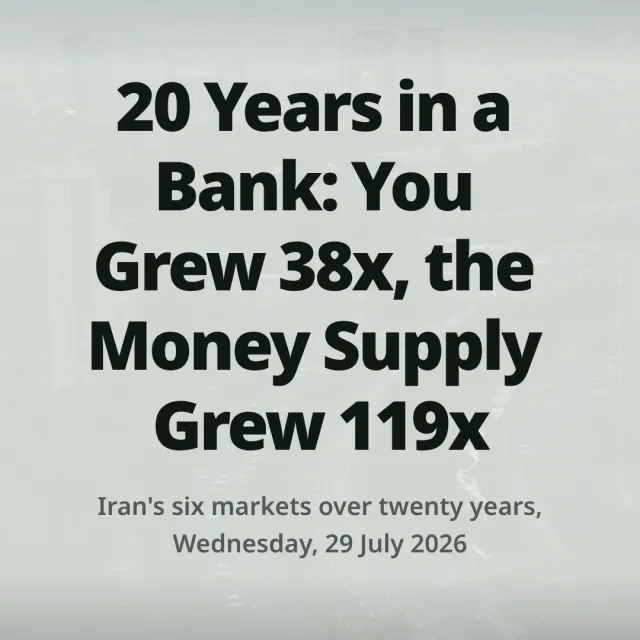
2. Always compute the real return, never the nominal one. Every time someone mentions "a 30 percent return", the first question should be: against what rate of inflation? That single subtraction filters out most financial decisions on its own. A look at the twenty year returns of six Iranian markets shows how wide that gap grows over time.

3. Compound losses are harder to undo than compound gains. If your asset falls 50 percent, returning to the starting point requires 100 percent growth, not 50 percent. That asymmetry is the main reason risk management matters, and we set out a framework for it in asset allocation in Iran's inflationary economy.

Conclusion

Compound interest is not a financial trick; it is a mathematical property that works in both directions without exception. In a low inflation economy it is the saver's patient friend. At 61.4 percent inflation it works quietly and relentlessly from the opposite side, halving idle money every fourteen months. What decides whether this force works for you or against you is neither emotion nor a market forecast, but one simple subtraction: nominal return minus inflation. If only one number from this piece stays with you, make it minus 24 percent, the figure a perfectly "safe" deposit produced in Tir 1405 (July 2026).

What to watch

Three numbers keep this calculation alive for anyone: the Statistical Center of Iran's monthly consumer price index report (which updates both the year on year and annual inflation rates), the Money and Credit Council's rulings on provisional deposit rates, and the nominal return of whatever instrument holds your money. Every time one of the three moves, redo the subtraction. For the underlying concepts, Sahmino Learn is the place to start, and for what this arithmetic does to purchasing power in practice, see money, inflation, and purchasing power.

This article is educational only and does not constitute investment advice. The figures in the examples are hypothetical and serve to illustrate the calculation mechanism.

Related articles

Stocks · Analysis

Iran's knowledge-based exports grew ninefold in four years to $2,690 million, but 84 percent of it comes from just 36 companies (Wednesday, 29 July 2026)

Exports by Iran's knowledge-based companies rose from about $296 million to about $2,690 million in four years, a more than ninefold increase. But according to the knowledge-based ecosystem report covering data through the end of 1403 (March 2025), roughly 84 percent of that figure comes from just 36 companies, while more than 12,000 others account...

9 min read · 29 July
Gold · Analysis

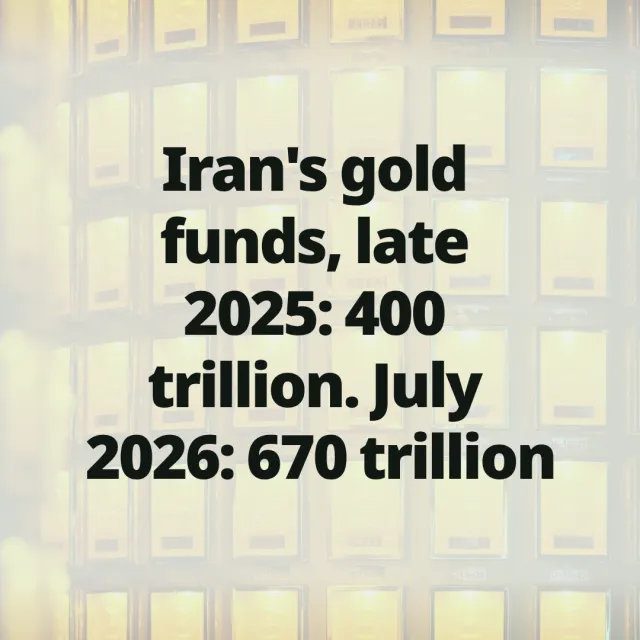
Iran's Gold Funds Went From 400 to 670 Trillion Tomans: The Day the Coin Premium Grew 65% and a Fund Unit Grew 1.4% (Wednesday, 29 July 2026)

The net asset value of Iran's exchange traded gold funds passed 670 trillion tomans in the week ending 26 Tir 1405 (17 July 2026), rising 4.4% week on week to 670,418 billion tomans. In Azar 1404 (late 2025) the figure was about 400 trillion. On Wednesday, 29 July 2026, the difference showed up in practice: the Emami coin premium grew 65.56% to 4,9...

7 min read · 29 July

Stocks · Analysis

20 Years, 6 Markets: Tehran's Main Index Rose About 382 Times While Money Supply Rose 119; Deposits and the Dollar Fell Behind (Wednesday, 29 July 2026)

If six Iranians each held 100,000 toman in 1380 (2001) and each put it into a different market, by the end of 1400 (2022) the gap between them was striking: the Tehran Stock Exchange main index about 382 times, gold coins about 190 times, Tehran housing about 96 times, bank deposits about 38 times, the free market dollar about 35 times and a Pride...

9 min read · 29 July

Commodity · Analysis

150 million tons crossed Iran's borders, but the value of each exported ton fell to $343 (Thursday, 30 July 2026)

Iran's customs administration reports that in the year 1404 (March 2025 to March 2026) the country exported 150,508,000 tons of non-oil goods worth $51,657 million, with total non-oil trade passing $109,673 million: the heaviest tonnage on record. Yet in 1403 a similar weight (about 152 million tons) earned about $57.8 billion. The value of each ex...

8 min read · 30 July