Up to 53% offSee the plans
Back to articles

Analysis

Iran's knowledge-based exports grew ninefold in four years to $2,690 million, but 84 percent of it comes from just 36 companies (Wednesday, 29 July 2026)

Exports by Iran's knowledge-based companies rose from about $296 million to about $2,690 million in four years, a more than ninefold increase. But according to the knowledge-based ecosystem report covering data through the end of 1403 (March 2025), roughly 84 percent of that figure comes from just 36 companies, while more than 12,000 others account...

Sahmino editorial· 29 July· 9 min read· Stocks

Related video

Watch onSahmino
Watch the full video

In an economy where good news is scarce, one number has settled into the official reports: exports by Iran's knowledge-based companies rose over four years from about $296 million to about $2,690 million, a more than ninefold increase. The figure comes from the knowledge-based companies ecosystem report, covering data through the end of the Iranian year 1403 (which ended in March 2025).

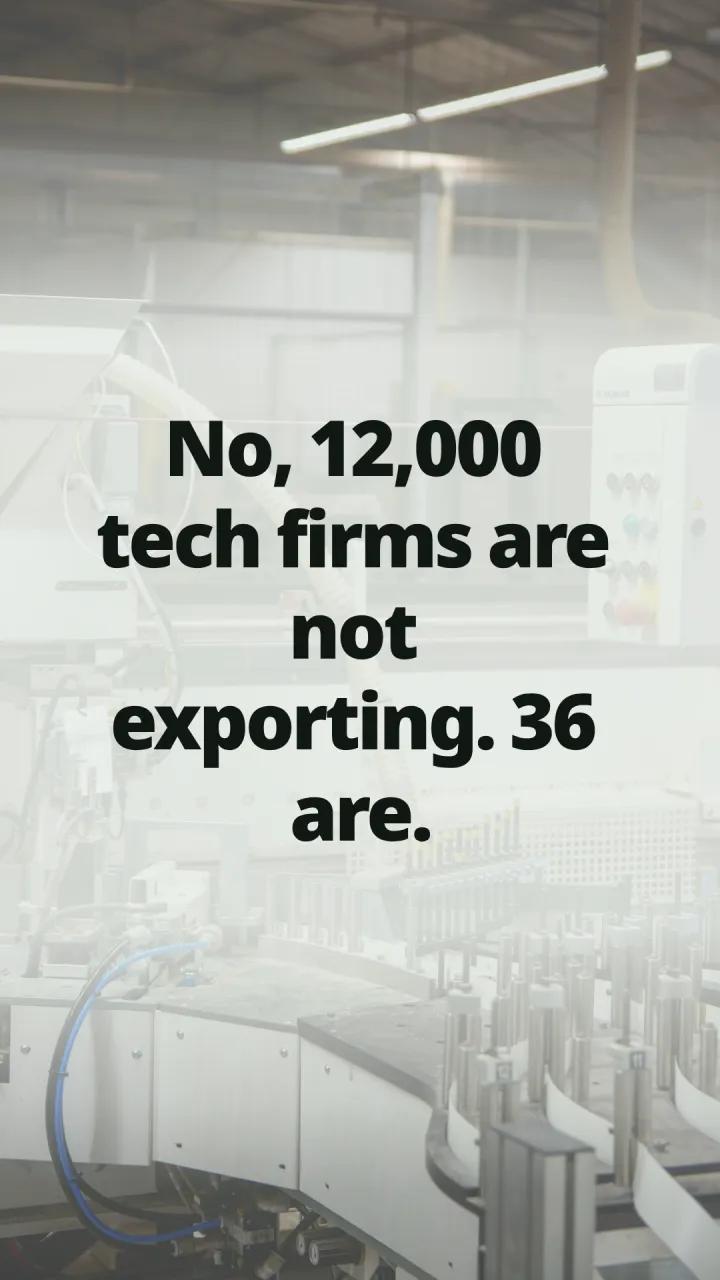
But the same report carries a second number that is quoted far less often, and it changes what the first one means: roughly 84 percent of those exports come from just 36 companies. The country's other 12,000 plus knowledge-based companies account, together, for the remaining 16 percent.

Background

To judge whether $2,690 million is a large number or a small one, you have to set it beside the size of the whole ecosystem. Through the end of 1403 (March 2025), at least 12,692 companies in Iran had received knowledge-based certification at least once. Their combined revenue is estimated at roughly 1,800 hemat (one hemat is 1,000 billion tomans), equivalent to about 2.8 percent of the country's gross domestic product.

The ecosystem has institutional scaffolding too: according to the same reporting, about 166 accelerators, 350 innovation centers and 23 innovation factories are active in the country. This is not a scattering of isolated firms; a structure has formed behind it.

Now the historical comparison. Four years ago the export figure was $296 million. Growing to $2,690 million means this ecosystem more than ninefolded its dollar volume of foreign sales during one of the harshest sanctions periods on record. Meanwhile, Iran's Seventh Development Plan targets raising the knowledge-based economy's share of GDP to about 7 percent. At today's 2.8 percent, the ecosystem has covered roughly 40 percent of that distance.

The core numbers

IndicatorValue
Exports, base year (four years earlier)$296 million
Exports, data through end of 1403 (March 2025)$2,690 million
Four-year growthMore than 9x
Certified knowledge-based companies12,692
Total ecosystem revenueAbout 1,800 hemat
Share of gross domestic productAbout 2.8 percent
Share of total exports held by the 36 largest84 percent
Exports as a share of total ecosystem revenueAbout 10 percent
Seventh Development Plan target (share of GDP)About 7 percent

Source: knowledge-based companies ecosystem report, data through the end of 1403 (March 2025); quantitative targets of the Seventh Development Plan.

A simple calculation on these same figures sharpens the picture. If 84 percent of $2,690 million comes from 36 companies, each of those 36 averages roughly $63 million in exports. Now divide the remaining 16 percent among the other 12,650 plus companies: average exports per company work out to about $34,000 a year. That is not an export business. It is closer to a sample shipment.

The drivers

Exporting requires scale. Selling technology abroad takes more than a good product: it needs a banking channel, international certification, after-sales service, a distribution network and sustained marketing. The fixed cost of that apparatus is high enough that only companies past a certain size threshold can carry it. So the 84 percent concentration among firms each exporting more than $10 million is not a statistical accident. It is a direct consequence of that threshold.

Sanctions set the geography, not marketing did. According to published reporting, the five main destinations for these companies' goods exports have been China, Iraq, the United Arab Emirates, Türkiye and Russia, together absorbing about 75 percent of exports, with China becoming Iran's largest technology partner. The mechanism is plain: when Western financial routes are closed, trade shifts toward markets where rial settlement, barter, or regional-currency clearing is possible. That is both an opportunity and a constraint, because it lowers the seller's bargaining power against a small number of buyers.

The export mix carries higher margins. Most of these exports consist of medical and laboratory equipment, pharmaceuticals and biotech products, industrial machinery, and software and engineering services. These typically earn better margins than raw-material sales, but demand heavier research and development spending and a costlier specialist workforce.

Exports are still the margin of the story, not its body. The key point that tends to get lost: exports make up only about 10 percent of the knowledge-based ecosystem's total revenue. Ninety percent of this economy is still the domestic market.

Why it matters for the capital market

A number of knowledge-based companies are listed on the Tehran Stock Exchange and Iran Fara Bourse, particularly in pharmaceuticals, medical equipment and information technology. For anyone reading currency rates alongside financial statements, foreign-currency revenue has three distinct effects.

First, a natural hedge against exchange-rate swings: a company with part of its sales in dollars books rial revenue growth sooner during periods when the rate jumps.

Second, a different margin profile: a technology product usually earns more per unit, but its research and development spending shows up in the income statement too.

Third, and more important than the previous two, customer concentration risk. The same concentration visible in the macro data repeats inside individual companies' financial statements. Dependence on one or two foreign markets, or one or two buyers, is a real risk and is usually traceable in the notes accompanying the financial statements. If those notes are unfamiliar territory, Sahmino Learn is a good place to start, and our analysis archive covers the Tehran market in more depth.

Outlook

This section is an estimate, not data. Moving from 2.8 percent to the Seventh Plan's 7 percent target means the ecosystem must more than double in size. If that growth comes through the current channel, meaning a few dozen large firms getting larger, the headline number rises but so does the fragility: it would take only a handful of those 36 companies losing their target market for a large share of the statistic to collapse within a year.

The second path is for the number of mid-sized exporters to grow, which is to say for that $34,000 average to become a meaningful figure. That road is slower, but it produces a statistic that survives a shock. The difference between these two paths is precisely what will determine whether the 7 percent target is met or stays on paper.

The bottom line

The ninefold figure is real, not a slogan. Under sanctions pressure, Iran has managed to build several dozen technology firms operating at serious export scale, and that is no small achievement. But the growth is exactly as real as the fragility beneath it.

Remember one thing: as long as 84 percent of knowledge-based exports depends on 36 companies, this statistic is the story of a few big successes, not the story of a broad technology economy. The depth has not arrived yet.

What to watch

  • The next annual ecosystem report, and whether those 36 companies' share rises or falls; a falling share would be the sign that depth is arriving.
  • The mix of export destinations, and whether concentration in the five main markets eases or tightens.
  • Quarterly filings from listed knowledge-based companies, especially the notes covering export sales and customer concentration.
  • The knowledge-based economy's share of GDP in future official reports, measured against the Seventh Plan's 7 percent target.

This article is not a recommendation to buy or sell any security. It is an analysis of published official data.

Related articles

General · Market update

Iran Market Pulse: Wednesday Midday, July 29, 2026; The Headline Index Fell 32,000 Points While the Equal-Weight Stayed Green

As of 11:12 on Wednesday, 7 Mordad 1405 (29 July 2026), the Tehran Stock Exchange headline index stood 32,166 points (0.63%) below yesterday's close, while the equal-weight index was 5,225 points (0.37%) higher at the very same moment: two indices, two directions. That means today's selling is concentrated in the large caps, not across the market....

13 min read · 29 July
General · Educational

Compound Interest in an Inflationary Economy: Why a 23% Deposit Against 61.4% Inflation Returns Minus 24%

Compound interest is not a financial trick but a mathematical property that works in both directions. At 20 percent, 100 million tomans becomes about 3,834 million over 20 years, while simple interest yields only 600 million. But inflation compounds too: at the 61.4 percent annual inflation of Tir 1405 (July 2026), the purchasing power of cash halv...

8 min read · 29 July

Stocks · Analysis

20 Years, 6 Markets: Tehran's Main Index Rose About 382 Times While Money Supply Rose 119; Deposits and the Dollar Fell Behind (Wednesday, 29 July 2026)

If six Iranians each held 100,000 toman in 1380 (2001) and each put it into a different market, by the end of 1400 (2022) the gap between them was striking: the Tehran Stock Exchange main index about 382 times, gold coins about 190 times, Tehran housing about 96 times, bank deposits about 38 times, the free market dollar about 35 times and a Pride...

9 min read · 29 July

General · Market update

Iran Market Pulse: Wednesday Morning, 29 July 2026; Brent Jumped 4.45% Overnight

Markets closed yesterday with Brent near $84 and open this morning with Brent at $87.61: a 4.45% overnight gain as of 07:57 on 7 Mordad 1405 (29 July 2026) refilled the risk premium that had drained last week. Meanwhile the 25 kg bullion auction did its work: the Emami coin fell 0.82% even as 18 karat gold rose, and its premium shrank by 1,731,000...

12 min read · 29 July