
Up to 53% offSee the plans

Back to articles | Analysis | Materials

Tehran Cement Bag Premium Nearly Halves in Three Weeks; Gap to Commodity Exchange Price Falls From 47% to 25% (Tuesday, September 1, 2026)

Sahmino Research Desk | 1 September 2026 | 7 min read

The price of a 50kg bag of Tehran cement fell from 291,000 tomans on August 13 to 240,000 tomans on September 1, 2026; Abyk cement dropped 21.5% and Saveh cement 12.3% over the same span. The gap between Tehran's retail bag price and the Iran Mercantile Exchange's discovered price (about 192,500 tomans) narrowed from 47% to nearly 25% in the…

Related video

Watch the full video

The price of a 50-kilogram bag of Tehran cement, which had been flat at 291,000 tomans (about $13.60 at the free-market rate) from August 7 to August 13, 2026, fell to 240,000 tomans by today, Tuesday, September 1 (10 Shahrivar 1405 on the Iranian calendar): a drop of 51,000 tomans, or 17.5 percent, in 19 days. Abyk-brand cement fell 21.5 percent and Saveh-brand cement 12.3 percent over the same span. The result, according to Sahmino's own price tracking, is that the gap between Tehran cement's retail bag price and the price discovered for the same product on Iran's commodity exchange (the Iran Mercantile Exchange, IME), which stood near 47 percent on August 13, has now fallen to roughly 25 percent: the retail "bag premium" that Sahmino reported had doubled in early August has roughly halved again over the following three weeks.

Background

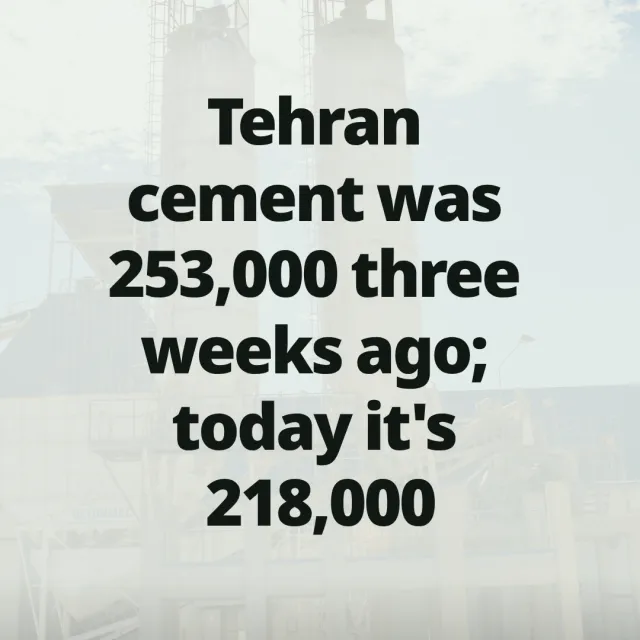
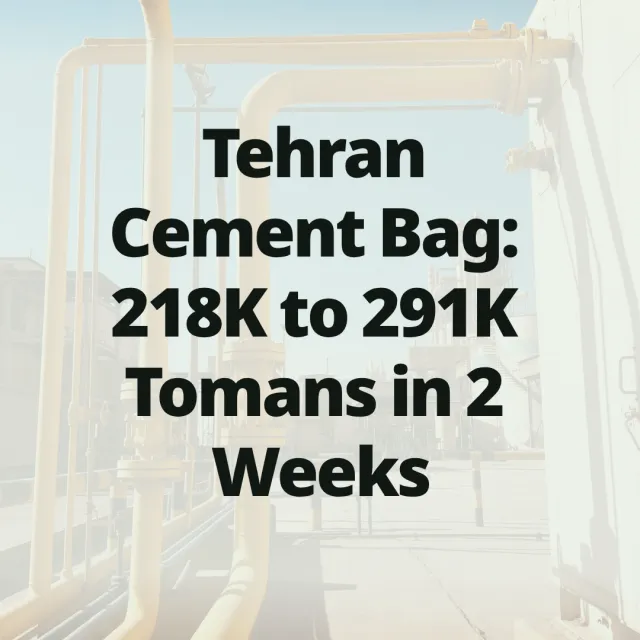
Tehran's cement bag market has completed a full cycle over the past month and a half. Sahmino reported on July 24, 2026, that the item had fallen about 14 percent from early July, to 218,000 tomans (Sahmino's July 24 report). Two weeks later, on August 7, the same item jumped 33.5 percent to 291,000 tomans, and the "bag premium," the gap between retail and the commodity exchange's discovered price, doubled at most producers (Sahmino's August 7 report). By August 13 the price had plateaued at that same 291,000 tomans, and Sahmino noted then that a price plateau does not mean the premium is closing, only that it has stopped widening; the gap to the exchange price was measured at close to 47 percent that day (Sahmino's August 13 report).

From August 13 to today, in other words in 19 days, the trend reversed for the first time in this cycle: all three major Tehran-area brands, Tehran, Abyk and Saveh, fell in price simultaneously and steadily.

Key numbers

ItemAug 13, 2026 (22 Mordad)Sep 1, 2026 (10 Shahrivar, today)Change
Tehran cement, 50kg bag (retail)291,000 tomans240,000 tomans-17.5%
Abyk cement, 50kg bag (retail)289,000 tomans227,000 tomans-21.5%
Saveh cement, 50kg bag (retail)260,000 tomans228,000 tomans-12.3%
Type 2 (42.5) cement, bag, IME discovered price~197,500 tomans (Aug 2 session)~192,500 tomans (Aug 31 session)-2.6%
Tehran bag's gap to the IME discovered price~47%~25%roughly halved

The retail rows are from Sahmino's own price tracking on the dates shown (Tehran cement price page and Abyk cement on Sahmino); the discovered-price row is from Type 2 (42.5) cement bag sessions on the Iran Mercantile Exchange (IME discovered cement bag price on Sahmino). An independent wholesale market survey published by Tejarat News on August 29, 2026 (7 Shahrivar), put Abyk Type 2 bags at 236,000 tomans and Saveh Type 2 bags at 245,000 tomans, the same 200,000-to-250,000-toman band Sahmino's own tracking recorded for these brands in the following days, not the 260,000-to-291,000-toman band seen in early August.

Drivers

One measurable structural factor behind the decline is the growing volume of cement moving through the Iran Mercantile Exchange's transparent channel: according to Kalanews, the exchange's own news service, more than 4,400 buyers from 30 provinces sourced nearly 966,000 tonnes of cement through the exchange in the week ending August 21, 2026 alone, and more than a million tonnes in the week ending July 31. The larger the share of cement supply that passes through this publicly discovered price, the harder it becomes for the gap with traditional retail pricing to widen again.

Donya-e-Eqtesad newspaper reported on August 9, 2026, three reasons building-material prices had calmed at that point: the end of psychological uncertainty from the 40-day war that had targeted cement and steel production, a halt in exports of some building materials, and the relative stability of the dollar rate in those weeks. Sahmino cannot confirm whether the first two reasons still hold, as no fresh reporting on cement export status or the post-war environment was available for this report. But the third reason, dollar stability, no longer matches September's reality: Iran's free-market dollar rate hit 214,000 tomans today, Tuesday, September 1, a fresh record and a jump of about 2.3 percent on the day alone, according to Sahmino's own live tracking. In other words, cement has gotten cheaper at the same time that the currency which normally drives up the cost of imported equipment and energy has hit a fresh record, a sign that the cement bag market has, at least in these past few weeks, moved more with domestic supply and the commodity exchange channel than with the dollar rate.

Outlook

Sahmino cannot make a firm call on whether this trend continues. The commodity exchange saw a multi-day pause in cement and rebar sessions ahead of the August holidays around August 2; if future sessions push the discovered price back up, or if weekly volume through the exchange declines, the retail gap could widen again, as it already has once this summer. Today's dollar record is also a factor to watch in the coming weeks for its effect on cement producers' energy and imported-equipment costs, even though it has shown no direct effect on the bag price so far.

Bottom line

In 19 days, from August 13 to September 1, 2026, the Tehran cement bag price fell 17.5 percent, and its gap to the commodity exchange's discovered price roughly halved, from about 47 percent to about 25 percent. The decline was recorded simultaneously across Tehran, Abyk and Saveh, the three major brands, and is consistent with an independent wholesale market survey from August 29. Notably, this decline happened alongside a fresh record for the free-market dollar, not in step with it, meaning that for now, the main driver behind the cement bag market should be sought in domestic supply and the commodity exchange channel, not the currency rate.

What to watch

  • Upcoming Type 2 cement sessions on the commodity exchange, and whether the discovered price holds against the retail decline or retreats itself.
  • Weekly cement purchase volume through the commodity exchange in upcoming Kalanews reports; a drop in that volume could be the first sign of the premium widening again.
  • Any effect of today's free-market dollar record on cement producers' energy and imported-equipment costs in future reports.

Related articles