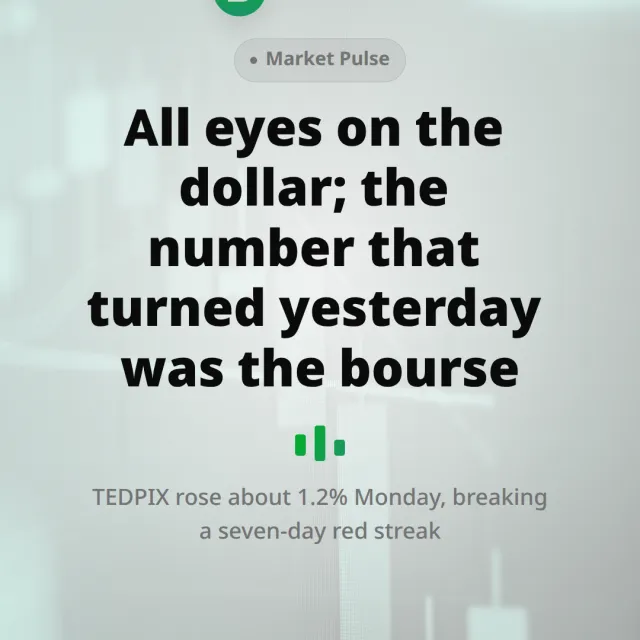
By midday on Monday, 20 July 2026 (29 Tir 1405), Tehran's bourse flipped. The overall index (TEDPIX), which had endured seven consecutive trading sessions of decline and a correction of nearly 10 percent, rose about 1.6 percent today (close to 80,000 units) to around 4,833,000, its first green session of this run. Demand returned to the banking, pharmaceutical, food, base-metals and cement groups, and selling pressure eased in the first half of trading. Notably, the rebound came on a day when all eyes were on the currency market and the dollar's recent records.
In the parallel market, after several days of record-setting, a relative calm prevailed. The free-market dollar steadied near 193,000 tomans, gram gold of 18 karat sat at around 18,765,000 tomans, and spot gold hovered right at the psychological 4,000 dollar line (around 4,005 dollars). The one restless market outside the bourse was oil: Brent held near 91 dollars on Strait of Hormuz concerns.
Today at a glance (through midday Monday, 20 July 2026)
| Indicator | Value | Change |
|---|
| TEDPIX (intraday) | about 4,833,000 | about +80,000 (1.6%) |
| Free-market dollar | about 193,000 tomans | about −1,500 tomans (0.8%) |
| Agreed (tavafoqi) dollar (Exchange Center, sell) | 150,462 tomans | +225 tomans |
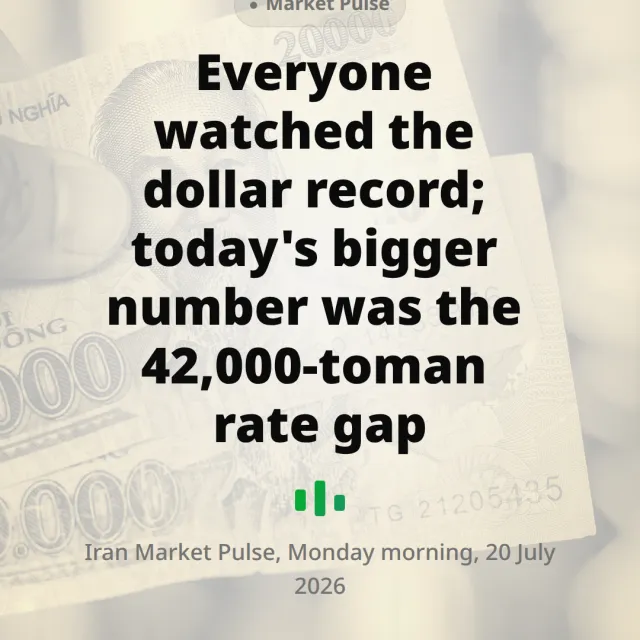
| Free vs agreed gap | over 42,500 tomans | near 28% |
| Gold, 18k (per gram) | about 18,765,000 tomans | near −2% |
| Emami coin | about 189 million tomans | about −0.5% |
| Emami coin premium | about 6.5 million tomans | about +6.9% |
| Bitcoin | about 64,800 dollars | little changed |
| Brent crude | about 90.5 dollars | near +3% |
| Spot gold (per ounce) | about 4,005 dollars | −0.3% |
Figures refer to the latest data recorded through midday Monday, 20 July 2026, and change during the session.
Today's headlines
- Per capital-market news agencies, the Tehran overall index turned green on Monday morning, 20 July, after seven straight down sessions, gaining about 80,000 units as demand returned to the banking, pharmaceutical and base-metals groups.
- Per economic media, the Exchange Center's agreed (tavafoqi) dollar rose 225 tomans on Sunday, 19 July, to a sell rate of 150,462 tomans, widening its gap with the open market to over 42,000 tomans (near 28 percent).
- Per diplomatic sources, the foreign ministers of Iran and Oman discussed a mechanism for vessel passage through the Strait of Hormuz in Muscat; Oman's draft proposal rests on two separate corridors, and reportedly the northern corridor (Iranian waters) would require prior Iranian approval with no toll. A Qatari delegation attended part of the meeting.
- Early Monday, Brent crude jumped more than 3 percent and touched a daily high near 91.4 dollars, reflecting the risk premium from Strait of Hormuz tension.
- Per the auto market, after the heavy jumps of recent days in step with the currency, the pace of price increases has softened at the start of the week as the dollar steadied.
Currency: relative calm, but the multi-rate gap persists
In the currency market, the free-market dollar, after entering the 194,000-toman channel for the first time on Sunday, 19 July, and climbing to around 195,000, pulled back about 1,500 tomans that evening and held near 193,000 tomans in today's trading. The free-market euro traded around 221,000 tomans.
On the official side, the sell rate of the agreed (tavafoqi) dollar at Iran's Currency and Gold Exchange Center rose 225 tomans on Sunday to 150,462 tomans (buy rate 149,108 tomans); the remittance euro was set at 172,113 and the UAE dirham at 40,970 tomans. That puts the gap between the free and agreed dollar at over 42,000 tomans, or nearly 28 percent.
Why it matters: the gap is a product of the multi-rate currency structure: part of demand is met through the cheaper official channel and the rest presses on the open market. Today's calmer dollar likely reflects hope tied to the Muscat talks and a temporary drop in speculative demand; but as long as geopolitical risk persists, inflation expectations and hedging demand for hard currency stay alive.
Gold and coin: base price down, but the coin premium up
In the gold and coin market, each gram of 18-karat gold fell nearly 2 percent in step with the softer currency and swings in global gold, settling around 18,765,000 tomans; the mesghal traded around 81,300,000 tomans. The Emami coin slipped about half a percent to around 189 million tomans.
The key point is the behavior of the coin premium (hobab): against the price drop, the Emami coin premium rose nearly 6.9 percent to around 6,500,000 tomans. A premium rising while the base price falls usually signals that precautionary demand for the coin as a safe asset remains strong, even as global gold eases. The global ounce hovered around 4,005 dollars, clinging to the psychological 4,000 dollar line.
Stocks: the first green session after seven red days
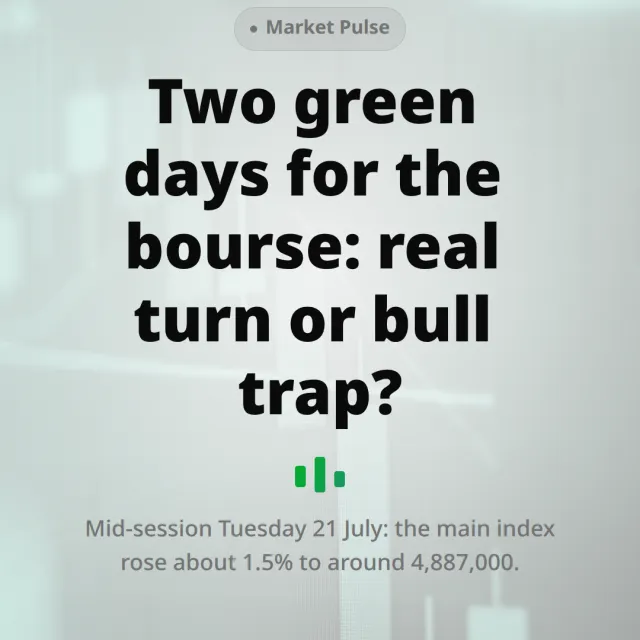
The Tehran overall index, which had closed Sunday, 19 July, down 21,784 units at 4,755,500, reversed course on Monday: in the course of trading it climbed about 1.6 percent, nearly 80,000 units, to around 4,833,000. This is the first green session after seven consecutive down days and a correction of nearly 10 percent. Market reports point to demand returning to the banking, pharmaceutical, food, base-metals and cement groups and to easing selling pressure in the first half of the session.
What is behind the rebound? Part of it is a technical feature of the market after a prolonged slide: when prices reach attractive levels and panic selling is exhausted, value and swing demand return. Part is tied to the relatively calmer currency and hope for lower risk via the Muscat talks. Still, this report covers mid-session, and the durability of the green trend depends on continued inflows and trade value through the close; in recent sessions the outflow of real-money (retail) capital, around 4.8 thousand billion tomans on Saturday, 18 July, had weighed on the market, and the return of that money is the main test of a sustained rally.
Crypto: little changed
In the crypto market, bitcoin traded little changed around 64,800 dollars and ether near 1,870 dollars. The domestic Tether rate remains roughly level with the free-market dollar (about 193,000 tomans). A reminder: the global price of crypto is measured in dollars and the toman price embeds the dollar rate, so part of the toman swing in crypto simply reflects the currency's move.
Iron and steel
In the iron and steel market, factory rebar prices held with little change and were slightly higher; for example, 10 mm Aryan Foulad rebar (A3) was set at about 70,450 tomans and 12 mm at about 69,180 tomans per kilogram (factory rates, 20 July). This market watches two variables above all: the currency rate, which sets the finished cost and the export price floor, and the trend in global steel. The jump in oil could spill over into energy costs and price expectations in the days ahead.
Cars: after the heavy jumps, a softer pace
In the auto market, Sunday, 19 July, was one of the most turbulent days in step with the currency jumps of recent days; per market reports, the Shahin Automatic rose about 111 million tomans to around 2.35 billion, the Quick S gained 43 million to around 1.265 billion, and the Dena Plus Automatic rose 20 million to around 2.78 billion tomans. With the dollar steadying at the start of the week, the pace of increases has softened, though the market margin (the gap between the factory price and the open-market price) remains high in the current inflationary setting and a direct function of the currency rate.
Building materials
In the materials market, cement prices held relatively steady; Tehran bulk Portland type 2 cement was set at about 4,014,000 tomans and Abyek bulk at about 3,673,000 tomans per ton (19 July). The main drivers are seasonal construction demand and energy costs, with the currency having an indirect effect.
Regional and global backdrop
The main driver of global markets remains the Strait of Hormuz. Early Monday, Brent crude jumped more than 3 percent from the prior close (near 88 dollars) to around 90.5 dollars and touched a daily high near 91.4 dollars during the day; fears of disruption to Hormuz shipping have kept the oil risk premium elevated. This variable reaches Tehran through two channels: the country's currency income and the psychological mood of the domestic market. Global gold hovered around 4,005 dollars near the 4,000 dollar line; the rise in oil and expectations that the Federal Reserve will keep rates high have been among the factors capping gold in recent days.
In the neighborhood, the Turkish lira traded around 47 to the dollar (each lira near 4,100 tomans in the domestic market), and the UAE dirham, one of the main corridors for Iran's trade, was priced at 40,970 tomans at the Exchange Center; the Chinese yuan traded around 28,510 tomans. The dirham and the yuan are two key channels for settling Iran's trade, and their swings feed directly into the finished cost of imports.
What to watch today and in the days ahead
- Whether the bourse rally holds: whether the overall index can keep its mid-session gain through the close and whether real money returns to the floor.
- Bar and coin auction: an auction event is on the market calendar for tomorrow, Tuesday, 21 July; its result could affect the coin and the premium.
- The Muscat table: continued technical and political talks between Iran and Oman on the two Hormuz corridors; any positive or negative news feeds straight into oil and the currency.
- Global: the path of Brent with Hormuz headlines, gold's behavior around 4,000 dollars, and Federal Reserve rate signals.
- For upcoming events see the Sahmino economic calendar, and for a full look at this morning, see the Monday morning Market Pulse.
This report is a news review of market conditions and is not buy or sell advice. Figures are dated and sourced and change during the day.

 Market update
 Market update
 Market update
 Market update