Up to 53% offSee the plans
Back to articles

News

Iran's New Car Market Directive Was Published Today, Wednesday, September 23, 2026: Cars Rated F May Not Raise Their Price, and the Tara Automatic V4 Trades at 3.4 Billion Tomans

Iran's Competition Council issued the updated passenger car directive, amended through September 15, 2026, and its full text was published on Wednesday, September 23, 2026. The key change turns the "competitiveness index" into a filter on price increases: each domestic or assembled car is measured against the average price of at least three similar…

Sahmino editorial· 23 September· 8 min read· Cars

Iran's Competition Council issued the updated "passenger car market regulation directive," carrying its latest amendments through 24 Shahrivar 1405 (September 15, 2026), and the full text was published on Wednesday, September 23, 2026 (1 Mehr 1405). The key change in this version turns the "competitiveness index" from a descriptive measure into a filter that can block an approved price increase outright. The same day, on Sahmino's own price tracking, the Tara Automatic V4 (model year 1405) traded at 3.4 billion tomans on the free market and the Dena Plus Turbo Automatic Optional (model year 1405) at 3.38 billion tomans.

Background

The directive still classifies the market for domestically produced and assembled passenger cars as monopolistic: competition does not set the price, so a regulator must impose a ceiling. Electric vehicles are excluded from its scope.

That monopoly is what has long given a single car two prices at once: the approved factory price and the free-market price. The gap between them is a rent, and the lottery is what distributes it among the winners. Our lesson on why cars became quasi-assets in Iran takes that mechanism apart step by step.

Car pricing has been reopened repeatedly this year. At its 758th session on July 8, 2026, the Competition Council found the Industry Ministry's approved 15 percent increase insufficient and referred the case to oversight bodies. Then, on August 19, 2026, the General Board of the Administrative Court of Justice annulled the Council's Resolution 473 on how car down payments are calculated. The new version arrives against that background.

The numbers

The prices below are free-market prices on September 23, 2026, from Sahmino's daily tracking. They are not approved factory prices:

Iran's car market, September 2026

Iran's car market, September 2026

Source: Khabaronline

  • Tara Automatic V4, model year 1405: 3.4 billion tomans
  • Dena Plus Turbo Automatic Optional, model year 1405: 3.38 billion tomans
  • Shahin Plus Automatic, model year 1405: 3.15 billion tomans
  • Peugeot 207 Automatic Panorama TU5P, model year 1405: 3.15 billion tomans
  • Chery Arrizo 5 FL Sport Excellent, model year 1404 (assembled): 3.66 billion tomans

The last two rows make a telling comparison. The Chery Arrizo 5 FL, an assembled car that falls under this same directive, traded 280 million tomans above the Dena Plus Turbo Automatic on the same day. This is a price comparison, not a judgement about the quality or class of the two cars.

How the competitiveness index works

Per the published text, the price of each domestic or assembled car is compared with the average price of at least three similar foreign cars, and cars are then placed in bands A through F. A car that lands at F, meaning an index below minus 15, may not raise its price until its competitiveness improves. The role of domestic professional bodies in proposing the comparable foreign models is also formally recognised.

The approval path, however, runs through three gates, and they are not equally strict. The carmaker calculates its price under the rules of the Price Determination and Stabilisation Board and submits it to the Consumer and Producer Protection Organisation, which has at most one month to respond. If it does not respond within that month, the carmaker's proposed price is treated as approved. If it objects, the Protection Organisation's view prevails. The announced figure is the supplier's base price and excludes value added tax, third-party insurance and registration fees.

What is driving it

Alongside the new filter, a currency amendment in the resolution of session 869, dated September 15, 2026, pushes the other way: if a carmaker does not have full access to official commercial remittance currency, the exchange rate it actually used in building its own cost base becomes the basis for calculating the competitive base price. One clause locks the price down; another raises the basis on which it is calculated.

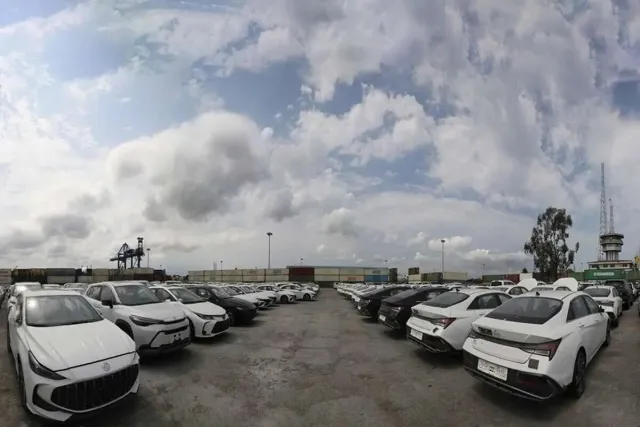
Car import and registration in Iran

Car import and registration in Iran

Archive photo · Source: khabaronline.ir

That clause was not written in a vacuum. On the same day, September 23, 2026, an assistant to the Governor of the Central Bank said that under constrained foreign currency resources the priority is essential goods and that no currency has been allocated for car imports; a car enters customs first, and the currency route is settled afterwards. The tighter access to official currency becomes, the higher the exchange rate underlying the competitive base price.

The buyer side, by contrast, has tightened. The minimum buyer age is set at 18; anyone who has bought a car from Iran Khodro or Saipa in the past 48 months may not register with those two companies again; transferring a purchase entitlement or reselling an allocation by proxy is banned; a lottery supervised by the competent authorities is mandatory whenever demand exceeds supply; and pre-selling cars whose price has not yet been set is prohibited. The condition lifting the registration ban for holders of an active licence plate has been removed from the sales conditions.

Outlook

This package targets the composition of the approved price, not the market price. The factory-to-market gap persists as long as supply falls short of demand, and the lottery remains what distributes it, as seen in Iran Khodro's 15th priority sale round on September 9, 2026. What has changed is who is entitled to stand in that queue, and which route a carmaker can use to lift the approved price.

The Protection Organisation is responsible for supervising implementation and must report on it to the Competition Council every six months. The first real test will be the publication of A to F ratings for high-volume models, and the fate of the price-increase requests left pending inside the Protection Organisation's one-month window.

Bottom line

The directive makes the approved price ceiling harder to lift but does not close the factory-to-market gap; the currency clauses and the "silence means approval" rule leave open the very route the F rating is meant to shut. Our reading is that the free-market price of the Tara Automatic V4 stays above 3.2 billion tomans through the end of Mehr 1405 (October 22, 2026), as long as factory supply remains below demand. A close below 3.2 billion tomans before the end of Mehr would invalidate that reading.

What to watch

  • Publication of competitiveness index ratings for high-volume domestic and assembled models
  • Price-increase requests, and whether the Protection Organisation's one-month window closes with an opinion or with silence
  • The gap between the approved price and the free-market price at the first sale round after the directive
  • Daily prices for the Tara, Dena, Shahin and Peugeot 207 on Sahmino's car price page
Also posted on:Instagram

Sources

  1. Mehr News Agency · Mehr News AgencyCars are placed in bands A to F on this index. Cars rated F (an index below minus 15) will not be permitted to raise their price until their competitiveness improves.Cited Sep 23, 2026
  2. Competition Council · Competition CouncilFull text of the passenger car market regulation directive with amendments through 24 Shahrivar 1405, based on the resolution of session 543 and the currency amendment of session 869.Cited Sep 23, 2026
  3. EcoIranThe Central Bank said that under constrained foreign currency resources the priority is essential goods, and that it has allocated no currency for car imports.Cited Sep 23, 2026

Related articles

Stocks · News

Half the Tonnage, Double the Rate: Ghachin's Tomato Paste Record Before Its 33 Percent Price Rise on 24 September 2026

On Thursday, 24 September 2026, Chin Chin Agro-Industrial (Ghachin) told Codal it had raised its base product's price from 2,099,000 to 2,799,000 rials, a 33.3% rise for a product that made up 78% of revenue in the fiscal year to 21 June 2026. Its August monthly report shows that in the first two months of the fiscal year, the average rate per ton…

8 min read · 24 September
Stocks · News

Bama Disclosed a Single Export Shipment Worth 41.83 Percent of Its Entire Prior Year Sales, and the Next Day the Stock Closed at the Floor at 5,060 Rials With a 125 Million Share Sell Queue (Tuesday, 22 September 2026)

On Monday, 21 September 2026, Bama filed a material disclosure with Codal recording the sale of one shipment to a foreign customer for 10,229,137 million rials; the form puts that at 41.83 percent of the company's entire prior year sales revenue. The book cost of the goods sold is 3,633,927 million rials, a 64.5 percent margin on this one deal agai…

9 min read · 22 September

Crypto · News

Bit24's Window to Sell Tesla Tokens Closes at Noon on Sunday, 27 September 2026, and Remaining Balances Convert to Rial: Nobitex Shuts Its Markets for Seven US Stock Tokens on Saturday

Bit24 has given holders of five tokens linked to Tesla and SpaceX shares until noon on Sunday, 27 September 2026 to sell, and Nobitex closes its markets for seven US tech stock tokens at 11:00 on Saturday, 26 September. Remaining balances convert to rial at a price the exchange sets. With tether at 232,682 tomans on 25 September, one TSLAX token is…

8 min read · 25 September

Stocks · Analysis

Sahmino screen of 1,699 TSE symbols finds 50 cheap, profitable stocks; three insurers trade at less than half their sector's P/E (Monday, September 21, 2026)

Sahmino's screen of all 1,699 Tehran bourse and Farabourse symbols found 50 stocks with a P/E under 6, ROE above 20% and real asset turnover. At the top: Asia (P/E 2.01), Parsian (2.04) and Hafari Shomal (2.29). For the first two insurers, that is under half the insurance sector's own 4.34 average on Monday, September 21, 2026. Parsian hit its dail…

6 min read · 21 September