Up to 53% offSee the plans

Back to articles | Analysis | Coin

Coin Premium Eased After a 6.85% Rise to July 2; What Role Does Global Gold's Drop Play? (Wednesday, July 8, 2026)

Sahmino Research Desk | 8 July 2026 | 6 min read

Per Sahmino's own price data, the Emami gold coin's premium reached about 7,091,000 tomans on Thursday, July 2, 2026, 6.85% above the June 28 reading, and eased to about 6,494,000 tomans by Tuesday, July 7. Global gold fell about $49 (1.2%) from $4,165 to $4,116 on Tuesday night after the Strait of Hormuz attack pushed the Fed toward a more…

Related video

Watch the full video

The premium on Iran's full Emami gold coin (the gap between its market price and the melt value of its gold plus minting costs and tax) reached about 7,091,000 tomans in the Thursday, July 2, 2026 (11 Tir 1405) reading, 6.85% above the Sunday, June 28 (7 Tir) reading of 6,636,000 tomans, over a stretch in which global gold also ended higher (from $4,073 at the Friday, June 26 close to $4,123 at the Thursday, July 2 close). The latest reading, Tuesday, July 7 (16 Tir), puts the premium at about 6,494,000 tomans (all per Sahmino's own price data). Meanwhile, on Tuesday night, July 7 (U.S. time), global gold fell roughly $49 (1.2%), from $4,165 to a daily low of $4,116 an ounce, in an inflationary reaction to a military attack on commercial ships in the Strait of Hormuz and a more hawkish market tone on the Fed's rate path, a move opposite to what a geopolitical shock would typically be expected to produce at first glance.

Background

The coin premium has swung sharply in recent weeks. Sahmino reported on Thursday, July 2, 2026 (11 Tir 1405), that the premium had widened about 44% in the week to July 1, with the Emami coin reaching 177 to 178 million tomans; that week largely overlaps the four days from June 28 to July 2, whose readings show only a 6.85% rise, a sign of how much a premium growth figure depends on the days it is measured from. Even so, the July 2 premium was about 41.5% below the April 5 (16 Farvardin) reading and 31% below the July 6, 2025 reading; the longer-term trend is still one of moderation, even as week-to-week swings remain large.

The Numbers

IndicatorValueDateSource
Emami coin premium~7,091,000 tomansThursday, July 2, 2026Sahmino price data
Premium rise from the June 28 reading (6,636,000 tomans)6.85%Sunday, June 28 to Thursday, July 2Sahmino price data
Emami coin premium, latest reading~6,494,000 tomansTuesday, July 7, 2026Sahmino price data
July 2 premium vs. the April 5 reading (~12,130,000 tomans)~41.5% lowerApril 5, 2026 (16 Farvardin 1405)Sahmino price data
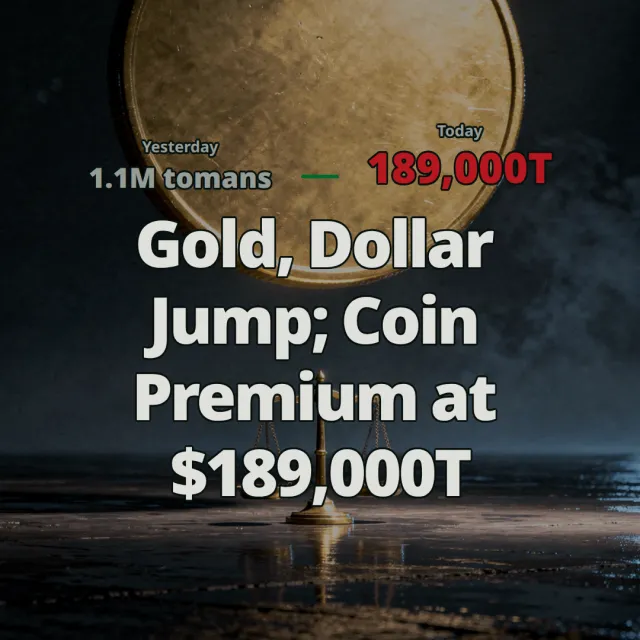
Emami coin price~177.5 to 179 million tomansJul 7 to 8, 2026Tasnim, open market
Global gold (ounce)Fell from $4,165 to $4,116Tuesday night, Jul 7Bloomberg
Brent crudeRose 5.6% to $76.04Tuesday night, Jul 7CNBC
Free-market dollar~175,300 tomansTuesday, Jul 7 (before the waiver news)Tejaratnews, EghtesadNews

Drivers

The coin premium and global gold answer to two different mechanisms. Internationally, Tuesday night's attack on commercial vessels in the Strait of Hormuz, and the U.S. Treasury's revocation of Iran's dollar oil-sale authorization, pushed Brent crude above $76 a barrel; the oil price jump raised inflation concerns in global markets and pushed expectations toward a more hawkish Federal Reserve stance on interest rates. Real Treasury yields typically rise in that environment, and since gold carries storage costs and pays no yield, higher real yields act as a near-term headwind for it, which is why global gold retreated despite the rise in geopolitical risk.

Domestically, though, the coin premium mainly stems from a supply-demand imbalance in Iran's informal coin market: buyers of coins in the free market, unlike buyers of newly minted coins from the mint, do not pay the minting fee or value-added tax, which creates extra demand for secondhand coins. Iran's Central Bank periodically offsets some of that supply through coin auctions to curb runaway premium growth, but as long as free-market exchange-rate expectations stay uncertain amid the Strait of Hormuz crisis, demand for physical assets like coins tends to stay elevated, regardless of which direction global gold moves.

Outlook

The July 7 reading (about 6,494,000 tomans) is about 8.4% below the July 2 reading; daily premium readings swing widely, and no single reading sets the direction of the trend. If Iran's free-market currency market shows its full reaction to the oil-waiver revocation and the Strait of Hormuz developments in the coming days, that reaction could directly affect the coin's underlying price, and by extension the size of the premium. This is an observation based on existing statistical trends, not a forecast for gold or coin prices.

What to Watch

Worth watching in the coming days: how the free-market dollar, gold, and coin prices react to last night's Strait of Hormuz developments, which are not yet reflected in today's official data; whether the Central Bank holds a fresh coin auction to curb the premium; and what effect the Federal Reserve's July 28 to 29 policy meeting has on global gold, and from there, on Iran's domestic market.

Correction, October 14, 2026: An earlier version dated the 7,091,000-toman premium reading to Sunday, July 5, and presented its 6.85% rise as a weekly gain made while global gold fell. That reading is from Thursday, July 2, and the 6.85% measures the June 28 to July 2 readings, a stretch in which global gold also ended higher; the headline, summary, text and table were corrected on that basis, with the July 7 reading added.

References

  1. BloombergGold fell $49, from $4,165 to an intraday low of $4,116, as a Hormuz strike pushed oil higher, stoking inflation and keeping the Fed hawkish.Cited Jul 8, 2026
  2. CNBCBrent popped 5.6% to $76.04 in after hours trading, while WTI jumped 5.4% to $72.25 following the waiver revocation.Cited Jul 8, 2026

The lesson behind this article

Related articles