
Newsroom
Short, verified market news summaries; every item names its source and publication date.
CENTCOM Says US Destroyed One Iranian Tanker, Disabled Two Others in Response to Missile Fire at US Warships
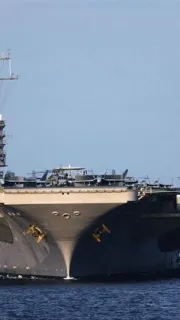
US Central Command (CENTCOM) said on Saturday, September 5, 2026 (14 Shahrivar 1405), that American forces struck three Iranian oil tankers in the Gulf of Oman and near Kharg Island, destroying one outright and disabling two others. CENTCOM described the strikes as a response to ballistic missiles it said Iran's Islamic Revolutionary Guard Corps (IRGC) fired at a US aircraft carrier and a guided missile destroyer in regional waters, claiming both American vessels evaded the attack with no casualties. This account comes from CENTCOM alone; Iran's side had not issued an official statement on the alleged missile launch at US warships at the time of writing. CENTCOM commander Admiral Brad Cooper said in a statement: "Let the message to the IRGC be clear: If you shoot at two of our ships, we will impose an even higher economic cost, taking out three of yours." According to Al Jazeera, the US described the tankers as part of a multibillion dollar network financing the IRGC and its regional proxies. Al Jazeera also reported that the six month old conflict has killed 18 US service members so far, and that negotiations to end it have collapsed. Iran's free market dollar rate in Tehran topped 227,000 tomans as the news spread today, while the Tehran Stock Exchange's main index (TEDPIX) rose more than 1.5 percent.
Al Jazeera
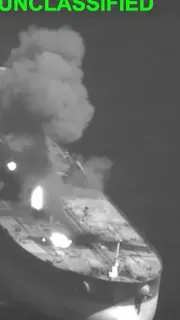
Iranian Tanker Near Kharg Island Struck by 4 US Projectiles
According to Tasnim, carried by Donya-e-Eqtesad, a small Iranian tanker was struck by a US military missile attack near Kharg Island's anchorage, about six miles from the island, on the morning of Saturday, September 5, 2026 (14 Shahrivar 1405). Per the report, the vessel was hit by 4 projectiles fired by US forces, and several explosions were heard from the direction of the Persian Gulf and Kharg Island shortly before the report was published. Local sources said the incident caused no casualties and that the tanker's crew were evacuating the vessel. Daneshjoo News Agency, carried by Khabaronline, confirmed the incident by publishing images of the struck tanker and of Kharg Island's condition afterward. Kharg Island is Iran's main crude oil export terminal, and prior reports estimate roughly 90 percent of the country's crude exports are loaded there, so any incident in the area can affect oil and currency markets. Further details on the extent of damage have not yet been released by responsible authorities.
Tasnim, citing Tasnim, via Donya-e-Eqtesad
Agriculture Ministry Exempts 24 Products Including Shrimp and Cucumber From Export Ban
According to Boursenews, the Agriculture Ministry's Trade Development Deputy sent the 17th list of tariff codes exempted from Iran's agricultural export ban to the Trade Development Organization, based on a letter dated 9 Shahrivar 1405 (August 31, 2026). Under the letter, 24 tariff codes covering chapters one through 24 of the export and import regulations book, including various fish and fish fillets, tilapia, shrimp, chicory, cucumber, asparagus, eggplant, various melons, palm fruit pits, rock candy, yufka bread, pizza and cold sauces, were removed from the export ban list. Following the letter, the Trade Development Organization's export and import regulations office notified Iran's Customs Administration of the list so that exports of these items would be permitted until further notice. This is the 17th such list issued as part of ongoing correspondence on exceptions to the agricultural export ban.
Boursenews
NIOC CEO: Iran Ranks World's Top Gas Discoverer With 17.5 Trillion Cubic Feet Found Since 2025
Hamid Bovard, CEO of the National Iranian Oil Company, said, according to Tasnim News Agency as carried by Donya-e-Eqtesad on Wednesday, September 2, 2026 (11 Shahrivar 1405), that Iran has recorded the world's largest volume of gas discovered since 2025 through a combined 17.5 trillion cubic feet found at the Takhteh gas field in southern Fars province and the Pazan field, putting the country in first place worldwide for gas exploration over that period. Bovard said drilling at the Takhteh gas field led to the discovery of 7,500 billion cubic feet of gas in place and 5,500 billion cubic feet of recoverable gas. He added that NIOC is shifting part of its exploration management activity toward the country's northern and northwestern regions, given their hydrocarbon potential, by adding exploration rigs and carrying out seismic survey projects, to help offset part of the country's energy imbalance using newly discovered resources.
Donya-e-Eqtesad, citing Tasnim
Iran's First Methanol Deposit Certificate Begins Trading on Energy Exchange
Iran Energy Exchange hosted the country's first trading of a methanol commodity deposit certificate, tied to Sabalan Petrochemical, on Wednesday, September 2, 2026 (11 Shahrivar 1405). Per Boursenews, Mohammad Nazifi, the exchange's CEO, said at the launch ceremony that this marks the first time a methanol deposit certificate has joined the exchange's roster of commodity deposit certificates. Sabalan Petrochemical's CEO said the exchange's backing has allowed the company to begin supplying methanol on the export ring, which is expected to provide useful working capital for the firm. Exchange officials said certificates for other petrochemical products are expected to follow.
Boursenews
US Treasury Secretary: Iran in 'Economic Death Spiral,' Does Not Control Hormuz
US Treasury Secretary Scott Bessent said on the sidelines of a G20 finance ministers' meeting in Asheville, North Carolina (Tuesday, September 1, 2026) that Iran's economic collapse has entered an "acceleration phase" and that Iran does not control the Strait of Hormuz, noting about 17 million barrels of crude passed through the strait on Monday, August 31. Bessent also said new US sanctions targeting Iranian financial institutions, as well as aircraft leasing firms and other entities tied to the IRGC, would be announced in the coming days, and predicted the strait's strategic importance would sharply diminish within two years as Gulf states complete pipeline bypasses. The remarks were reported by Gulf News, Oilprice.com, and Reuters (via gCaptain).
Gulf News
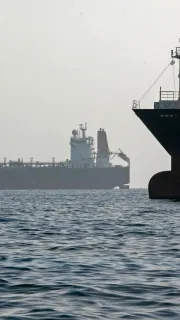
Iran's Oil Exports Stall for Seven Weeks, the First Time on Record
Per Reuters, published Tuesday, September 1, 2026 (10 Shahrivar 1405), for the first time on record Iran has gone about seven weeks without shipping meaningful crude exports through the Strait of Hormuz to China, its only major remaining oil customer, a result analysts attribute to the US naval blockade rather than sanctions alone. Tanker-tracking data from Kpler, Vortexa and TankerTrackers.com show no Iranian crude cargo has cleared Hormuz for China since the US reinstated its blockade on July 14 as part of the two countries' six-month conflict; Iran can now only sell from floating storage in Asian waters. Iran's crude and condensate loadings fell to roughly 220,000 to 255,000 barrels per day in August, down from about 740,000 barrels per day in July and nearly 2 million barrels per day in March. A Kpler analyst said the export collapse could push Tehran to finance spending by printing money, risking even higher inflation; the IMF estimates Iran's inflation this year at nearly 70 percent, the world's third highest after Venezuela and Sudan.
Reuters, citing یاهو فایننس
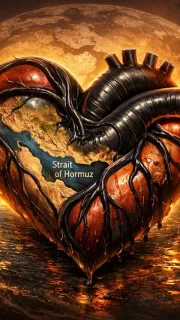
Parliament's National Security Committee Ties Strait of Hormuz Transit to War Compensation Payments
Hassan Ghashghavi, spokesman for parliament's National Security and Foreign Policy Committee, said Tuesday, September 1, 2026, that the committee approved Article 7 of the "Strategic Action for Security and Sustainable Development in the Strait of Hormuz" bill. Under the article, any country, organization or entity that caused Iran damage during the war must agree on compensation terms with the government or be denied passage through the Strait of Hormuz. The committee also approved Note 2 of Article 5, requiring bank guarantees and insurance for transit through the strait, and Article 6, which sets a mechanism for service and insurance tariffs in the waterway. Ghashghavi said the measures still need approval from parliament's full floor and then the Guardian Council before becoming law.
IRNA
Transport Minister: Construction Begins on Bandar Imam Oil Storage Tanks With a 2,380 Billion Toman Investment
Construction began Tuesday afternoon, September 1, 2026 (10 Shahrivar 1405), on an oil-products storage project at Bandar Imam Khomeini port, attended by Iran's Minister of Roads and Urban Development, the Khuzestan governor and provincial ports officials. Per ecoiran, citing Mehr News Agency, initial investment is estimated at 2,380 billion tomans, with 71,000 cubic meters of nominal tank capacity across 11 main tanks plus one safety tank: three dedicated mazut tanks (32,000 cubic meters), four dual-use mazut and light-product tanks (17,000 cubic meters), and four light-products tanks (21,000 cubic meters). The facility is expected to create 100 jobs and aims to boost the port's competitiveness and expand transit infrastructure for petroleum derivatives.
EcoIran, citing Mehr News Agency
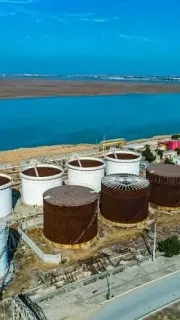
Diesel Price for Non Major Mines Set at 8,070 Tomans per Liter for the Shahrivar to Aban Period
Under a new directive from Iran's National Iranian Oil Products Distribution Company, reported by Ecoiran on Monday, 9 Shahrivar 1405 (August 31, 2026), the price of diesel for non major mines from the start of Shahrivar through the end of Aban 1405 (roughly September through November 2026), within the set consumption quota, will be 8,070 tomans per liter, before value added tax and duties. The rate applies only within each mine's set consumption ceiling, and major mines are excluded from it. According to Ecoiran, at this rate, 100,000 liters of diesel costs a mine about 807 million tomans and 1 million liters about 8.1 billion tomans in base cost before tax. Ecoiran wrote that while such costs are manageable for large mining operations, they can meaningfully cut into the margins of small and medium sized mines; if the official fuel quota does not match a mine's actual operational needs, operators sourcing diesel on the open market also face the risk of being accused of fuel product smuggling.
Ecoiran
Head of Agricultural Guilds Chamber: Border Wheat Dealers Are Paying Up to 60,000 Tomans, Above the Guaranteed Price
Peyman Alami, head of Iran's Agricultural Guilds Chamber, told Tasnim's economic desk, as carried by Ecoiran on Tuesday, 10 Shahrivar 1405 (September 1, 2026), that the guaranteed wheat purchase price is 49,500 tomans, but dealers across the country are buying wheat at about 38,000 to 44,000 tomans, and in border regions where wheat can be moved out of the country that figure reaches as high as 60,000 tomans. Criticizing the government's delay in paying wheat farmers, he said the delay forces growers to sell their crop to dealers before receiving payment from the state. He said that despite earlier hopes of self sufficiency in wheat supply, guaranteed purchases are running behind projections because of these delays, with about 8 million tonnes bought so far this year. With the new planting season starting in two to three weeks, Alami warned that discouraged farmers, frustrated by delayed payments, could also affect next year's production.
Ecoiran, citing Tasnim
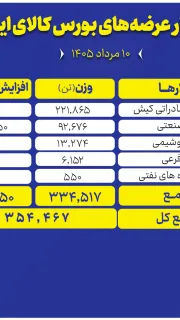
Iran Mercantile Exchange Trades 290,000 Tons of Products in a Single Session
According to Boursenews and IME Report, the news outlet of the Iran Mercantile Exchange, a total of 290,024 tons of products changed hands across the exchange's various trading halls on Monday, 9 Shahrivar 1405 (August 31, 2026). The volume covered petrochemical, metal, agricultural and other commodities listed on the exchange. The Iran Mercantile Exchange is one of the main platforms for transparent price discovery for the country's industrial and mining products, and its daily trading volume serves as a gauge of activity across domestic supply chains and demand for basic and industrial goods.
IME Report
Iran Cancels Customs Duty Exemption on Mining Machinery Imports
Iran's Trade Development Organization has instructed Iran Customs to cancel the import duty exemption on machinery and equipment needed for the mining sector, previously granted under Article 109 of the Mining Law's executive regulations. According to Iran's IRIB news agency and the Donya e Eqtesad newspaper, which reported the circular on Tuesday, 10 Shahrivar 1405 (September 1, 2026), exploration, extraction and processing machinery that was previously exempt from import duties with Ministry of Industry, Mine and Trade approval will now be subject to those duties. The Trade Development Organization cited Article 3 of the Knowledge Based Production Leap Law as grounds for effectively repealing Article 109. The change could raise the cost of imported equipment for mining and mineral processing companies, including listed firms in the sector, as they pursue development projects.
Donya-e-Eqtesad
Trump's AI Video on Kharg Island: Reuters Says Likely Fake, Iran Calls It 'Laughable'
US President Donald Trump wrote on his Truth Social platform on Sunday night, 8 Shahrivar 1405 (August 30, 2026), that Kharg Island, the hub of Iran's oil exports, had been "blown to smithereens," attaching a video showing explosions. According to Reuters, in a report carried by The Straits Times on Monday, 9 Shahrivar (August 31), Reuters used software that detects AI-manipulated imagery and found the clip was most likely synthetically generated. The White House and the US Defense Department did not respond to Reuters requests for comment outside regular business hours. Hamid Bovard, chief executive of the National Iranian Oil Company, said in comments carried by the semi-official outlet Nournews that Trump's remarks were "laughable" and that conditions on Kharg Island were "calm and normal." He said oil operations had not stopped and that workers were repairing earlier damage and modernizing facilities. The same Reuters report said a supertanker caught fire and came to a complete halt after being struck by two naval mines in the southern Strait of Hormuz, according to a Revolutionary Guard statement carried by Iranian state television. Reuters also reported that the number of commercial vessels transiting the Strait of Hormuz fell to about five a day over the weekend.
Reuters, citing Reuters, via The Straits Times

Customs Duty Exemption of 1.2 Percent Announced for 14 Tariff Codes of Frozen Red Meat Imports
Iran's Ministry of Agriculture Jihad deputy for commerce development announced a list of 14 tariff codes for frozen red meat, including bone in and boneless veal cuts, frozen lamb carcasses and goat meat, that are exempt from the 1.2 percent (12 in 1000) customs valuation fee, according to a report by ILNA carried by Khabar Online on Sunday, 8 Shahrivar 1405 (30 August 2026). The move follows a letter from Mohammad Reza Talaei, the ministry's deputy for commerce development, to Iran's Trade Development Organization and Customs Administration, continuing earlier correspondence on tariff codes for basic goods eligible for the exemption.
Khabar Online, citing ILNA

Agriculture Minister: No Need to Draw Down Strategic Reserves of Basic Goods Since Tensions Began on 9 Esfand
Gholamreza Nouri Ghezeljeh, Iran's Minister of Agriculture Jihad, said in televised remarks reported by Tasnim News Agency and carried by Ecoiran on Sunday, 8 Shahrivar 1405 (30 August 2026), that the country has not needed to draw down its strategic reserves of basic goods since tensions began on 9 Esfand (around late February 2026). He cited growth in agricultural output over the past two years, including a claimed 5 percent rise in poultry meat production, 8.5 percent in eggs and 2.5 percent in red meat, and said Iran has achieved self sufficiency in poultry meat production for the first time. These figures are drawn directly from the minister's own remarks; no independent dataset was available to verify them separately.
EcoIran, citing Tasnim

Iran Mercantile Exchange Hosts 2.7 Million Tons of Product Offerings on the Week's First Day
According to Boursenews, halls at the Iran Mercantile Exchange hosted offerings of 2,682,106 tons of product on Saturday, 7 Shahrivar 1405 (August 29, 2026), the first trading day of the week. The industrial and mining hall alone offered 1,590,528 tons, including 1,397,700 tons of iron ore and 102,250 tons of sponge iron, while 946,398 tons of cement went on the board in the cement hall. The Kish export hall offered 114,598 tons of products including cement, bitumen, clinker and iron ore, and the petrochemical and oil products hall offered 27,345 tons of chemical and polymer products. In a separate report, Boursenews said the Iran Energy Exchange's physical hydrocarbon market offered a total of 4,988 tons of hydrocarbon products the same day, with 4,508 tons in the domestic ring and 480 tons in the international ring.
Boursenews
Oil Ministry: Iran Has Enough Oil Outside the Naval Blockade for the 1405 Budget
According to Fars News, published Saturday, 7 Shahrivar 1405 (August 29, 2026) and carried by Donya-e-Eqtesad, Iran's Oil Ministry said the country, outside the naval blockade, has enough oil available for sale to fund the 1405 (2026/27) budget. The report said budgeted oil revenue realization reached 99 percent in the first 4 months of the current Iranian year. The Oil Ministry has already handed 7.5 billion dollars in foreign currency from oil sales during those first 4 months to the central bank, an amount that, based on the government's long term dollar spending pattern, is expected to cover the government's foreign currency expenditures from Tir (June/July) through Dey (December/January) of this year.
Donya-e-Eqtesad, citing Fars News Agency
Iran's Oil Minister Says Crude Sales Continue Despite Lower Volumes
Iran's Oil Minister Mohsen Paknejad said on Friday that crude oil sales and deliveries to customers in distant waters are continuing, responding to claims that oil sales had stopped. He said a significant portion of crude had been transferred to delivery points for customers at various points, and that sales continued, albeit reduced, both before and after Iran's blockade periods. Paknejad declined to give further details, saying disclosure could be exploited by adversaries, but said efforts to sustain oil sales continue in earnest.
Bourse News
Pezeshkian Sets Iran's Third Tier Gasoline Price at 10,000 Tomans
Iranian President Masoud Pezeshkian said on the evening of Friday, August 28, 2026 (6 Shahrivar 1405), during state broadcaster IRIB's live interview program, that the country's third tier gasoline price will rise from 5,000 to 10,000 tomans per liter after coordination with relevant institutions. He stressed the third tier price would not go any higher than that figure. Debate over revising the third tier price had circulated in Iranian media since July 2026, and the government's spokesperson had denied any such plan on July 21. Friday night's remarks mark the first time the final figure has been confirmed by the country's top executive official; an exact implementation date has not yet been announced.
Donya-e-Eqtesad, citing IRIB News
Iran's Daily Gasoline Distribution Hits 150 Million Liters as Fuel Distributor Denies Shortage
Keramat Veiskarami, CEO of the National Iranian Oil Products Distribution Company, called social media rumors about a gasoline shortage baseless on Thursday, 5 Shahrivar 1405 (August 27, 2026). According to Ecoiran, citing Tasnim News Agency and separately carried by Boursenews, he said average daily gasoline distribution in Mordad (July/August) was 138 million liters, rising to 145 million liters over the past three days and reaching 150 million liters nationwide on Wednesday, 4 Shahrivar. Veiskarami stressed that gasoline supply remains stable and is running at maximum production, transfer and distribution capacity, and asked citizens not to return to filling stations without genuine need, citing recent long queues at some locations.
Ecoiran, citing Tasnim
Despite Central Bank Chief's Claim, Oil Minister Says Iranian Crude Sales Continue
Iranian Oil Minister Mohsen Paknejad rejected on Thursday, 5 Shahrivar 1405 (August 27, 2026), a claim by Central Bank Governor Mohammadreza Farzin that Iran's oil sales had effectively stopped. According to Ecoiran, citing the Jamaran news agency, Paknejad, speaking on the sidelines of a ceremony at Imam Khomeini's shrine, said he would not go into detail because disclosing information could be exploited by what he called "the enemy," but stressed that a significant volume of Iranian crude has been delivered to customers at points outside the country's territorial waters. He said the process of selling oil in distant waters, meaning actual delivery to customers, continues, and that sales, though reduced in volume, did not stop even during the period between the two phases of the US naval blockade. Paknejad added the Oil Ministry is pursuing new measures to sustain exports under current conditions.
Ecoiran, citing Jamaran
Activity at Kharg Oil Terminal Continues Uninterrupted Despite Earlier Bombardments
Hamid Bourd, CEO of National Iranian Oil Company, said on Iranian state television program Ekofa on Thursday, 5 Shahrivar 1405 (August 27, 2026), that operations on Kharg Island have not stopped for even a moment despite repeated US and Israeli bombardment during the recent war. According to Fars News Agency, carried by Donya-e-Eqtesad, he said several contractors are currently repairing and upgrading the terminal's storage tanks and docks, with some projects between 20 and 30 percent complete. Bourd said one key wartime measure was managing Iran's strategic oil storage capacity across sites both inside and outside the country. Kharg Island is Iran's main crude export terminal; loading at its western terminal had earlier resumed in mid-August 2026 after a 25 day complete halt.
Donya-e-Eqtesad, citing Fars
Iran Mercantile Exchange Hosts Trade of 180,155 Tons of Products Across Five Halls
The Iran Mercantile Exchange hosted trade of 180,155 tons of products across its halls on Wednesday, 4 Shahrivar 1405 (August 26, 2026), according to Kala Khabar, the exchange's official news outlet. The industrial hall traded 76,593 tons of steel products, 50 tons of zinc and 35 tons of copper. The export hall hosted trade of 32,900 tons of cement, 10,000 tons of clinker, 8,019 tons of bitumen, 2,500 tons of sulfur, 1,000 tons of copper, 637 tons of chemical products and 22 tons of moisture insulation. The cement hall sold 8,045 tons of cement, and the secondary hall hosted trade of 10,392 tons of mineral, chemical and steel products. The petrochemical and oil products hall traded 26,547 tons of chemical products, 1,300 tons of bitumen, 1,827 tons of polymer products, 260 tons of sulfur and 27 tons of oil.
Kala Khabar, Iran Mercantile Exchange
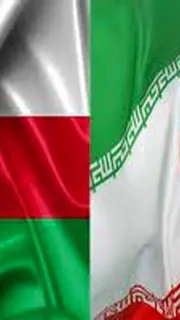
Deputy Foreign Minister: Iran-Oman Talks on the Strait of Hormuz to Conclude Within 30 to 60 Days
Kazem Gharibabadi, Iran's deputy foreign minister for legal and international affairs, said in a televised interview aired Wednesday, Shahrivar 4, 1405 (August 26, 2026), that under clause five of the Islamabad memorandum of understanding, talks between Iran and Oman on joint arrangements for the future management of the Strait of Hormuz must be completed within 30 to 60 days. He said the goal of these technical talks is to replace the previous maritime traffic scheme, in place for nearly 58 years, with a new corridor for commercial shipping, and that passage through the strait will be permitted for commercial vessels only, not military ones. Gharibabadi said that under the memorandum, Iran's only commitment regarding the strait was to manage it for 30 days under Iranian arrangements, followed by 60 days of free passage, after which the two countries would negotiate the strait's longer term management and maritime services. He said Iran is fully prepared to face any scenario and has serious countermeasures available should sanctions and the economic blockade continue.
Ecoiran

Government Spokesperson Denies Gasoline Price Hike; Quota Rates Stay Unchanged
Iran's government spokesperson on Tuesday, August 25, 2026, denied any increase in gasoline prices, saying the fuel quota system's rates of 1,500 and 3,000 tomans per liter remain unchanged. The statement responded to recent speculation about an imminent change to the pricing mechanism. The government has previously denied similar price hike rumors, though the 3,000-toman quota, which started at 100 liters, was cut to 70 liters during the war period and later to 50 liters.
EcoIran
Iran's Oil Exports Fall to 534,000 Barrels a Day as US Sanctions Tighten
Iran's crude oil exports have fallen to about 534,000 barrels per day since the start of Shahrivar (late August), down from an average of 823,000 barrels per day in July, as tighter US sanctions and reduced tanker traffic through the Strait of Hormuz weigh on shipments. According to Oilprice.com, citing Reuters, Iran's Economy Minister Ali Madanizadeh said on Tuesday, August 25, 2026 (3 Shahrivar 1405), responding to the new US sanctions package called "Operation Economic Outcast," that Iran has its own tools to respond. He said Russia and China have not accepted the new sanctions and that he expects other trading partners to follow suit. China, which buys more than 80 percent of Iran's crude exports, remains Iran's largest oil customer, the report said.
Oilprice.com, citing Reuters
In Fars Province, Oil Ministry Announces 7.5 Trillion Cubic Foot Gas Discovery
Iran's oil ministry has announced a new gas discovery in the southern province of Fars, estimated to hold 7.5 trillion cubic feet of gas, of which 73 percent, or 5.7 trillion cubic feet, is recoverable. According to Oilprice.com, citing Iranian media, Oil Minister Mohsen Paknejad said on Monday, August 24, 2026 (2 Shahrivar 1405), that the volume is equivalent to one block of the South Pars field and could supply gas for 15 years. He said the gas is sweet, which lowers development and operating costs. The oil ministry also said repairs at the South Pars field, damaged in the early days of the war, are now 70 percent complete, and that fully restoring the field will take at least three years.
Oilprice.com

Long Lines at Tehran Gas Stations as 1,500 Toman Quota Fuel Trades for Up to 2,500 Tomans on the Informal Market
According to Khabaronline, in a report relayed by Donya-e-Eqtesad on Monday, August 24, 2026 (2 Shahrivar 1405), long lines of cars and motorcycles have formed at Tehran gas stations in recent days. Several motorists and station attendants told the outlet the main driver is concern over a possible cut to gasoline quotas and a change in pricing, concern that intensified after the president's chief of staff recently said a quota cut is definite, without specifying the size of the cut or the price for consumption above the quota. Some drivers said they are also queuing out of fear that stations could close or run out of fuel. Khabaronline's report adds that an informal market for reselling gasoline quotas has emerged alongside the stations: buyers seeking someone else's 1,500-toman-tier quota pay that seller an average of about 2,000 to 2,500 tomans per liter, on top of the official pump price, while for the 3,000-toman tier the resale premium averages about 1,500 tomans per liter.
Donya-e-Eqtesad, citing Khabaronline
Oil Minister Announces Discovery of a 7.65 Trillion Cubic Foot Gas Field in Southern Fars Province
Oil Minister Mohsen Paknejad confirmed the discovery of a new gas field in southern Fars province holding roughly 7.65 trillion cubic feet of gas in place (more than 7,500 billion cubic feet), according to a Mehr News Agency report published Sunday, Shahrivar 1, 1405 (August 23, 2026). He said that accounting for the recovery factor, about 5,700 billion cubic feet of gas could be extracted from the field, a volume he said is equivalent to 15 years of gas supply for one phase of South Pars. Paknejad added that the field's gas is "sweet," a quality that lowers development and operating costs, and that it also holds a significant volume of gas condensate worth tens of billions of dollars. He said the oil ministry would work to plan and execute the field's development as quickly as possible.
Mehr News Agency
Persian Gulf Waterway Authority: Vessels Violating Hormuz Rules Face Fines or Detention
Iran's Persian Gulf waterway management authority said on Monday, Shahrivar 2, 1405 (August 24, 2026), that vessels violating Iran's announced arrangements for transiting the Strait of Hormuz will face restrictions on subsequent voyages, including fines, detention or confiscation. According to Ecoiran, the notice said vessels using ship to ship transfers, transshipment or other methods to cooperate with sanctioned vessels on Iran's list would also be added to the list of violators. The warning follows a string of Iranian measures to control Hormuz transit; hours earlier, the Majlis National Security and Foreign Policy Committee had approved charging passing ships for navigation, refueling, insurance and safety services. Further details on penalty amounts or an enforcement timeline have not yet been announced.
Ecoiran
Majlis National Security Committee Approves Charging Transit Fees on Ships Passing Through the Strait of Hormuz
The Majlis National Security and Foreign Policy Committee approved charging transit fees on ships passing through the Strait of Hormuz on Sunday, Shahrivar 1, 1405 (August 23, 2026), during review of a bill on securing the strait. According to Donya-e-Eqtesad, the committee's spokesperson said the approved fees would cover navigation, refueling, insurance and safety services provided to passing vessels. The exact fee rates and an implementation date have not yet been announced.
Donya-e-Eqtesad
Mismanagement of Iranian Oil Cargoes at Chinese Ports Referred to Audit Court Prosecutor
Iran's Supreme Audit Court said on Sunday, Shahrivar 1, 1405 (August 23, 2026), according to ISNA, that its review of the process for leasing storage tanks and managing and selling Iranian oil cargoes at three Chinese ports found evidence of laxity in safeguarding state assets, overreach of authority, and failure to carry out legally required duties. The Court said these violations, which have persisted from past years, have resulted in losses to public funds. According to the Audit Court, failure to make timely decisions on managing the oil cargoes and unjustified storage of them in leased tanks reduced the cargoes' quality and economic value while imposing mounting tank rental costs on public funds. The case concerning these failures and the resulting losses has been referred to the Audit Court's own prosecutor's office for investigation and legal action. The report comes as Iran's oil exports in recent months have faced constraints from the war, sanctions, and the partial closure of the Strait of Hormuz.
ISNA, via Donya-e-Eqtesad
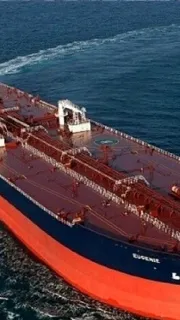
Iran Warns Neighboring States: Siding With US Pressure Would Put Their Interests and Oil Export Routes in Tehran's Crosshairs
Mohsen Rezaei, secretary of Iran's Supreme National Security Council, warned on Saturday, August 22, 2026 (31 Mordad 1405) that if Iran's neighboring states side with US economic pressure on Tehran, Iran would target their interests as well as their oil export routes through the Persian Gulf. According to EcoIran, the remarks came amid rising economic and political tension in recent days between Iran and some regional states. The Strait of Hormuz and Persian Gulf shipping lanes are among the world's principal oil export corridors, and any threat against them could affect global energy markets.
EcoIran
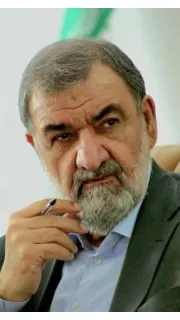
Despite Wartime Conditions, Basic Goods Supply Continues; Cooking Oil and Legumes Priced Below Cost
According to Khabaronline, published Saturday, August 22, 2026 (31 Mordad 1405), Mohammad Jafari, secretary of Iran's Grain Association, said that despite wartime conditions, the supply of imported basic goods continues, and some items are even in oversupply. He said cooking oil prices are currently low and legumes are being sold below their cost price, while rice prices sit around cost. Jafari, pointing to importers' experience over the past four to five years, including during wartime, said goods supply would continue under any conditions, but stressed that the government must meet its obligations to pay importers what they are owed so that no concern arises over basic goods supply through the end of the year.
Khabaronline
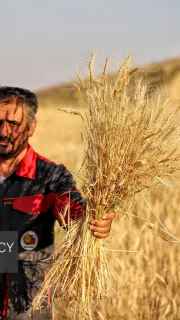
Investment Output Gap in Iran's Mines: Copper and Iron Ore's Production Share Doubles Their Investment Share
Based on Statistical Center of Iran data on operating mines for the Iranian year 1403, iron ore accounted for 35 percent of total mining sector investment while generating 50 percent of the sector's production value, and copper, with a 12 percent share of investment, produced 26 percent of output. According to Donya-e-Eqtesad, the production value of copper ore reached about 137 trillion tomans in 1403, while its recorded investment was only about 2.7 trillion tomans, putting its production to investment ratio at 51 times. By contrast, gold ore absorbed 6 percent of mining sector investment but generated only 1.5 percent of production value, and sand and gravel, with a 13.5 percent investment share, accounted for just 4 percent of output. The report said the production to investment ratio across Iran's mining sector averages about 24 times, but cautioned the figure should not be read as a rate of return, since investment recorded in a given year does not necessarily translate into that same year's output, and some investment, particularly in exploration, only affects production with a time lag.
Donya-e-Eqtesad

14th Silver Investment Fund 'NoghreAmad' Opens Subscription on Iran Mercantile Exchange From Shahrivar 1
According to Boursenews, published Thursday, August 20, 2026 (29 Mordad 1405), subscription for investment units of the Efficient Commodity Fund's silver metal branch, trading under the ticker "NoghreAmad," Iran's 14th silver fund, will open on Sunday, the first of Shahrivar 1405 (August 23, 2026) at 11:45 to 18:00 (with a 15-minute pre-opening), running for three business days on the Iran Mercantile Exchange. Under a license from Iran's Securities and Exchange Organization, the fund is backed by silver and was established to reduce investment risk and let investors benefit from economies of scale.\n\nPer the published notice, the fund may issue up to 200 million investment units, offered in the standard subscription format. Secondary trading of the fund's units will begin once the subscription period ends and the fund is registered in the Iran Mercantile Exchange's investment fund market.
Boursenews
At the Strait of Hormuz, Iran-US Diplomacy Stalls Again as Trump Tweet Fuels Tension
US President Donald Trump wrote on Truth Social on Tuesday, August 18, 2026 (27 Mordad 1405) that no negotiations with Iran are under way and that the naval blockade of the Strait of Hormuz remains in force with full force. According to Donya-e-Eqtesad, Iranian Foreign Minister Abbas Araghchi had earlier said message exchanges through intermediaries continue but do not amount to negotiations, and a source close to Iran's negotiating team said recent talks with Oman concerned Iran's sovereignty arrangements over Hormuz, not talks with the US. Shipping tracker Kepler reported confirmed transits through the strait fell 17 percent to 10 on Tuesday, none of them via the strait's official shipping lane. Citing the Financial Times and CNN, Donya-e-Eqtesad reported that Trump has instructed his team to halt talks with Iran and that US strategy has shifted from seeking a quick deal to applying gradual pressure. In response, Iranian deputy foreign minister Kazem Gharibabadi said the strait will only be managed under Iran's own arrangements. Before the war began, about one fifth of the world's energy supply passed through the strait.
Donya-e-Eqtesad
Iran Energy Exchange to offer 85,000 tons of hydrocarbon products and 675 million kWh of electricity today
Iran Energy Exchange's communications management announced that a total of 85,001 tons of hydrocarbon products will be offered in the exchange's physical hydrocarbon market on Wednesday, August 19, 2026 (28 Mordad 1405); of that, 22,759 tons will be offered on the domestic ring and 62,242 tons on the international ring. According to Bourse News, the electricity market will offer a total of 675,360,000 kilowatt-hours on the free electricity board, while no supply is scheduled on the normal and green electricity boards.
Bourse News
Iran Mercantile Exchange trades 579,000 tons of commodities in Tuesday's session
Iran Mercantile Exchange (IME) traded 579,325 tons of commodities across its markets on Tuesday, August 18, 2026 (27 Mordad 1405), according to the exchange's official website. The open auction hall and the cement hall accounted for the largest share of the day's trading volume. IME is one of the main channels for transparent pricing of Iran's industrial, mining, petrochemical and agricultural commodities, and its daily trading volume serves as a gauge of domestic industrial demand for raw materials.
Iran Mercantile Exchange
Lawmaker Warns New Gasoline Plan Could Raise Household Monthly Costs by Up to 8 Million Tomans
According to Ecoiran, citing Tasnim News Agency and published on Tuesday, 18 August 2026 (27 Mordad 1405), lawmaker Meysam Zohourian criticized a new gasoline plan from Iran's Fuel Consumption Optimization Organization, saying it lacks a stakeholder analysis identifying winners and losers. He said the monthly gasoline quota for households with a car, currently averaging 190 liters at prices of 1,500 to 5,000 tomans a liter, would fall to 90 liters under the new plan. Zohourian said that if the market price of gasoline settles around the 80,000 toman level proposed in the so called Kerman plan, the average household, many of them in lower income deciles, would face about 8 million tomans in additional monthly costs. He added that reports available to parliament so far include no reliable study of the plan's social effects, including a potential rise in the cost of a tank of gasoline beyond the quota to about 4 million tomans.
Ecoiran, citing Tasnim News Agency
Iran Mercantile Exchange Hosts 812,000-Ton Supply and 13th Silver Fund Subscription Today
According to Boursenews, published on Tuesday, 18 August 2026 (27 Mordad 1405), the Iran Mercantile Exchange is hosting the supply of 812,286 tons of various products today. At the same time, subscription for the Torang Kala 1 commodity investment fund (silver branch), the exchange's 13th silver fund under ticker YAS, will open on Wednesday, 28 Mordad, for three business days. Per a separate Boursenews report, Iran's Energy Exchange will also supply a total of 27,411,840 kilowatt hours of electricity in its power market today.
Boursenews
Iran Mercantile Exchange's Derivatives and Certificate Market Traded 11 Trillion Tomans Monday
According to Boursenews and IME Report, the Iran Mercantile Exchange's own reporting outlet, published on Tuesday, 18 August 2026 (27 Mordad 1405), the exchange's financial and derivatives market recorded a total of 2.051 billion contracts worth 11,000 billion tomans (11 trillion tomans) on Monday, 17 August (26 Mordad). Per separate IME Report figures from the same day, in the deposit certificate market, 1,141,466,118 units of gold funds worth 7.5 trillion tomans, more than 892 million units of silver funds worth 975.4 billion tomans, and, in the saffron market, certificates and funds worth 330.7 billion tomans, known as "red gold," were traded.
Boursenews, citing IME Report

An Emirati Tanker Was Stopped Near Qeshm While Transiting the Strait of Hormuz
According to Donya-e-Eqtesad, citing Fars News Agency and published on Monday, 17 August 2026 (26 Mordad 1405), a tanker owned by a UAE based company was stopped near Qeshm island while transiting the Strait of Hormuz. Maritime navigation data showed the vessel was halted while using Iran's designated transit corridor. Ecoiran separately reported the same day that an Emirati tanker had been stopped in the strait. Donya-e-Eqtesad said that under Iran's arrangements for safe passage through the Strait of Hormuz, tankers are required to use the Iranian designated route, pay a service fee and obtain Iran's permission. The report came as Iran and Oman continue working to finalize an agreement on facilitating safe ship transit through the strategic waterway.
Donya-e-Eqtesad, citing Fars News Agency
Silva Silver Fund's Unit Cap Raised; Subscription for 200 Million More Units Extended Two Days
According to Kalakhabar, the Iran Mercantile Exchange's official news outlet, the exchange's derivatives and new financial instruments market management said on Monday, 26 Mordad 1405 (August 17, 2026), that Iran's Securities and Exchange Organization approved an amendment to the prospectus of the Padash Commodity Fund 1 (traded as Silva) to raise its investment unit cap. As a result, Silva will offer 200 million additional investment units for subscription through the IME's fund market over two business days starting Monday, 26 Mordad. The cap increase was announced after the fund's first three-day subscription window, which opened Sunday, 25 Mordad (August 16) as Iran's 12th commodity exchange silver fund, drew strong demand and raised 200 billion tomans within the opening minutes of Monday morning. The demand coincided with global silver prices rising above $65.60 an ounce.
Kalakhabar, Iran Mercantile Exchange's official news outlet

Market Regulation Headquarters adds frozen cut chicken to electronic subsidy list
Iran's Market Regulation Headquarters, chaired by First Vice President Mohammad Reza Aref, added packaged or portioned frozen chicken to the list of goods covered by the electronic subsidy card (kalabarg) program, Khabaronline reported citing ISNA on Monday, August 17, 2026. The meeting also stressed the need to pay outstanding dues owed to stores participating in the program. At the same meeting, the Ministry of Agriculture Jihad and the Ministry of Industry, Mine and Trade presented reports on prices of selected goods, and the headquarters approved in principle a plan to allow imports of essential goods through free trade zones; details are to be reviewed and finalized by a specialized working group.
Khabaronline, citing ISNA

Araghchi: Iran and Oman finalizing safe shipping route through Strait of Hormuz
Iranian Foreign Minister Seyed Abbas Araghchi, in a phone call with his Turkish counterpart on Monday, August 17, 2026, described the latest status of bilateral talks between Iran and Oman, saying the two countries are finalizing a suitable route for the safe passage of ships through the Strait of Hormuz, and stressed Iran's determination to continue the process. The two ministers also discussed the latest regional developments and the need to continue diplomatic efforts to prevent escalation and strengthen regional stability and security. The report was published by Tasnim News Agency and carried by Donya-e-Eqtesad.
Donya-e-Eqtesad, citing Tasnim
Investors Rush Into New Silver Fund Silva; Subscription Raises 200 Billion Tomans in Minutes
According to Bourse News, subscription for the 12th silver investment fund on the Iran Mercantile Exchange, trading under the symbol Silva, which opened on Sunday, 25 Mordad 1405 (August 16, 2026) for a three business day window, closed successfully today, Monday, 26 Mordad 1405 (August 17, 2026), after drawing strong investor demand and raising 200 billion tomans within its first minutes. The demand came as the global price of silver rose to more than 65.60 dollars an ounce today; silver has faced a global supply deficit for a sixth consecutive year, a trend noted in earlier market reports.
Boursenews
668 Million Liters of Gasoline Consumed in 5 Days; Daily Average Tops 133 Million Liters
According to official data from Iran's Ministry of Petroleum published by Bourse News, the country consumed a combined 668 million liters of gasoline over the five days of 12 to 16 Mordad 1405 (August 3 to 7, 2026). Per figures from the National Iranian Oil Products Distribution Company, the highest daily consumption was recorded on 12 Mordad at 140.7 million liters and the lowest on 16 Mordad at 122.3 million liters. Average daily consumption over the period topped 133 million liters. Per the company's official data, gasoline consumption has grown by an average of about 5 percent a year since the start of the revolution through 1402 (2023/24), and by 10 percent over the past four years alone. Forecasts show that if the current trend continues, daily gasoline consumption will reach 170 million liters by 1407 (2028/29), with the resulting supply gap costing more than 16 billion dollars a year in foreign currency by then.
Boursenews, citing the Ministry of Petroleum
Parliament's National Security Committee Bans Israeli Vessels From the Strait of Hormuz
Ebrahim Azizi, chairman of the Iranian parliament's National Security and Foreign Policy Committee, said today, Monday, 26 Mordad 1405 (August 17, 2026), that the committee approved a clause at its Sunday, 25 Mordad session banning transit through the Strait of Hormuz for all vessels owned by Israel or carrying cargo bound to or from Israel. According to Ecoiran, citing ISNA, the clause is part of a bill called the "Strategic Action for Securing and Sustainably Developing the Strait of Hormuz," known as the Martyr Tangsiri law. Azizi said that once the law receives final approval from Iran's competent authorities, Israel will be barred entirely from presence or transit in the Strait of Hormuz. The measure was announced as vessel traffic through the strait has fallen sharply in recent weeks amid the US naval blockade and reported attacks on oil tankers.
Ecoiran, citing ISNA
Energy Exchange Offers 1.8 Billion Kilowatt Hours of Electricity and Hydrocarbon Products Today
Iran Energy Exchange's communications management said its electricity market will offer a combined 1,802,976,000 kilowatt hours of power today, Sunday, August 16, 2026 (25 Mordad 1405). According to Bourse News, of that total, 994,467,840 kilowatt hours will be offered on the standard board, 19,047,888 kilowatt hours on the green power board and 788,485,248 kilowatt hours on the free power board. In the exchange's physical hydrocarbon market, a combined 51,789 tons of hydrocarbon products will also be offered today, with 17,789 tons on the domestic ring and 34,000 tons on the international ring.
Boursenews
211 Kilograms of Gold Bullion and 2.9 Tons of Silver Bullion Change Hands on Commodity Exchange in a Week
A review of trading statistics on Iran Mercantile Exchange's financial markets for the week ending Saturday, August 14, 2026 (23 Mordad 1405), shows that more than 2,119,440 gold bullion deposit certificates, equal to 211 kilograms, were traded for a combined 5,300 billion tomans. According to Bourse News, the silver bullion deposit certificate market saw 2,954,217 certificates change hands, equal to 2.9 tons of silver, worth 1,207 billion tomans. Over the same week, gold investment funds recorded turnover of 4.64 billion units worth about 32,500 billion tomans, while silver funds traded 3.408 billion units worth 3,700 billion tomans. In the gold options market, 61,004 contracts were concluded, equal to 6.1 kilograms of bullion, worth 39 billion tomans.
Boursenews
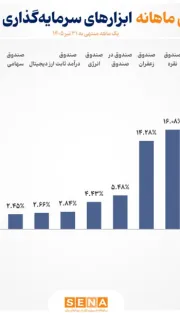
Energy Exchange Raises Base Price of Imported Premium Gasoline to 89,700 Tomans for August 28 Trading
Iran Energy Exchange's domestic ring will host the sale of 240,000 liters of imported premium (super) gasoline in trading on Thursday, August 20, 2026 (28 Mordad 1405), with a base price of 89,700 tomans per liter. According to EcoIran, citing IRNA, data from the oil, gas and energy carriers board set a price floor of 85,215 tomans and a ceiling of 94,185 tomans for the offering. Per IRNA's report, premium gasoline pricing on the energy exchange has followed a steady upward trend in recent months. The product's first offering, on 2 Azar 1404, was priced at 65,800 tomans per liter; that rose to 72,800 tomans from 14 Bahman 1404 and to 79,800 tomans from 19 Khordad 1405, before settling at 84,600 tomans from 29 Khordad. Eight licensed private companies currently handle distribution of the product nationwide.
EcoIran, citing IRNA
Iran Mercantile Exchange Offers Nearly 3 Million Tons of Iron Ore and Cement
Iran Mercantile Exchange halls hosted the offering of 2,906,289 tons of products on Sunday, August 16, 2026 (25 Mordad 1405), with the main focus on iron ore and cement. According to Kalakhabar via Bourse News, the open auction hall offered 1,147,628 tons of products including 922,000 tons of iron ore, 218,000 tons of vacuum bottom and 3,620 tons of copper cathode. The cement hall traded 988,828 tons of cement. The industrial hall hosted 563,620 tons of products including 444,000 tons of iron ore pellets, 106,250 tons of sponge iron and 5,250 tons of rebar. The export hall offered 203,383 tons of products including 70,292 tons of cement, 12,200 tons of clinker and 4,000 tons of steel bloom and billet. The petrochemical hall listed 90,514 tons of products including 81,500 tons of lube cut.
Bourse News, citing Kalakhabar
Iran Mercantile Exchange to Launch Gold Bullion Options Contract Maturing May 2027
The Iran Mercantile Exchange's derivatives and financial instruments management unit announced on Sunday, 25 Mordad 1405 (August 16, 2026), the launch of a gold bullion options contract maturing in Ordibehesht 1406. According to Kalakhabar, the exchange's official news outlet, trading in the contract will begin Saturday, 31 Mordad 1405 (August 22, 2026), with a maturity date of 18 Ordibehesht 1406 (May 8, 2027). Per the announcement, the options contracts carry no price fluctuation band and open with a 15-minute opening auction at the start of each trading session before moving into normal continuous trading. The instrument lets market participants hedge against gold bullion price swings or take positions on price moves over the contract's set period.
Kalakhabar, Iran Mercantile Exchange's official news outlet

12th Silver Fund 'Silva' Draws Strong Demand, Raises 200 Billion Tomans in Opening Minutes
Padash Kala Investment Fund, under a license from Iran's Securities and Exchange Organization, began subscription on Sunday, 25 Mordad 1405 (August 16, 2026), for units of its "Kala-ye Padash 1" fund, trading under the ticker "Silva," the 12th silver-backed fund on the Iran Mercantile Exchange. According to Kalakhabar, the exchange's own news outlet, the three-business-day subscription drew strong investor demand, raising 200 billion tomans in the opening minutes of trading alone. With Silva's launch, the number of active silver funds on the commodity exchange reached 12, joining existing funds including Sian, Noghrat, Plata, Siglo, Noghrefam, Noghrin, Noghran, Noghrabi, Simin, Silver and Noghresa. Secondary trading of Silva's units will begin once the subscription period ends and the fund is formally registered on the exchange's investment fund market.
Kalakhabar, Iran Mercantile Exchange's official news outlet

Oil Loading Resumes at Kharg Island's Western Terminal After 25-Day Halt
The western terminal at Iran's Kharg Island, the country's main crude export hub, resumed oil loading on Tuesday, 20 Mordad 1405 (August 12, 2026), after a complete 25-day halt. According to Donya-e-Eqtesad, citing maritime intelligence firm Windward, satellite imagery shows a VLCC-class tanker roughly 333 meters long, anchored in the terminal's waiting area since 20 Tir 1405 (July 11), finally docked and began loading crude. UAE-based The National separately confirmed the same event and the same 25-day halt in its own report. Separately, the northern Larak Island anchorage near the Strait of Hormuz recorded a marked rise in sanctioned tanker traffic: satellite images from August 12 show 35 tankers and cargo vessels moored there, up from 28 on August 10, with about 74 percent transiting with tracking systems switched off. The US naval blockade of Iranian ports, which had halted loading at Kharg for the first sustained stretch since the war began, continues with no clear diplomatic framework in sight.
Donya-e-Eqtesad, citing Windward
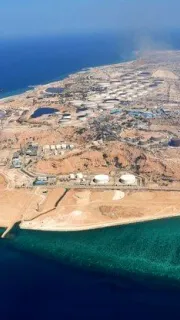
Government Weighs Three Scenarios to Manage 14 Million Liter Gasoline Shortfall
According to EcoIran, Iran's daily gasoline consumption stands at about 135 million liters against daily production of 121 million liters, leaving a daily shortfall of roughly 14 million liters. Citing official Saghab Esfahani, the report said the government is weighing three scenarios to manage the gap: cutting off rationed gasoline supply at stations once the daily cap is reached; keeping the current ration and selling surplus consumption at free market prices; or shifting the subsidy from vehicles to individuals, allocating about 1.1 liters a day to each of Iran's roughly 85 million people, alongside 30 million liters a day for public transport. Separately, official Oil Ministry data published by Boursenews showed that in just five days, 12 to 16 Mordad 1405, the country consumed a combined 668 million liters of gasoline. The highest daily figure in that span was 140.7 million liters on 12 Mordad, and the lowest was 122.3 million liters on 16 Mordad.
EcoIran
62 Commercial Ships Have Rerouted Since July 14 Due to US Naval Blockade, CENTCOM Says
US Central Command (CENTCOM) said on Friday, 23 Mordad 1405 (August 14, 2026), that since July 14 (23 Tir), when Washington resumed its naval blockade of Iranian ports, the US Navy has diverted the route of 62 commercial ships. According to Eco Iran, the figure is the latest official US tally on the scope of the naval blockade, which has continued since mid-Tir 1405 (early July). The claim follows earlier remarks by US Secretary of War Pete Hegseth, who said on Thursday, 22 Mordad (August 13), that the US Navy could keep the blockade on Iranian ports "for as long as necessary." Rerouted vessels typically travel via the Cape of Good Hope or overland routes, which raise the cost and transit time of shipping goods to Iran.
Eco Iran
Iran Mercantile Exchange Trades More Than 231,000 Tons of Goods Today Across Its Halls
According to Kala Khabar, the Iran Mercantile Exchange hosted trading of more than 231,410 tons of goods across its halls on Saturday, August 15, 2026 (24 Mordad 1405). The industrial hall traded 150,230 tons of steel sheet, 16,100 tons of bloom and billet, 2,500 tons of rebar, 1,012 tons of steel wire and 1,252 tons of beams. The export hall sold 29,140 tons of cement and 8,084 tons of bitumen. The petrochemical hall recorded sales of 5,302 tons of chemical products and 1,922 tons of polymer products, while the oil products hall traded 400 tons of bitumen. The cement hall hosted trading of 13,955 tons of product, while the side hall recorded 990 tons and the open auction hall recorded 22 tons of chemical product.
Kalakhabar, citing Kala Khabar, via Iran Mercantile Exchange

Canada Sanctions Five Iranian Officials Over Threats to Strait of Hormuz Security
Canada's Foreign Ministry said in an official statement on Friday, August 14, 2026 (23 Mordad 1405), that under the country's Special Economic Measures Act it has imposed new sanctions on five Iranian individuals, including officials linked to the Islamic Revolutionary Guard Corps. According to Khabaronline, citing the official website of the Government of Canada and IRNA, the ministry cited threats to a critical international waterway and violations of navigation rights in and around the Strait of Hormuz as the reason for the sanctions. Canadian Foreign Minister Anita Anand said in the statement that freedom of navigation through the Strait of Hormuz is essential for global trade and energy security, and called on Tehran to reduce tensions and respect international navigation rights. Canada's Foreign Ministry said the move is aligned with efforts by its allies, and that Canada is prepared to support efforts to stabilize the situation in the strait if conditions allow. Iranian officials have repeatedly said that control over transit through the Strait of Hormuz rests with Iran.
Khabaronline, citing the Government of Canada and IRNA
Iran Mercantile Exchange Halls Host 493,000 Tons of Product Offerings Today
According to Bourse News, on the first trading day of the week, Saturday, August 15, 2026 (24 Mordad 1405), the halls of the Iran Mercantile Exchange are hosting offerings of 493,573 tons of products. The report said 197,014 tons, including 139,140 tons of cement, 40,000 tons of clinker, 15,374 tons of bitumen and 2,500 tons of sulfur, are being offered on the Kish export hall. The industrial hall is offering 275,489 tons of products, including 275,134 tons of steel sections and 355 tons of copper wire and rod, while the petrochemical and oil products hall is offering 19,230 tons, including chemicals, bitumen and polymer materials. The sub-market hall is listing 1,840 tons of steel, polymer materials and zinc scrap.
Bourse News
Iran Mercantile Exchange Trade Value Reaches 100,500 Billion Tomans in Week Ending August 14
According to Bourse News, trading data from the physical market of the Iran Mercantile Exchange (IME) showed that around 2,814,000 tons of goods and products worth more than 100,500 billion tomans were traded in the week ending August 14, 2026 (23 Mordad 1405). The trading value of the exchange's top 10 companies reached more than 53,400 billion tomans. The report showed Foolad Mobarakeh Isfahan topped the sellers' list, trading 235,960 tons of steel sheet and argon worth 20,800 billion tomans. National Iranian Copper Industries ranked second, selling 19,192 tons of copper, sulfuric acid and molybdenum oxide worth 10,550 billion tomans, while Khuzestan Steel came third with 96,100 tons of slab and bloom ingots worth 6,748 billion tomans.
Bourse News

Iran Mercantile Exchange Enters the Pistachio Market With a New Commodity Deposit Certificate
Iran Mercantile Exchange has begun operating its first accredited pistachio warehouse after naming pistachio as the underlying asset for a new commodity deposit certificate market. According to Bourse News, citing Mahboubeh Eskandari, head of the exchange's warehouse admission office, the warehouse belongs to Mani Asia Company in Maragheh, East Azerbaijan province, with a current capacity of 100 tons that can be expanded later. The underlying asset is Fandoghi pistachio with a 30 or 32 count per ounce and a kernel yield of 49.5 to 50.5 percent. The warehouse operator charges an evaluation fee of 7 million tomans for each incoming batch of up to 25 tons, and the minimum batch size for deposit or withdrawal is 2 tons. Eskandari said the instrument lets producers and traders pledge their certificates, which represent ownership of the physical pistachios, to banks for financing, so growers are no longer forced to sell at low prices during the harvest season.
Bourse News

Trump Says He Will Declare Strait of Hormuz US 'Territory'; Iran Pushes Back
US President Donald Trump said in a campaign speech in New York on Friday, August 14, 2026 (23 Mordad 1405), that after Iran's "complete defeat" he will soon declare the Strait of Hormuz "a territory of the United States." According to Al Jazeera, he described the US naval blockade of the strait as "a wall of steel" that is impenetrable. Control of Hormuz, through which roughly 20 percent of global oil exports passed before the US and Israeli war on Iran that began on February 28, 2026 (9 Esfand 1404), has been a central sticking point in ceasefire talks between the two countries. Kazem Gharibabadi, Iran's deputy foreign minister for legal and international affairs, responded on social media that the Strait of Hormuz "cannot be taken by a tweet, an aircraft carrier, or an election speech," saying Iran is neither afraid nor intimidated. The US and Iran have separately floated the idea of a 20 percent toll on cargo transiting the strait, though legal experts say such a measure would violate international maritime law.
Al Jazeera
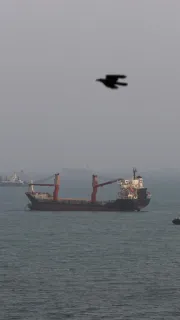
IRGC Says It Shot Down a US MQ-9 Drone Over Hormozgan
Iran's Islamic Revolutionary Guard Corps (IRGC) said on Friday, August 14, 2026 (23 Mordad 1405), that a US MQ-9 drone was tracked and shot down over the skies of Hormozgan province by the IRGC's new advanced air defense system, operating under the country's integrated air defense network. According to Khabaronline, citing Tasnim News Agency, no further details on the exact time of interception or the precise crash site have been released. Ecoiran and Donya-e-Eqtesad separately reported the same IRGC statement.\n\nThe incident comes amid the prolonged US-Iran deadlock over the Strait of Hormuz, a waterway that has been the focus of military tension in recent weeks, the site of attacks on oil tankers, and an area of markedly reduced shipping traffic. Hormozgan province sits on the northern shore of the Strait of Hormuz and is home to Bandar Abbas, Iran's largest commercial port, so any escalation in the area feeds directly into global oil market expectations, shipping insurance premiums, and Iran's currency rate.
Khabar Online, citing Tasnim
In Parliament: Talks With Oman Over the Strait of Hormuz Do Not Mean Its Reopening
Behnam Saeedi, a member of the presiding board of the Iranian parliament's National Security and Foreign Policy Committee, said in a televised interview reported by Khabaronline, citing Mehr News Agency, on Friday, August 14, 2026 (23 Mordad 1405), that Iran's ongoing talks with Oman over the Strait of Hormuz concern only a temporary transit arrangement and should not be interpreted as a reopening of the waterway. He said a full reopening of the strait will not be possible as long as the United States continues its naval blockade, and that the temporary arrangement under discussion with Oman does not change that situation. He added that reopening the waterway depends on the United States accepting the conditions and measures the Islamic Republic of Iran has set out.
Khabar Online, citing Mehr News Agency
Chicken Prices at Tehran's Fruit and Vegetable Markets Reach 320,000 Tomans a Kilogram
According to Mehr News, as carried by Donya-e-Eqtesad on Friday, August 14, 2026 (23 Mordad 1405), prices for staple goods at Tehran's fruit and vegetable markets for the week ending August 13, 2026 (22 Mordad 1405) show unpackaged chicken selling at 320,000 tomans a kilogram and unpackaged turkey at 495,000 tomans a kilogram. A 30 count carton of eggs was priced between 490,000 and 500,000 tomans, and sheep tail fat (donbeh) at 990,000 tomans a kilogram. The same report showed Iranian rice priced at 450,000 to 550,000 tomans a kilogram and imported rice at 166,000 to 260,000 tomans, while unpackaged lamb ranged from 1.6 to 2.2 million tomans a kilogram and packaged mixed ground beef was 1,575,000 tomans a kilogram. Cooking oil in an 810 gram package was listed at 309,000 tomans and Iranian tea at 350,000 tomans a kilogram. The weekly price survey is among the indicators used to track household basket costs in Tehran.
Donya-e-Eqtesad, citing Mehr News

Government Announces New Feedstock and Fuel Gas Rates for Petrochemical, Refining and Steel Plants
According to Bourse News, Iran's government has issued the natural gas feedstock rate for petrochemical plants along with the fuel gas rate for petrochemical, refining and steel direct-reduction complexes for the early months of the current Iranian year. Under the notice, the petrochemical feedstock gas rate was set at 17,956 tomans per cubic meter for Farvardin and Ordibehesht (the year's first two months), 20,127 tomans for Khordad, and 20,026 tomans for Tir. The fuel gas rate for petrochemical plants, refineries and steel DRI complexes was set at 10,774 tomans per cubic meter for Farvardin through Khordad and 12,076 tomans for Tir. For methanol producers that settle their feedstock bill within 30 days, the feedstock rate will be calculated at 95 percent of the petrochemical gas feedstock rate. Feedstock pricing is one of the main drivers of profitability for listed petrochemical, refining and steel companies, and uncertainty over the rate had previously prompted letters and clarification filings from producers and Parliament's Energy Committee.
Bourse News
Iran's Oil Output Rose 26,000 Barrels a Day in July to 2.478 Million Barrels
According to Bourse News, OPEC's latest monthly report, published Wednesday, August 12, 2026 (21 Mordad 1405) and based on secondary source data, showed Iran's oil production rose 26,000 barrels per day in July from June to reach 2.478 million barrels a day. The same report put combined output from OPEC's 11 members up 1.659 million barrels a day in July to 23.632 million barrels a day, while OPEC+ partner countries' output fell 235,000 barrels a day to 14.024 million barrels a day. OPEC also said Iran Heavy crude averaged $82.07 a barrel in July, down $8.70 from June; its average from the start of 2026 through July stood at $92.37, above the $70.73 average over the same period in 2025. OPEC's Reference Basket fell $6.76 from June to average $82.99 a barrel in July.
Bourse News, citing OPEC
CENTCOM Denies Its Commander Is Pushing to Resume Attacks on Iran
CENTCOM spokesman Tim Hawkins said on Thursday, 22 Mordad 1405 (August 13, 2026), that reports claiming CENTCOM commander Brad Cooper is pushing to resume attacks on Iran are "completely fabricated." According to Ecoiran, citing Tasnim and a Jerusalem Post reporter, Hawkins was responding to an earlier claim by Israel's Channel 13. Channel 13 had reported hours earlier that Cooper, during a recent visit to Tel Aviv, told Israeli officials the United States might ultimately have no choice but to strike Iran again alongside Israel, and had raised the possibility of hitting Iranian oil, gas and power infrastructure. The denial comes as the US naval blockade of Iranian ports remains in place following the collapse of the June ceasefire memorandum, with the US war secretary reaffirming its continuation earlier this week.
Ecoiran, citing Tasnim
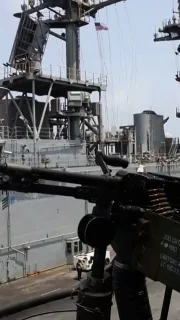
Hegseth: US Will Keep Naval Blockade on Iran 'As Long As Needed'; IRGC Navy Commander Says Hormuz Is Closed
US Secretary of War (Defense) Pete Hegseth told reporters on Thursday, 22 Mordad 1405 (August 13, 2026), that the US Navy can maintain the naval blockade of Iranian ports for as long as it deems necessary. According to Middle East Eye, he said: "Indefinitely, the United States Navy can maintain a blockade like that because we'll rotate ships in and out, as we have, and we'll continue to." In response, the same day, Rear Admiral Ali Ozmaei, commander of the Islamic Revolutionary Guard Corps' navy, said the Strait of Hormuz is closed, according to Ecoiran and Donya e Eqtesad, citing Daneshjoo News Agency. He said: "Our dominance over movements in the strait is complete and decisive... the reality should be seen in the field, not in statements by American officials." Ship tracking data previously reported by Reuters and Kpler has shown daily transits through Hormuz falling from roughly 130 to 140 vessels before the war to fewer than ten a day.
Middle East Eye

Iranian MP: Temporary Shipping Route With Oman Does Not Mean Hormuz Will Reopen
Behnam Saeedi, a member of the presiding board of the Iranian parliament's National Security and Foreign Policy Committee, said in a televised interview carried by Mehr News on Thursday, August 13, 2026 (22 Mordad 1405), that Iran's ongoing talks with Oman over the Strait of Hormuz concern only a temporary shipping route, and that any agreement on that route does not mean the strait will fully reopen. He added that Hormuz will not reopen until the United States ends its naval blockade and meets the conditions Iran has set.
Donya-e-Eqtesad, citing Mehr News
Iran Mercantile Exchange Hosts Trade of More Than 391,000 Tons of Goods in a Single Day
According to Bourse News, the Iran Mercantile Exchange hosted trade of 391,650 tons of goods across its various trading halls on Tuesday, August 11, 2026 (20 Mordad 1405). The industrial hall saw 55,839 tons of rebar, 17,250 tons of steel sheet, 9,608 tons of I-beams and 1,375 tons of steel bloom change hands. The cement hall sold 140,375 tons of cement, while the export hall recorded sales of 250,000 tons of cement and 28,252 tons of bitumen. The same report said the petrochemical hall hosted trade of 50,304 tons of polymer products and 22,828 tons of chemical products, while the open-auction hall recorded trade of 14,000 tons of steel and 10,000 tons of iron ore.
Bourse News
Kerman's Fuel Distribution Company Halts Refinery Price Gasoline Plan
Ahmad Salarifar, director of the National Iranian Oil Products Distribution Company for Kerman province, announced early Thursday, August 13, 2026 (22 Mordad 1405) that implementation of a new refinery price gasoline plan in Kerman, priced at 87,200 tomans and launched only a day earlier, has been temporarily suspended. He said the decision followed the Kerman governor's follow up with national officials, and that until further notice fuel will be sold at the province's stations under the previous method, within the national quota of 110 liters. The suspended plan had also included a provincial quota of 40 extra liters for Kerman residents on top of the national allowance.
Donya-e-Eqtesad, citing Tasnim

Unsubsidized Gasoline Launches in Kerman at 87,200 Tomans From Thursday Dawn as a New 40 Liter Provincial Quota Takes Effect
According to ISNA, Ali Asghar Zakeri Harandi, Kerman province's deputy governor for development coordination, said that from midnight Wednesday, 21 Mordad 1405 (early Thursday, August 13, 2026), unsubsidized gasoline priced at the refinery cost of 87,200 tomans per liter will go on sale at 204 fuel stations across Kerman province. He said that alongside the national ration of 110 liters, Kerman residents will now receive an additional 40 liter provincial quota, credited in two installments of 20 liters each. He added that province fuel cards are ready for unsubsidized fuel distribution, and that service, emergency and police vehicles will receive a special allowance of 8 liters per 100 kilometers traveled.
Donya-e-Eqtesad, citing ISNA

Strait of Hormuz Traffic Falls to Recent Low as Trump Again Claims US Has 'Total Control'
According to Al Jazeera, in a report published Wednesday, August 12, 2026 (21 Mordad 1405), US President Donald Trump again claimed in a Truth Social post that the United States has "total control" of the Strait of Hormuz, describing Washington's naval blockade of Iranian ports as "a wall of steel." The claim came as, according to Reuters citing ship tracking data from Kpler, just eight vessels transited the strait on Tuesday, August 11, far below both the recent ten day average of about twelve ships a day and the pre war rate of roughly 130 to 140 ships a day. A separate report by Donya-e-Eqtesad, citing Al Jazeera and Kpler, put the same week's total at 84 vessels, with only nine crossing in a single day. Iran has said it will not allow the strait to reopen fully until the United States ends its naval blockade, lifts sanctions and unfreezes Iran's assets. Al Jazeera also reported that on Tuesday the US military fired from a Navy helicopter at the Panama flagged cargo vessel Vela Nova, which it said was attempting to breach the blockade of Iranian ports.
Al Jazeera, citing Reuters
Iran Mercantile Exchange Admits a Pistachio Warehouse in Bonab, Returning the Product to Its Deposit Certificate Market
According to Bourse News, citing Iran's Capital Market News Agency (SENA), the Iran Mercantile Exchange has approved a warehouse operated by the Mani Asia International Group in Bonab, East Azerbaijan province, for trading pistachio deposit certificates. With this approval, pistachio becomes the 12th active asset in the exchange's commodity deposit certificate market and its second agricultural product after saffron, returning to trading after certificates were last traded on 25 Mehr 1403 (October 2024). According to the exchange's treasury and warehouse management, the certificate's underlying asset is set at one kilogram of open-mouth "fandoghi" pistachio, with a minimum purchase of one certificate. Physical delivery from the warehouse requires holding at least 2,065 certificates, equal to about 2,000 kilograms of pistachios. The exchange said it will announce the exact date the symbol opens for trading at a later time. Pistachio deposit certificate trading first began on Iran's Mercantile Exchange in Mehr 1398 (October 2019).
Bourse News, citing SENA

Senior Iranian Source Tells Reuters: No Talks Underway to Extend Ceasefire With US
According to Fars News, in a report carried on Wednesday, August 12, 2026 (21 Mordad 1405), Reuters cited a senior Iranian source as saying no talks are underway on extending a ceasefire with the United States. The source said that from Iran's perspective, the ceasefire never had a defined start date in the first place, so there is nothing to extend. The same report said the source recalled that the United States violated the previous interim agreement just 48 hours after it was reached and withdrew from it days later. The remarks come as the state of the ceasefire and the Strait of Hormuz directly affect global oil prices and the prospects for reopening Persian Gulf shipping routes.
Donya-e-Eqtesad, citing Fars News Agency and Reuters

Parliament's Energy Committee Chair Calls for Refinery Feedstock Pricing Directive to Be Extended to Year End
According to Bourse News, Mousa Ahmadi, chairman of the Iranian parliament's Energy Committee, sent a letter dated 14 Mordad 1405 (August 5, 2026) to Iran's First Vice President calling for the temporary extension, through the end of the current Iranian year, of the cabinet's 6 Ordibehesht 1405 decree on the pricing directive for refinery feedstock and main petroleum products. The letter, prompted by an August 5 request from the Refining Industry Association, asks the government to issue the order needed to extend the decree while observing Article 1 of the law amending certain provisions of the state's financial regulations in setting the directive. The request comes as stability in refinery feedstock pricing is one of the variables shaping profit margins and production planning at listed refining companies, and letting the decree lapse without extension could leave these companies facing pricing uncertainty.
Bourse News
Mohsen Rezaei: Strait of Hormuz Stays Closed Until War Ends and Iran's Frozen Assets Are Released
Mohsen Rezaei, the newly appointed secretary of Iran's Supreme National Security Council, wrote in his first statement on the Strait of Hormuz since taking the post, on the evening of Tuesday, August 11, 2026 (20 Mordad 1405): "Iran's message is clear: the Strait of Hormuz will not reopen until the United States ends the war and the blockade, releases Iran's frozen assets, and the war across the region, including in Lebanon and Gaza, ends." According to Khabar Online, he added that the strait will remain closed until all these conditions are met. According to Donya-e-Eqtesad, Rezaei repeated the same three conditions, ending the war, releasing Iran's frozen assets, and ending regional conflicts, the same day in a meeting with China's ambassador to Tehran. The comments came as, according to Oilprice.com, Brent crude rose about 1.12 percent to $88.70 a barrel shortly after 1pm US Eastern time the same day, following the remarks.
Khabar Online

Trump Demands 50 Years of Compensation From Iran, Complicating Strait of Hormuz Reopening Talks
Al Jazeera reported that US President Donald Trump said at the White House on Monday, August 10, 2026 (19 Mordad 1405), that his administration would seek compensation for damage it says Iran caused over the past 50 years, a remark made in response to Iran's earlier demand for war reparations as a condition for reopening the Strait of Hormuz. Trump claimed 52,000 people had been killed in Iran over the past four months, a figure that does not match Iran's own official count (3,117 deaths in the January protests) or the estimate from the non-governmental group HRANA (about 7,000 deaths). He also called for compensation for the families of 17 US sailors killed in the 2000 attack on the USS Cole in Yemen, an attack that has been attributed to al-Qaeda, not Iran. Iranian Foreign Ministry spokesman Esmaeil Baghaei told state media that talks with Oman over the strait were "progressing smoothly and constructively" and that agreement had been reached on a shipping route map, though some technical issues remain unresolved. He described the US naval blockade of Iranian ports as an "act of aggression." Charles Kupchan, an analyst and former special assistant to President Obama, described Trump's compensation remarks as "banter" and said both sides have strong incentives to reach a deal.
Al Jazeera

Iranian MP: Tehran Does Not Intend to Close Strait of Hormuz Permanently, but Transit Needs Iran's Permission
Behnam Saeedi, a member of the Iranian parliament's National Security and Foreign Policy Committee, said in remarks carried on Tuesday, August 11, 2026 (20 Mordad 1405) that Iran does not intend to close the Strait of Hormuz and keep it closed permanently, and that Iran's position is that transit through the strait must be authorized by Iran and follow arrangements set by its armed forces. According to Khabar Online, as reported by Ecoiran, Saeedi added that if these rules are respected and the United States does not interfere, there will be no problem with traffic through the strait. He also said talks have been held with Oman on transit routes, since Oman, as a coastal neighbor, holds part of the strait within its territorial waters, but that these talks are being pursued in a way that keeps the United States out of the matter.
Ecoiran, citing Khabar Online
Iran Parliament Security Committee Chief Says Law on Full Sovereignty Over Strait of Hormuz Is Being Drafted
Ebrahim Azizi, chair of the Iranian parliament's National Security and Foreign Policy Committee, told reporters on the evening of Tuesday, August 11, 2026 (20 Mordad 1405) that a law is being drafted under which no hostile vessel, military or commercial, from hostile states will be allowed to enter the Persian Gulf without Iran's permission. According to Donya-e-Eqtesad, Azizi described the law as comparable in importance to Iran's 1951 oil nationalization law and said the measure was already approved at committee level during the recent war and is now moving toward final passage. He claimed that not a single US warship is currently present in the Persian Gulf, compared with 14 bases and hundreds of vessels the US previously maintained in the region. Azizi also said Iran's talks with regional states on the strait's security should continue without a return to what he called previous miscalculations.
Donya-e-Eqtesad
CENTCOM Fires on Cargo Ship Vela Nova in Gulf of Oman, Says It Blocked an Iran Bound Route
According to a report published by Al Jazeera on Tuesday, August 11, 2026 (20 Mordad 1405), US Central Command (CENTCOM) said a US Navy MH-60 helicopter fired two Hellfire missiles at the Panama flagged cargo vessel Vela Nova, disabling its engine room and steering gear in the Gulf of Oman. CENTCOM claimed the ship was attempting to violate the US naval blockade of Iran by sailing toward an Iranian port, and that its crew ignored repeated warnings from US forces. CENTCOM said US forces have redirected 55 commercial vessels, disabled three "non compliant" vessels and boarded two since the blockade was intensified. According to Ecoiran, Iran has repeatedly warned that all shipping through the area requires its permission and has rejected CENTCOM's account of the incident. The strike came after the naval blockade of Iranian ports was reimposed following the collapse of a June ceasefire memorandum between Iran and the United States, with Iran reasserting its own control over the Strait of Hormuz.
Al Jazeera

Commodity Deposit Certificate and Commodity Fund Trading on Iran Mercantile Exchange Tops 7 Trillion Tomans on 19 Mordad
According to Kalakhabar, the Iran Mercantile Exchange's commodity deposit certificate market saw trading of 507,127 gold bullion certificates worth 1,255 billion tomans, 756,206 silver bullion certificates worth 305 billion tomans, 201 coin certificates worth 37 billion tomans, and 182,700 saffron certificates worth 47 billion tomans on Monday, August 10, 2026 (19 Mordad 1405). In the same session, the derivatives and financial market saw 1,311,975,413 commodity fund units change hands for 6,126 billion tomans, alongside 519,562 commodity options contracts worth 90 billion tomans.
Kalakhabar (Iran Mercantile Exchange)
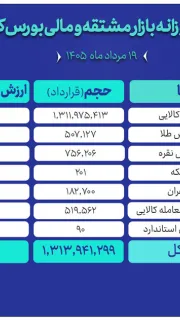
Iran Mercantile Exchange to host trading of 817,487 tonnes across its halls today
Iran's Mercantile Exchange (IME) is hosting trading of 817,487 tonnes of products across its halls on Tuesday, August 11, 2026 (20 Mordad 1405), according to the exchange's own report. The Kish export hall leads with 304,884 tonnes, including 125,200 tonnes of cement, 47,852 tonnes of bitumen, 40,000 tonnes of copper concentrate and 35,000 tonnes of iron ore concentrate. The cement hall is offering 201,354 tonnes of cement, the industrial hall 106,301 tonnes, mostly steel billets and sections, and the petrochemical hall 149,866 tonnes of polymer and oil products. The open auction hall is offering a further 51,340 tonnes, including steel slab and iron ore concentrate, while the secondary and simultaneous auction halls together carry under 4,000 tonnes.
Kalakhabar (Iran Mercantile Exchange)
Iran Mercantile Exchange's 12th Silver Fund, Silva, to Open Subscription Next Sunday
According to Iran's capital market news agency SENA, published Monday, 10 August 2026 (19 Mordad 1405), the Kalaye Padash investment fund, licensed by the Securities and Exchange Organization, will open subscription for units of its "Kalaye Padash 1" fund, trading under the symbol Silva (a silver metal fund), starting next Sunday on the Iran Mercantile Exchange's ETF market. The fund has 200 million standard units on offer, with secondary trading to begin once the subscription period ends and the fund is formally registered. Nine silver funds are currently trading on the Iran Mercantile Exchange: Plata, Siglo, Neghrefam, Neghresa, Neghrin, Neghran, Neghrabi, Simin and Silver. Counting the previously subscribed Neghrat and Sian funds and the addition of Silva, the number of silver funds on the exchange will reach 12, a trend that reflects steadily growing interest among Iranian investors in the metal.
Iran Capital Market News Agency (SENA)
Iran Mercantile Exchange Trades 415,525 Tonnes of Products, Industrial Hall Leads
The Iran Mercantile Exchange (IME) hosted trading of 415,525 tonnes of products across its various halls on Monday, 19 Mordad 1405 (August 10, 2026). According to Kalakhabar, the exchange's own news outlet, the industrial hall led the day's trading with 116,050 tonnes of hot rolled coil, 72,725 tonnes of bloom ingots, 85 tonnes of rebar and 790 tonnes of wire rod copper. The petroleum products hall traded 3,100 tonnes of sulfur, 2,501 tonnes of base oil, 54 tonnes of slack wax and 25 tonnes of bitumen, while the petrochemical hall hosted trading of 15,839 tonnes of polymer and chemical products. The cement hall recorded sales of 12,893 tonnes of cement. In the export hall, 50,000 tonnes of slab, 40,048 tonnes of cement, 63,264 tonnes of bitumen, 20,000 tonnes of bloom ingots, 11,700 tonnes of clinker and 254 tonnes of moisture insulation were traded.
Kalakhabar (Iran Mercantile Exchange)

Trump: In Response to Iran's Compensation Demand, US Will Seek Its Own Reparations Including for USS Cole Attack
US President Donald Trump said in a statement on Monday, 19 Mordad 1405 (August 10, 2026), that Iranian negotiators have been seeking compensation for damage from the five month war with the United States and Israel. According to Ecoiran, Trump wrote that the issue had never previously come up in talks or meetings between the two sides, but that he is now seeking compensation from Iran in return, for people he said were killed or badly wounded in attacks including roadside bombings and conflicts "originally led by General [Qasem] Soleimani," including the families of those killed in the USS Cole attack. Trump added that he has instructed US representatives to pursue the compensation claim seriously in any future negotiations with Iran. Donya-e-Eqtesad, citing ILNA, and Al Jazeera both carried the remarks the same day. The comments come as Iran and Oman continue talks over arrangements to reopen the Strait of Hormuz, and could become a fresh obstacle to resuming direct US-Iran negotiations.
Ecoiran

Iran Conditions Hormuz Reopening on Six US Demands
Iran said in a statement issued over the weekend of 17 to 18 Mordad 1405 (August 8 to 9, 2026) that it will only reopen the Strait of Hormuz if the United States meets six conditions: a full withdrawal of US forces from the region, a permanent peace agreement, compensation for war damage, and sanctions relief including the release of Iran's frozen assets. Oilprice.com reported on Monday, 19 Mordad 1405 (August 10, 2026), that accepting these terms would be politically costly for the Trump administration, making near term acceptance unlikely. The same day, Iranian Foreign Ministry spokesperson Esmaeil Baghaei said separately that reopening Hormuz depends on removing conditions he described as stemming from US and Israeli military aggression against Iran and the wider region. His remarks are distinct from Iran's separate, ongoing talks with Oman over technical shipping arrangements for the strait.
Oilprice.com
US Senator Murphy: I'm Ready to Back a 'Bad Deal' to End the War and Reopen the Strait of Hormuz
US Senator Chris Murphy, a senior Democrat, said Sunday, 18 Mordad 1405 (August 9, 2026), according to Tasnim (reflected by Donya-e-Eqtesad), that the cost of reopening the Strait of Hormuz is rising by the day, and that he is ready to support a "bad deal" to end the war with Iran because, in his view, the only option currently available is an "extremely bad and disastrous" one. Murphy said the United States has grown weaker and Iran stronger during the war, and that prolonging it keeps raising Washington's cost of reopening the strait. He described the deal reportedly on the table as one that would pay Iran $100 billion a year to reopen the strait. These figures and characterizations reflect the senator's own description of the proposed terms and have not been officially confirmed by the US or Iranian governments.
Donya-e-Eqtesad, citing Tasnim
Iran Mercantile Exchange's Weekly Commodity Deposit Certificate Trading Value Tops 8 Trillion Tomans
According to Kalakhabar, the Iran Mercantile Exchange's own news outlet, 7,583,000 commodity deposit certificates worth more than 8 trillion tomans were traded on the exchange in the week ending 16 Mordad 1405 (August 7, 2026). The report said investors in this market are turning to certificates beyond gold and silver, including saffron, copper, bitumen, rebar, and zinc and lead ingots. Kalakhabar also said the record for silver bullion deposits into the exchange's vault was broken during the same week.
Kalakhabar (Iran Mercantile Exchange)
Trump: US Only 'Semi Negotiating' With Iran, Waiting for Economic Pressure to Mount; Araghchi Denies Direct Talks
Al Jazeera reported on Monday, 19 Mordad 1405 (August 10, 2026), that US President Donald Trump said Washington is currently only "semi negotiating" with Tehran and will wait for economic pressure on Iran to build, describing the approach as "low keying it." In the same report, Iran's Foreign Minister Abbas Araghchi said there are no direct talks under way between Iran and the United States, and stressed that the Strait of Hormuz will not reopen until Washington meets Tehran's demands, including an end to the naval blockade. The remarks come amid weeks of indirect talks between Iran, Oman and the United States over shipping arrangements in the strait.
Al Jazeera

IME to Change Trading Hall Scheduling and Auction Method From August 22
The Iran Mercantile Exchange's physical market operations management issued a notice Sunday, 18 Mordad 1405 (August 9, 2026), announcing changes to the separation, order scheduling and start times of its trading halls. According to IME's news outlet Kalakhabar, the changes to hall separation, order timing and the auction method take effect Saturday, 31 Mordad 1405 (August 22, 2026). Full details on which halls are affected are to be announced in the exchange's official notice.
Kalakhabar
Iran Mercantile Exchange Extends Financial Markets Closing Time to 18:00
The Iran Mercantile Exchange (IME) said in a notice published Sunday, 18 Mordad 1405 (August 9, 2026), that it is extending the closing time of its financial markets. According to IME's own news outlet Kalakhabar, citing the exchange's derivatives and new financial instruments management, trading in commodity funds, commodity deposit certificates, standard parallel salaf bonds and options contracts will close at 18:00 starting Sunday, 25 Mordad 1405 (August 16, 2026), an hour later than the current 17:00 close.
Kalakhabar
Axios: Trump Chooses Economic Pressure Over Broad War With Iran as Tehran Sets New Conditions for Reopening Strait of Hormuz
Axios reported, as relayed by Donya-e-Eqtesad on Sunday, 18 Mordad 1405 (August 9, 2026), that US President Donald Trump told the outlet in a brief call that Washington is moving quietly for now and negotiating with Iran only to a limited extent, choosing to let economic pressure on Tehran build rather than ordering a return to broad war. He said Iran is economically "in very bad shape" and cannot pay its military, and that the US naval blockade has deepened that crisis. Trump also claimed that oil's drop to just over $75 a barrel has eased the cost of the war for American consumers. According to the same report, Qatari and Pakistani mediators had earlier expected a US-Iran deal on shipping through the Strait of Hormuz to be announced on Wednesday, 14 Mordad, but the outlook has since dimmed. On Saturday, 17 Mordad, Mohammad-Baqer Zolghadr, then secretary of Iran's Supreme National Security Council, set out a new list of conditions for fully reopening the strait, beyond the proposed arrangement with Oman: an end to any threats or insults toward Iran, a permanent end to the war against Iran and its allies in Lebanon, Gaza, Yemen and Iraq, lifting the naval blockade and withdrawing US forces from around Iran, full compensation for war damages, and lifting sanctions with the unconditional release of Iran's frozen assets. Separately, Al Jazeera, citing informed sources, reported that Tehran is awaiting a formal US commitment to lift the port blockade and suspend sanctions.
Donya-e-Eqtesad, citing Axios
Head of Iran's Expediency Council: Iran Will Not Retreat From the Strait of Hormuz
Sadeq Amoli Larijani, head of Iran's Expediency Discernment Council, said on Sunday, 18 Mordad 1405 (August 9, 2026), at a council session, that Iran would not retreat from the Strait of Hormuz at any price and that conditions in the waterway would not return to their pre-war state. According to Ecoiran, citing the Mehr news agency, he added that Iran's armed forces and people "stand at the Strait of Hormuz" and that sovereignty over the waterway belongs to the Islamic Republic; he said free passage for ships is conditional on the other side accepting the terms of the memorandum of understanding. The remarks came the same day Iranian Foreign Minister Abbas Araghchi said talks with Oman over designating a new transit route through the Strait of Hormuz are in their final stage, though he said a full reopening remains conditional on the United States making up for what Tehran calls violations of an earlier memorandum. The strait carries a large share of Persian Gulf oil exports, and any signal about its future affects global oil prices and Iran's currency market.
Ecoiran, citing Mehr News Agency
Copper Tops Iran Mercantile Exchange Physical Trading Value for Second Straight Week at 12,889 Billion Tomans
Copper topped the weekly trading value table on the Iran Mercantile Exchange's physical market for a second consecutive week in the week ending August 7, 2026 (16 Mordad 1405), even as the number of trading days fell to four, recording 12,889 billion tomans in value, Boursenews reported. Blister bloom copper ingots followed with 8,549 billion tomans and iron ore pellets with 5,625 billion tomans. By volume, cement remained the most heavily traded commodity at 1,105,000 tonnes, with iron ore pellets and concentrate in second and third place. The rise in copper's trading value comes as global copper prices have climbed to fresh records in recent weeks.
Boursenews
Subscription for Iran's 11th Silver Investment Fund "Cyan" Opens, Draws 200 Billion Tomans in First Minutes
Subscription for Iran's 11th silver investment fund, traded under the symbol Cyan on the Iran Mercantile Exchange, opened on Sunday, August 9, 2026 (18 Mordad 1405) and will run for three trading days. According to IME Report, the fund drew strong investor interest in its opening minutes, raising 200 billion tomans. Silver investment funds on the commodity exchange give retail investors indirect exposure to the metal, and the launch of an eleventh such fund reflects continued growth of this market in Iran.
IME Report