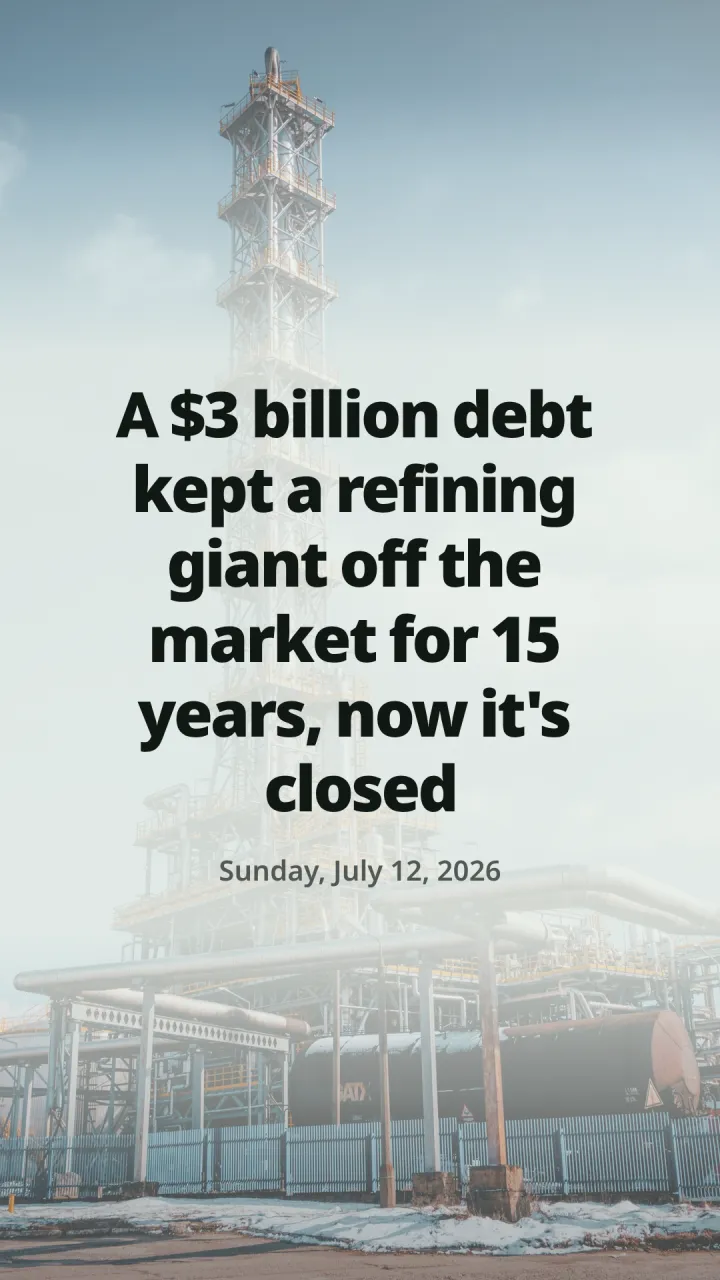
The CEO of TAPICO (Tamin Petroleum and Petrochemical Investment Company) says the multi-billion-dollar foreign-currency (FX) debt of Persian Gulf Star Oil Company has been closed after roughly 15 years, and the refinery is now "one step" from an initial public offering (IPO). TAPICO holds 49% of this plant, the world's largest gas-condensate refinery, so removing the main obstacle to the Persian Gulf Star listing is tied directly to this holding company's investment case. The PTAP symbol traded at 2,962 tomans (29,620 rials) on Sunday, July 12, 2026, down about 2.98% from the previous session (TAPICO price page on Sahmino, updated July 12, 2026).
Background: a debt that grew every year
Persian Gulf Star Refinery in Bandar Abbas, one of Iran's largest national projects of recent years, was built in three phases and today processes between 360,000 and 420,000 barrels of gas condensate per day. According to the complex's managers, it supplies more than 40% of the country's gasoline and delivers roughly $14 billion a year in FX savings for the country (Shana, quoting the CEO of the Social Security Investment Company, August 6, 2024).
But this asset's Achilles heel was not operating profitability; it was the financial structure. A large share of the construction funding came from FX facilities: loans against the central bank's FX deposits held at Naftiran (Niko), the National Development Fund, the Oil (Energy) Fund and the FX Reserve Fund, with Bank Mellat and Bank Tejarat acting as agents. The problem was that the debt was denominated in foreign currency, so every jump in the exchange rate enlarged its rial value: a floating liability that grew heavier year after year. This FX debt, reflected in Persian Gulf Star's recent financial statements at about $3 billion, was for years considered the main obstacle to listing the company's shares.
Key figures
The most important numbers in this file, each with its date and source:
| Metric | Value | Date / source |
|---|
| TAPICO share price (PTAP) | 2,962 tomans, down 2.98% | July 12, 2026 / Sahmino prices |
| TAPICO stake in Persian Gulf Star | 49% | Shana and TAPICO AGM report |
| Other shareholders | Oil-industry pension fund 34.5%, government 17.5% | Shana, August 6, 2024 |
| Persian Gulf Star FX debt | about $3 billion | Persian Gulf Star recent financials |
| Estimated refinery value | more than $8 billion | TAPICO CEO |
| Initial construction investment | about $3.4 billion | Shana, August 6, 2024 |
| TAPICO six-month profit | more than 2,700 billion tomans | 1405 interim reports |
Last year the TAPICO CEO described the refinery's value at more than $8 billion, which at the exchange rate of that period was equivalent to roughly 780 trillion tomans (780 hemmat); this should be read as a management estimate, not a price discovered in the market. The exact value becomes clear only once the offering takes place and the price is discovered on the board.
Drivers: why closing the debt file matters
The mechanism is simple but decisive. As long as the debt stayed in foreign currency, every weakening of the rial worsened Persian Gulf Star's balance sheet and ate into its net worth, an uncertainty that both locked the IPO and cast a shadow over the valuation of TAPICO's stake. According to the TAPICO CEO, part of these facilities, including the Niko loan and Energy Fund resources, has been settled, and for the remaining debt, coordination to convert FX into rials is under way. Converting the FX debt into rial debt "locks" that variable financial burden: it no longer grows with each dollar spike and takes on a fixed figure that can be reflected in the financial statements and in the offering price.
For TAPICO, this means that a 49% stake in an asset that has until now been carried in the portfolio largely at book value could, upon an offering, move closer to market value. This is the same logic we have examined before with listed refiners; for example, in our report on refinery valuations on the Tehran Stock Exchange we showed that the market sometimes prices refining assets at a substantial discount to replacement cost. These refiners' profitability is also tied to the refining margin, the crack spread we track on the commodity and energy price board.
Valuation: what the market is pricing
A simple valuation frame helps. TAPICO is an investment holding company, and its value derives mainly from the sum of the values of its subsidiaries; that is why the common yardstick for such companies is price to net asset value (P/NAV). Based on the latest published NAV of about 3,767 tomans per share, the current price of 2,962 tomans means it trades at roughly 79% of NAV, that is about 21% below net asset value. This discount to NAV is common in holding-company shares and does not by itself prove a stock is "cheap" or "expensive"; the point is that part of this NAV rests on an asset like Persian Gulf Star that still has no market price and is carried at an estimated value.
In other words, an IPO of Persian Gulf Star would do two things at once: first, it removes the debt uncertainty; second, it turns a large part of TAPICO's NAV from an "estimate" into a "discovered price." How much of this possibility the market already reflects in the price today is a question with no definitive answer, but any news that sharpens the timing and terms of the offering feeds directly into this calculation.
Outlook
This section is estimate and scenario, not settled fact. The Persian Gulf Star IPO has been promised for years and repeatedly postponed, so "one step from an offering" should be read with caution. Even assuming the debt is fully resolved, the exact timing of the offering, the free-float percentage and the pricing method remain unclear, and each could affect TAPICO differently. Alongside Persian Gulf Star, TAPICO has several other subsidiaries queued for offering, noted in its 1404 (2025) AGM report. The cautious conclusion: resolving the debt is a real and positive step for the transparency of this file, but turning it into realized return for the shareholder depends on the offering being executed and on its terms.
What to watch
To follow this file, these signals matter: official notices from the Securities and Exchange Organization and the over-the-counter market on admitting and timing the Persian Gulf Star offering; disclosure of Persian Gulf Star's audited financial statements and how the FX-to-rial debt conversion is reflected in them; decisions on refinery feedstock pricing, which directly affects profitability; and TAPICO's own AGM and interim reports. This report is an educational and informational analysis and is not a recommendation to buy or sell any share; the investment decision, relying on official sources and professional advice, belongs to the investor.