The price of a 50-kilogram bag of Tehran cement, which had jumped 33.5 percent from 218,000 tomans to 291,000 tomans in the first two weeks of Mordad (late July to early August 2026), has held at that same 291,000 tomans from August 7 through today, Thursday, August 13, 2026 (22 Mordad 1405). At the same time, Iran's Statistics Center reported that the quarterly growth rate of Tehran's residential construction input price index eased to 20.7 percent in spring 1405, nearly half the prior quarter's 36.0 percent, even as the index's annual growth rate climbed to 80 percent.
Background
Sahmino reported on August 7 that the Tehran cement bag price had jumped 33.5 percent in two weeks and that the "bag premium" (the gap between retail price and the price discovered on the Iran Mercantile Exchange, IME) had doubled at most producers (Sahmino's August 7 report). Before that, on August 2, the same item had been roughly 14 percent cheaper than it was in early July (Sahmino's August 2 report). In other words, Tehran's cement market has run a full cycle in the past month: down, then up, and now flat. The volatility traces back to electricity rationing and gas cuts at cement and steel plants in June and July, which had tightened supply (Sahmino's July report).
Key numbers
| Item | Price | Date | Source |
|---|
| Tehran cement, 50kg bag (retail) | 291,000 tomans (unchanged since Aug 7) | Aug 13, 2026 | Sahmino price tracking |
| Saveh cement, 50kg bag (retail) | 260,000 tomans | Aug 13, 2026 | Sahmino price tracking |
| Abyek cement, 50kg bag (retail) | 289,000 tomans | Aug 13, 2026 | Sahmino price tracking |
| Type 2 (42.5) bagged cement, IME-discovered price | about 197,500 tomans (39,495.79 rials/kg) | Aug 11, 2026 (last session) | Iran Mercantile Exchange, Sahmino tracking |
| Rebar A3, 14 to 20mm, IME-discovered price | about 67,563 tomans/kg (675,629 rials) | Aug 11, 2026 (last session) | Iran Mercantile Exchange, Sahmino tracking |
| Aryan Foolad 14mm A3 rebar (factory) | 68,640 tomans/kg | Aug 13, 2026 | Sahmino price tracking |
Setting these two rows side by side tells two different stories. The gap between Tehran's retail cement price (291,000 tomans) and the IME-discovered price for the same bag (about 197,500 tomans) is still close to 47 percent, the same "bag premium" reported a week ago, and it has not closed. In rebar, the gap is far smaller: Aryan Foolad's factory price for 14mm bar runs only about 1.6 percent above the IME-discovered price for a comparable size. In other words, prices no longer climbing in cement does not mean the premium has closed; it only means the premium has stopped growing.
Iran's Statistics Center, in a report released on August 10, 2026 (19 Mordad 1405), put Tehran's residential construction input price index at 336.4 for spring 1405. Quarterly inflation (versus winter) was 20.7 percent, against 36.0 percent the prior quarter, a deceleration of 15.3 percentage points. But point-to-point inflation (versus spring 1404, the same season a year earlier) rose to 106.8 percent, and annual inflation (the trailing four quarters) rose to 80.0 percent, both higher than the prior quarter. Among the index's component groups, "building painting" led quarterly inflation at 64.9 percent while "machinery rental" trailed at 10.8 percent; "wood" led both point-to-point (208.9 percent) and annual (155.8 percent) inflation.
Drivers
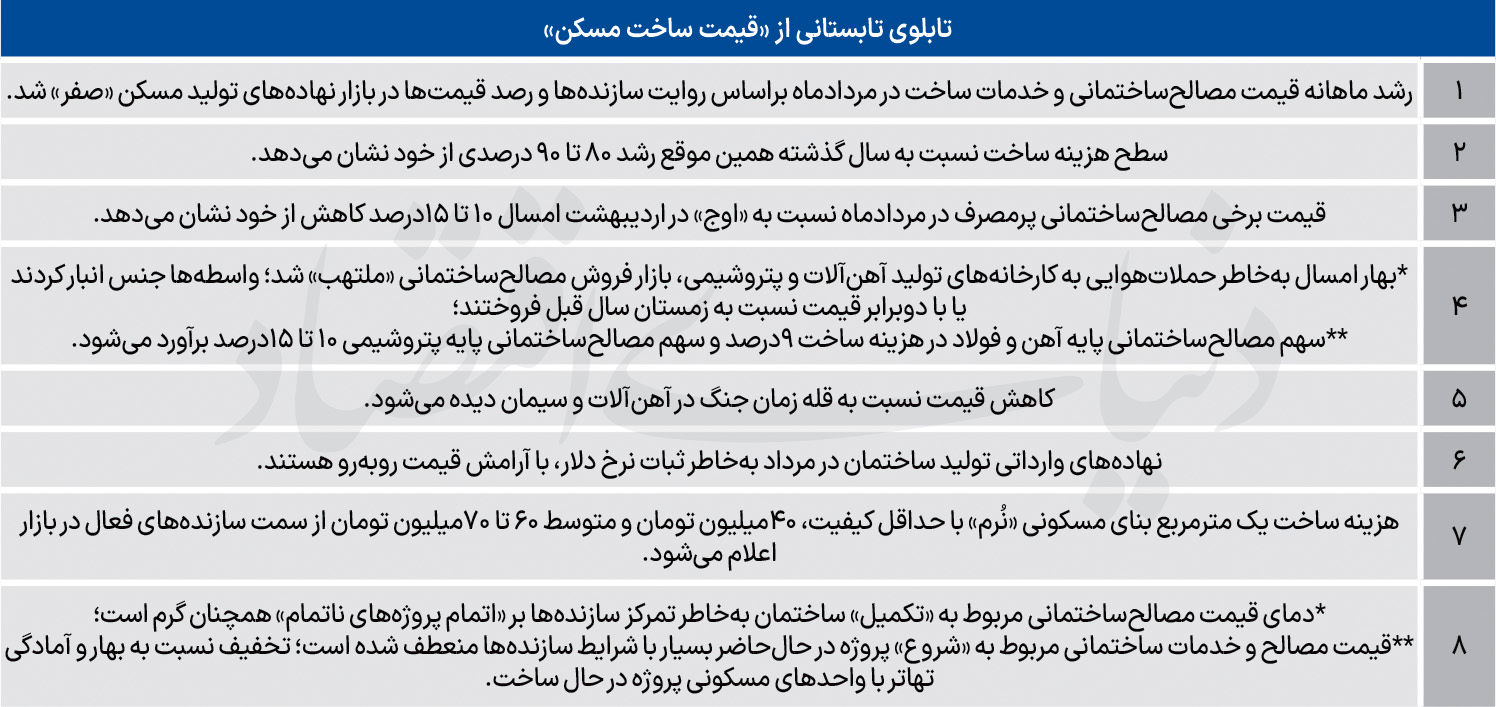
Donya-e-Eqtesad, in a field report published Sunday, August 9, 2026 (18 Mordad 1405), quoted Tehran and metro-area homebuilders as saying the month-on-month growth in mostly domestically produced construction material prices hit "zero" in Mordad versus Tir, and that rebar and cement prices for the "start of construction" phase have fallen 5 to 10 percent from their mid-spring peak. The paper identified three reasons for the calm: the end of the psychological uncertainty from the 40-day war that had targeted steel and cement plants, a halt in exports of some construction materials, and the relative stability of the free-market dollar in recent weeks, which has held down the cost of imported building equipment.
Donya-e-Eqtesad also noted the market is two-speed: materials for the "start" phase are being discounted, even bartered for finished housing units, but heavy demand from unfinished projects racing to complete has so far kept "completion" phase materials from following suit.
Outlook
Builders quoted by Donya-e-Eqtesad cautioned against calling Mordad's price stability durable, given how sharply political and currency risk can still move prices. The IME has not held a fresh cement or rebar session since August 11; its next auction after the Mordad holidays will be the next test of whether the calm holds.
Bottom line
Tehran's cement bag price has not moved in a week, and the monthly rise in start-phase materials has effectively stopped in Mordad, but that pause is not the same as getting cheaper. Builders still put the cost of building a square meter of housing in Tehran 80 to 90 percent above a year ago, the Statistics Center's own construction input index has its annual growth rate at 80 percent, and the gap between cement's retail price and its IME-discovered price is still close to 47 percent. What changed is the pace of the increase, not its level.
What to watch
- The IME's first cement and rebar session after the Mordad holidays, and whether the discovered price holds as flat as the retail market has.
- Whether the free-market dollar's recent stability continues, one of builders' three cited reasons for the materials market's calm.
- The Statistics Center's next quarterly construction input report, which will show whether spring's slower quarterly pace continues.