
Tether's Real Return After 83% Inflation: The Brutal 12-Month Math to July 2026
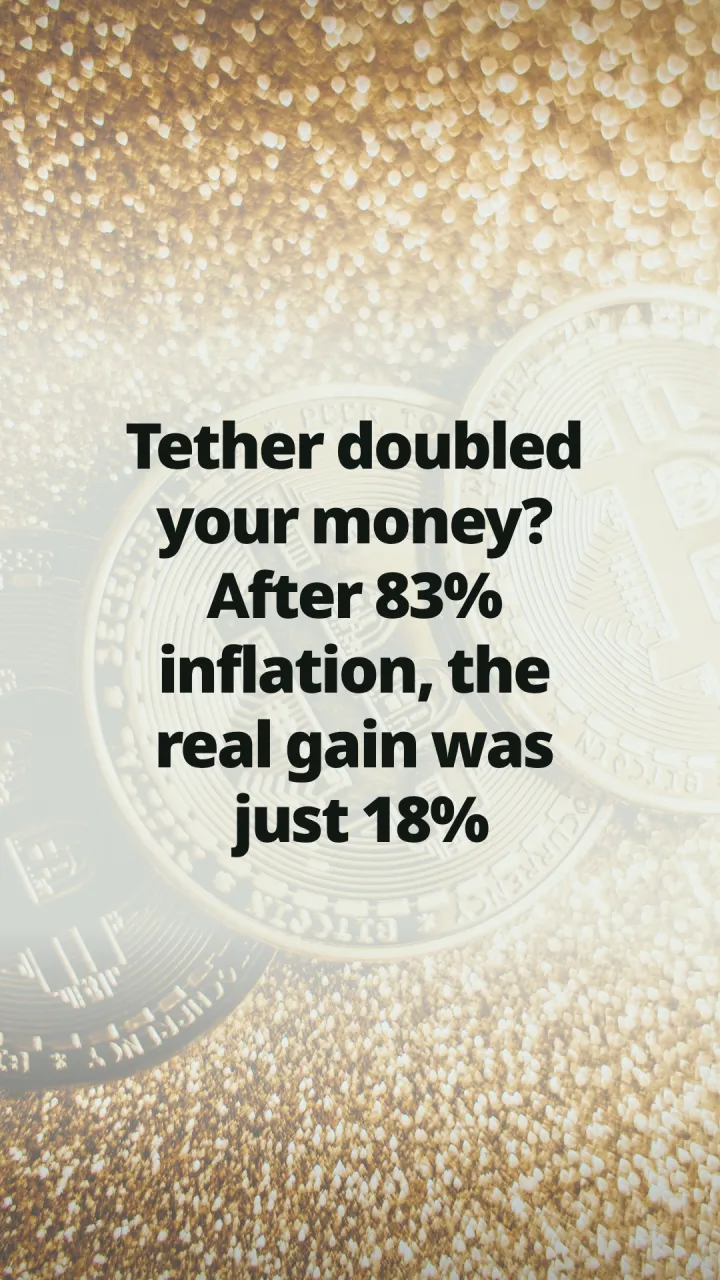
Over the twelve months to mid-July 2026, Tether roughly doubled Iranian holders' money (a nominal return near 117 to 121 percent). But after the central bank's 83 percent year-on-year inflation, its real gain shrank to about 18 percent. In the same window melted gold and the Emami coin returned more in real terms, while cash and bank deposits were heavy losers to inflation. A dated, brutal accounting.
Related video
Millions of Iranians treat Tether as a "digital dollar," a shield against the rial's slide and against inflation. The logic is simple: the toman price of one Tether is roughly the live free-market dollar rate times one global dollar, which always stays near one dollar. So when the dollar rises, Tether's toman value rises with it. But the real question is not "how many tomans did Tether reach," it is "how much did your purchasing power actually grow." That gap is the line between nominal and real return, and when year-on-year inflation has passed 83 percent, the line turns brutal.
In this analysis we run the brutal math: Tether's twelve-month nominal return in tomans, its real return after stripping out inflation, and a head-to-head comparison with melted gold, the Emami coin, holding cash, and a one-year bank deposit. Every figure is dated. This is not buy or sell advice; the only goal is to clarify a calculation that is too often ignored.
Why Iranians buy Tether
Tether (USDT) is a stablecoin: a cryptocurrency whose global value is pegged to the US dollar and stays near one dollar. For an Iranian user the appeal is nothing more than fast, around-the-clock access to a "dollar" without physical banknotes. When political or military uncertainty rises, demand for Tether jumps and its toman price reacts before the official currency market. The market is large: per Chainalysis, crypto volume attributed to Iran in 2026 was near 8 billion dollars, and the firm TRM puts the figure closer to 10 billion dollars. For a plain-language primer on what Tether is and why it became Iran's digital dollar, Sahmino's crypto lessons are a good starting point.
Nominal return: how many tomans did Tether reach in twelve months?
We take the starting point at roughly 15 July 2025 (24 Tir 1404). That day one Tether was about 88,310 tomans (per Fararu, 24 Tir 1404) and the free-market dollar sat around 88,800 tomans (Eghtesad News, 24 Tir 1404).
One year later, in the second half of Tir 1405 (mid-July 2026), Tether set fresh records. Nobitex reported that Tether hit 195,499 tomans on 26 Tir 1405 (17 July 2026), a new price record. In the same window the free-market dollar reached a record near 194,500 tomans (27 to 28 Tir 1405). The final prints of Tir 1405 were a little lower: Tether around 192,995 tomans on 28 Tir 1405 and about 192,416 tomans on 29 Tir 1405. You can follow the live Tether price on Sahmino's Tether page.
If we take the sell point at around 192,000 tomans, Tether's twelve-month nominal return is about 117 percent; at the 195,500 record it reaches about 121 percent. In other words, your money roughly doubled. It looks like a big number, but it is not the whole story.
The real-return formula, and why inflation changes everything
Nominal return says how many times your account balance grew; real return says how much your purchasing power changed. The correct relationship is not simple subtraction, it is division:
Real return ≈ ((1 + nominal return) ÷ (1 + inflation)) minus 1
Now we plug in inflation. The Central Bank of Iran put point-to-point (year-on-year) inflation at the end of Khordad 1405 at 83.1 percent and annual (average) inflation at 57.7 percent. The difference matters: annual inflation (57.7%) is the average price growth over the twelve months to Khordad 1405 versus the prior twelve months, while point-to-point inflation (83.1%) says how much more expensive the household basket was in June 2026 than in June 2025. Because we measure an asset's return from one point in time to another, the point-to-point figure is the more accurate yardstick.
The Statistical Center of Iran reported higher figures: point-to-point inflation for Khordad 1405 near 88.6 percent and annual inflation near 62 percent. If we use that higher number, the real return shrinks further still.
The 100-million-toman example
Suppose on 24 Tir 1404 (15 July 2025) you bought Tether with 100 million tomans (at 88,310 tomans each), that is about 1,132 units of Tether.
- If you sold in Tir 1405 near the record (around 192,000 tomans each), your nominal asset value would be about 217 million tomans; a nominal return near 117 percent.
- But with 83.1 percent point-to-point inflation, that same 217 million tomans is worth only about 119 million tomans in Tir 1404 purchasing power; a real return of roughly positive 18 percent.
- If we use the Statistical Center figure (88.6%), real purchasing power is about 115 million tomans and the real return is roughly positive 15 percent.
The brutal part is in the "timing of the sale." If you had sold the same holding a few weeks earlier, at the end of Khordad 1405 (when Tether was around 159,000 tomans), your cash value would be about 180 million tomans and the nominal return about 80 percent; a figure that lags 83 percent inflation and pushes the real return to near zero or slightly negative. So much of Tether's "gain" in this particular period came from the dollar's jump in the final weeks, not from steady growth.
Head-to-head: Tether, melted gold, coin, cash, and deposit
To see how Tether did against the alternatives, we line up the twelve-month return of several assets from roughly 24 Tir 1404 to roughly 30 Tir 1405 (21 July 2026). Ending prices are from the Sahmino price feed (30 Tir 1405) and year-ago prices from dated sources.
| Asset | Start (24 Tir 1404) | End (30 Tir 1405) | Nominal return | Real return (83.1% inflation) |
|---|---|---|---|---|
| Melted gold, cash (per mesghal) | 30,641,000 tomans | 79,353,000 tomans | about +159% | about +41% |
| Emami coin | 81,160,000 tomans | 185,990,000 tomans | about +129% | about +25% |
| Tether / free-market dollar | 88,310 tomans | about 192,000 tomans | about +117% | about +18% |
| One-year bank deposit | set rate 20.5% | n/a | 20.5% | about −34% |
| Holding cash (toman) | n/a | n/a | 0% | about −45% |
Hold those numbers in mind. Tether preserved the money's value and even edged ahead, but holding cash and a bank deposit were both heavy losers to inflation last year: cash lost about 45 percent and a one-year deposit about 34 percent of their purchasing power. This is the "negative real interest rate" that becomes unavoidable when the bank rate is 20.5 percent and inflation is above 80 percent. Live prices for all these assets are available in the Sahmino prices section.
The drivers: why gold outran the dollar
The most important finding of this comparison is this: over these twelve months, gold outran the dollar and Tether. Melted gold, with a nominal return near 159 percent, and the Emami coin, near 129 percent, both beat Tether and the dollar (near 117 percent). After adjusting for inflation, melted gold's real return was about 41 percent, the coin about 25 percent, and Tether about 18 percent.
The mechanism is clear: in this period both the global gold price jumped and the toman dollar rose, so domestic gold drew on two engines of gain, while Tether was tied only to the toman-dollar engine. The global gold ounce crossed 4,000 dollars for the first time in 2025 and rose about 54 percent that year, its strongest annual gain since the 1979 oil crisis; and as of 30 Tir 1405 (21 July 2026) it traded near 4,063 dollars (Yahoo Finance).
This means the common narrative that "Tether is the best inflation shield" did not hold in this particular window; Tether preserved value, but gold did better. For a technical comparison of melted gold and the coin and which carries a smaller premium, and for a basic look at the household asset mix, see Sahmino's lessons.
Tether's hidden risks that do not show on the price chart
Real return is only half the story. Tether carries risks invisible in its toman price:
First, the freeze capability. Tether can block any wallet at the smart-contract level. In 2026 the United States used this lever extensively. Per a Chainalysis report (16 July 2026), Tether has frozen nearly 475 million dollars from wallets that OFAC deemed to belong to Iran's central bank. The latest action came on 23 Tir 1405 (14 July 2026): OFAC added four Tron-network wallets attributed to Iran's central bank to the sanctions list (announced by US Treasury Secretary Scott Bessent), and per CoinDesk those wallets had received more than 165 million dollars in stablecoins, of which Tether immediately blocked about 131 million. Earlier, in Farvardin 1405 (April 2026), Tether had frozen more than 344 million dollars on two other wallets. These moves are part of a campaign called Operation Economic Fury, which, per Bessent, had seized roughly one billion dollars of Iranian crypto assets by May 2026 (per Decrypt).
Second, central-bank caps. On 5 Mehr 1404 the Central Bank of Iran set an annual stablecoin purchase cap of 5,000 dollars per national ID and a holding cap of 10,000 dollars. Legally, then, Tether is no longer an unlimited tool for capital flight.
Third, exchange risk. On 28 Khordad 1404 (18 June 2025) the exchange Nobitex was hacked. Estimates vary: per crypto.news, TRM, Chainalysis, and Elliptic all put the loss near 90 million dollars, while the independent analyst ZachXBT calculated at least 81.7 million. Then on 12 Khordad 1405 (2 June 2026), OFAC sanctioned four large Iranian exchanges, namely Nobitex, Wallex, Bitpin, and Ramzinex; Nobitex alone had processed more than 50 percent of Iran's digital-asset inflow in 2025.
Together these risks mean: Tether may hold its toman value, but your access to that value is not guaranteed.
Bottom line
The brutal math has a clear conclusion: over the past twelve months Tether roughly doubled your money (a nominal return near 117 to 121 percent), but after 83 percent point-to-point inflation its real gain shrank to about 18 percent and was highly sensitive to the sale date. In the same window melted gold and the coin delivered more in real terms, while holding cash and a bank deposit were heavy losers to inflation. Tether preserved value, but neither better than gold nor without the hidden risks of freezing and sanctions. This is not buy or sell advice; every decision depends on your own time horizon, risk tolerance, and liquidity needs.
What to watch
- Point-to-point inflation for Tir and Mordad 1405 (central bank and Statistical Center), which sets the floor of every asset's real return.
- The gap between the Tether rate and the free-market and agreed (tavafoqi) dollar, a thermometer of capital-flight demand.
- Fresh OFAC and Tether actions freezing Iran-linked wallets, and their effect on access risk.
- The global gold ounce around the 4,000-dollar line, one of the two engines of domestic gold's return.
FAQ
What is the difference between nominal and real return?
Nominal return is how many times your account balance grew; real return is how much your purchasing power changed after inflation. With inflation above 80 percent, a 117 percent nominal return can melt to a real return near 18 percent.
Why did we use point-to-point inflation, not annual?
Because we measure an asset's return from one point in time to another. Point-to-point inflation (83.1% for Khordad 1405 per the central bank) measures exactly that change, while annual inflation (57.7%) is the full-year average.
Is Tether the safest way to hold dollars?
Tether gives fast access to dollar value, but it carries risks banknotes do not: wallet freezes by Tether, sanctioned exchanges, and legal central-bank caps. Its safety is not absolute.
Sources
- 1Central Bank of IranPoint-to-point inflation for Khordad 1405 at 83.1 percent, annual inflation 57.7 percentCited Jul 22, 2026
- 2FararuOne Tether about 88,310 tomans, 24 Tir 1404 (15 July 2025)Cited Jul 22, 2026
- 3Yahoo Finance · Yahoo FinanceGlobal gold ounce near 4,063 dollars as of 21 July 2026Cited Jul 22, 2026
- 4CoinDeskTether blocked about 131 million dollars linked to Iran's central bank wallets; 14 July 2026Cited Jul 22, 2026