
The iPhone 18 Pro Equals About 17 Months of Iran's 1405 Minimum Base Wage, and 11.5 Grams of Gold; 94% of Its One-Year Rial Price Rise Was the Exchange Rate (Thursday, 10 September 2026)
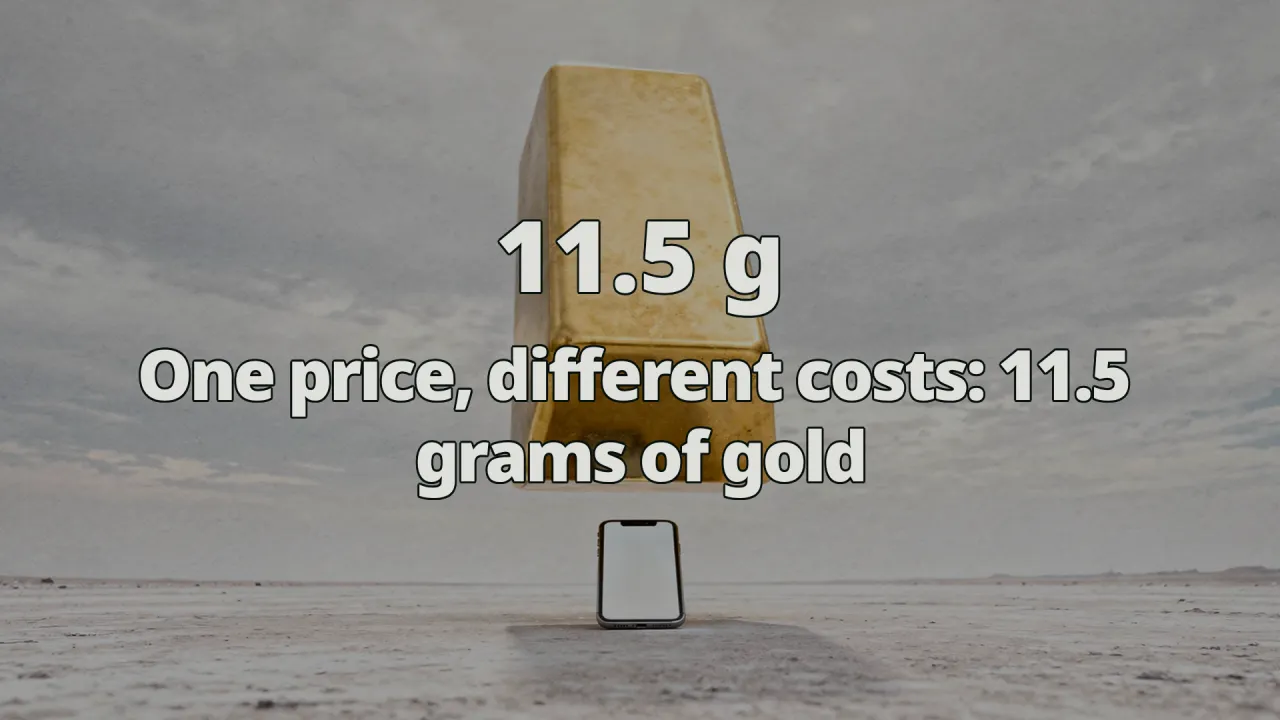
At Apple's official 1,199 dollars and the free-market dollar of 232,700 tomans recorded on 9 September 2026, the 256GB iPhone 18 Pro converts to 278.9 million tomans: about 16.8 months of Iran's 1405 minimum base wage, roughly 3,220 working hours, and 11.5 grams of 18-karat gold. Of its 168 million toman one-year rise, about 94% came from the exchange rate and about 6% from Apple's pricing decision.
Related video
How many months of your income does the new iPhone cost? Despite appearances, that question is not about a phone. A dollar-priced good whose global price is the same for everyone becomes a measuring stick for the purchasing power of a national currency. And the answer, for a minimum-wage worker, an office employee, a business owner and an investor, is four completely different numbers.
The short answer
The basis of the calculation is a raw currency conversion. The 256GB iPhone 18 Pro was launched on 9 September 2026 at an official 1,199 dollars, and at the free-market dollar of 232,700 tomans recorded in Sahmino's own time series that same day, it comes to 278,947,000 tomans. (One toman equals ten rials; the free-market dollar, «دلار آزاد», is the openly traded street rate, distinct from the Exchange Centre's remittance rate.)
One warning before any figure: this is not the Iranian retail price. It is the absolute floor of the calculation, and passenger-import costs, handset registry fees, the seller's margin and currency risk sit on top of it separately. Every number that follows is built on that floor.
Now divide those 278,947,000 tomans by monthly income:
- 16,625,000 tomans (the 1405 minimum base wage): about 16.8 months
- 30 million tomans: about 9.3 months
- 50 million tomans: about 5.6 months
- 100 million tomans: about 2.8 months
- 200 million tomans: about 1.4 months
- 500 million tomans: about 17 days
- 1 billion tomans: about 8 days
This index does not show real affordability, because no household sets aside its entire income; rent, food and transport come out of the same figure. What it measures is the ratio of a global good to monthly income, not the capacity to save.
The minimum-wage worker: about 17 months, 3,220 hours, 440 working days
Under the Supreme Labour Council's resolution at session 341 of 15 March 2026, Iran's daily minimum wage for the year 1405 was set at 5,541,850 rials and the monthly base wage at 166,255,500 rials, that is 16,625,000 tomans: a 60% increase on the previous year, as reported by the newspaper Donya-e-Eqtesad on 10 September 2026. Allowances such as the housing and food subsidies are separate from this figure.
If a minimum-wage worker set aside the whole base wage and in that period paid no rent, bought no food and made no journeys, they would reach this phone in about 17 months: close to a year and a half of life in which not a single rial was spent. The same figure can be written in units of work. At 192 legal working hours a month (44 hours a week), the hourly wage is about 86,600 tomans, and the phone equals roughly 3,220 hours of work, that is about 440 full working days.
Background: one year, two dated ends
The gap between the two launches is exactly one year, and both ends of it are announced and dated. The 256GB iPhone 17 Pro started at 1,099 dollars on 9 September 2025, and the iPhone 18 Pro at the same capacity started at 1,199 dollars on 9 September 2026: a difference of 100 dollars, about 9.1%.
In that same year, another end moved that has nothing to do with Apple. On Sahmino's time series, the free-market dollar stood at 100,830 tomans on 9 September 2025 and at 232,700 tomans on 9 September 2026: a rise of 131,870 tomans, equal to 130.8%. Both figures come from one series and one source, and both are dated to that year's launch day. You can follow the daily rate on Sahmino's US dollar price page; our latest record, at 16:59 on 10 September 2026, is 235,975 tomans.
The drivers: about 6% Apple, about 94% the dollar
Multiplying the two produces the rial figure. The iPhone 17 Pro on its launch day equalled 110,812,000 tomans, and the iPhone 18 Pro on its launch day equals 278,947,000 tomans: a difference of 168,135,000 tomans, a rise of 151.7%.
Now separate the two drivers. Had the dollar stayed at last year's 100,830 tomans, the iPhone 18 Pro at its new dollar price would have cost 120,895,000 tomans; so Apple's pricing decision on its own added about 10 million tomans and the dollar's move added about 158 million. The exchange rate's share of the total rise is about 94%, Apple's about 6%. This is what economists call imported inflation and exchange rate pass-through: the global price of the good barely moved, and what changed was our unit of measurement.
The simplest way to see it is to change the unit. A gram of 18-karat gold cost 8,850,000 tomans on 9 September 2025 and 24,342,000 tomans on 9 September 2026 (both from Sahmino's time series, followable on the 18-karat gold price page). Dividing the phone's price by the gold price on those same dates gives a result consistent with the rial story but shaped very differently: the iPhone 17 Pro equalled 12.5 grams of gold, and the iPhone 18 Pro equals 11.5 grams, about 8.5% less. In tomans it is 151.7% dearer; in gold it is slightly cheaper. The good is roughly the same; the ruler changed.
Inflation and the real wage
That ruler has shortened across the whole economy. Per the Statistical Centre of Iran's consumer price index report for Mordad 1405 data, reflected in the press on 10 September 2026, the index rose 3.4% month on month, point-to-point inflation reached 89% and annual (twelve-month average) inflation 69.9%; point-to-point inflation for the food and beverages group was 127.5%.
The simple consequence: the nominal wage rose 60% while the general price level rose 89%, so the minimum-wage worker's real wage shrank by about 15% in a year. Measured against the food basket, which is a larger share of a low-income household's spending, that fall reaches about 30%. Iran's labour minister said in September that the 60% wage rise had not fully offset the pressure on living costs and that a wage committee is being formed to review it; no new figure has been approved to date.
If you can afford the iPhone: the question is opportunity cost
For someone with 279 million tomans on hand, the question is no longer whether they can. It is what that money would have built elsewhere: a business, the stock market, gold, currency, a deposit, education or the tools of production. That is opportunity cost, and in an economy with 89% point-to-point inflation it is a serious number.
But the conclusion "therefore do not buy" does not follow from that arithmetic. The distinction between consumption and productive consumption sits exactly here: if the phone is a work tool and earns income through content production, commercial photography and video, online selling, client contact or access to artificial-intelligence tools, then buying it is an investment decision and must be weighed against the forgone return, not against its price. The break-even is simple: to pay for itself within a year it must generate about 23,250,000 tomans of direct monthly income, close to 1.4 times the 1405 minimum base wage. That is a yardstick, not advice.
What an investor reads in the price of an iPhone
For an investor the iPhone is an indicator, not an asset. Its rial price is almost entirely a function of the exchange rate, so its movement says nothing about the phone and a great deal about the rial. A 151.7% rise in a good's rial price does not mean a 151.7% return on investing in it: consumer electronics depreciate, are made obsolete by the next generation, resell at a meaningful discount, and unlike gold or currency are not a capital asset. The iPhone is not an inflation hedge; it is an inflation gauge.
An index comparison with the European Union
One comparison, with a methodological warning that must be stated plainly. Per Eurostat, average hourly labour cost in the European Union in 2025 was 34.9 euros, and 38.2 euros in the euro area. That figure is not a European employee's net salary: it is the hourly cost of labour to the employer, about 24.8% of which is non-wage components such as the employer's social contributions. So it must not be translated into "what a European could buy with this money".
With that caveat, the question becomes an index one: what is the economic value of the same number of working hours at European Union scale? 3,220 hours multiplied by 34.9 euros is about 112,000 euros, and at the euro to dollar rate of 1.1615 in Sahmino's data on 10 September 2026, about 130,000 dollars. In the United States, at Mercedes-Benz's published prices, that sum is roughly 2.6 C 300 sedans at a 49,650 dollar starting price, or about 109 iPhone 18 Pro handsets. What this ratio measures is productivity and the exchange rate, not effort; an hour of work is an hour in both countries, its economic value is not.
The digital economy: technology alone does not create growth
The larger question is whether people's access to an up-to-date handset helps growth at the macro level. Per the GSMA's Mobile Economy 2026 report, mobile technologies and services generated 7.6 trillion dollars for the global economy in 2025, equal to 6.4% of world GDP, and that figure is projected to reach 11.3 trillion dollars by 2030. A phone today is a tool for education, online work, freelancing, e-commerce, payments, content production and access to artificial intelligence.
But one point must stay clear: access to technology on its own does not create economic growth. What creates growth is a combination of technology, stable internet, skills, the business environment, capital, market access and digital infrastructure. In Iran, limits on access to global payment gateways, bandwidth, and the absence of an official supply channel make the same tool less productive. The price of the phone is one layer of the problem; the second is that the same phone can do fewer things in Iran.
Outlook
Three variables will set this phone's rial figure in the coming weeks, and all three are outside Apple's control: the free-market dollar, recorded at 235,975 tomans on 10 September 2026; the regulatory decision on registering handsets without a physical SIM tray, still unannounced; and the outcome of the wage review committee, which has approved no figure yet. These are announced variables, not a forecast of price behaviour.
Conclusion
The price of a good is the same for everyone, but its economic cost is not: for the low earner cost means time, for the high earner it means opportunity cost, for the economy it means purchasing power. On 9 September 2026 the iPhone 18 Pro converts to 278,947,000 tomans: about 16.8 months of the minimum base wage, roughly 3,220 hours of work, and 11.5 grams of gold. Our reading: as long as the free-market dollar stays above 230,000 tomans, the iPhone 18 Pro stays above 11 grams of gold, through the official 18 September release; a fall in the free-market dollar below 220,000 tomans invalidates that reading. The one thing to remember is that of the 168 million toman one-year rise in this phone's price, about 94% was the work of the dollar and not of Apple.
At a glance
- Official price, 256GB iPhone 18 Pro: 1,199 dollars (9 September 2026)
- Raw currency conversion: 278,947,000 tomans
- Equivalent in 1405 minimum base wages: about 16.8 months
- Equivalent in legal working hours: about 3,220 hours, that is about 440 working days
- Equivalent in 18-karat gold: 11.5 grams, against 12.5 grams for the previous generation
- One-year rial price rise: 168,135,000 tomans, that is 151.7%
- Exchange rate's share of that rise: about 94%; Apple's pricing share: about 6%
- Free-market dollar: 100,830 tomans on 9 September 2025 and 232,700 tomans on 9 September 2026
- Point-to-point inflation, Mordad 1405 data: 89%; food and beverages group: 127.5%
- Fall in the minimum-wage worker's real wage over one year: about 15%
What to watch
- The free-market dollar through the official release on 18 September, on the US dollar price page.
- The output of the wage review committee and any newly approved figure for the second half of 1405.
- The Shahrivar 1405 consumer price index report and the path of food inflation, on Sahmino's economic calendar.
- The first announced Iranian retail prices for the iPhone 18 Pro and their gap with the raw currency conversion.
Sources and method
Dollar prices from Apple's official announcement. The free-market dollar and the 18-karat gold price from Sahmino's own recorded time series, each observation dated. The 1405 minimum wage from the Supreme Labour Council's session 341 resolution of 15 March 2026, and its 60% increase as reported by Donya-e-Eqtesad on 10 September 2026. Inflation from the Statistical Centre of Iran's consumer price index report for Mordad 1405 data. European Union hourly labour cost from Eurostat, 2025 data extracted on 31 March 2026. The Mercedes-Benz C 300 starting price from Mercedes-Benz USA's official website. The mobile economy's share of world GDP from the GSMA's Mobile Economy 2026 report. The working month is calculated on 192 legal hours and the working day on 7 hours and 20 minutes. All currency conversions are raw conversions and are not Iranian retail prices. Other Sahmino coverage is indexed under articles.