A Sahmino reader sent a question: with roughly 500 million tomans and a six-month horizon, what would be a good pick for a stock portfolio to close out next week, or is it better to wait for a correction in Mehr (Iran's calendar month starting late September)? Sahmino is a reference publication, not an investment adviser, and does not point to any specific stock or timing for buying or selling. What follows is a framework for screening stocks using real, dated Tehran Stock Exchange data; the final decision, and responsibility for it, rests with the investor.
Background
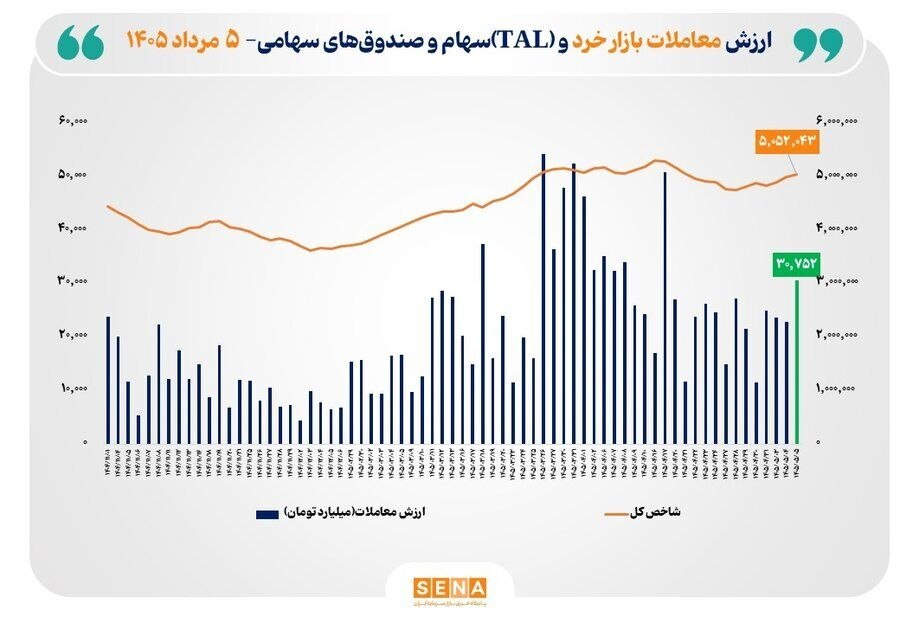
Tehran's main index (TEDPIX) reached 5,736,512 points on Tuesday, August 11, 2026 (20 Mordad 1405), up about 11.3 percent from 5,154,059 on Sunday, August 2 (12 Mordad), across seven trading sessions. The equal-weight index rose from 1,461,309 to 1,604,923 points over the same span, up nearly 9.8 percent, meaning the rally was not confined to a handful of large-cap names (Sahmino trading data, August 11, 2026). Sahmino previously reported that Tehran bourse retail turnover hit a record 65 trillion tomans on Sunday, August 9, and that in the same stretch, retail investors were net buyers for five straight sessions while institutions were net sellers, a sign of fresh liquidity from individual investors. At the same time, Iran's Chamber of Commerce, Industries, Mines and Agriculture Research Center reported the economy-wide Purchasing Managers' Index (PMI) at 47.3 for Tir 1405 (the month ending roughly late July 2026), the sixteenth consecutive month below the 50 threshold that separates expansion from contraction, meaning the real economy is still reporting contraction even as the stock index sets records. These two pictures, a boom on the trading floor and contraction in the real economy, are exactly why "buy now or wait" has no simple answer.
Four Screening Criteria, Not a Guess
Rather than predicting whether the index corrects in Mehr, Sahmino's own data tools offer four measurable criteria for any stock. To show how to read these numbers, three large, heavily traded names appear below, not as buy suggestions but purely as worked examples of the method, all based on the closing data for the night of August 11 (20 Mordad 1405):
- P/E versus its own sector: Fold (Foolad Mobarakeh, Iran's largest steelmaker) trades at a P/E of about 4.4 against a basic-metals sector average of 9.8, below its sector; MSMI (Iran National Copper Industries, "Fameli") trades at a P/E of about 12.9 in the same sector, above the sector average. BMLT (Bank Mellat, "Vabmellat") trades at a P/E of about 2.8 against a banking-sector average of 4.9, below its own sector. Comparing a stock to its own sector, not the market as a whole, is the first screening step; on its own it is still not a reason to buy.
- Trailing twelve-month EPS: Fold's EPS TTM is 518 rials, MSMI's is 1,411 rials and BMLT's is 454 rials per share; this figure is what P/E is built on and should be read alongside the trend in earnings, not as a single-night number.
- Free float and liquidity: Fold's free float is 36 percent with average monthly volume near 1.2 billion shares; MSMI's is 34 percent with average volume near 271 million shares; BMLT's is 38 percent with average volume near 6.6 billion shares. For an amount near 500 million tomans, a stock with low float and thin volume can make it hard to enter, and especially to exit, a position; this figure is checkable before any purchase.
- Venue and regulatory flags: all three names above trade on Tehran's main board (Market One) and carry no special-supervision flag. Farabourse's بازار پایه (base market) names have wider price bands, thinner liquidity and far more trading halts; that venue difference is part of a stock's risk, independent of how attractive its price looks.
Why These Four Criteria Matter
A P/E below its sector average does not by itself guarantee a stock is "cheap"; the market may have correctly priced it lower for a reason, such as earnings quality or margin outlook. That is why EPS has to be read alongside P/E: earnings that are not durable make a low P/E misleading. Free float and trading volume relate directly to position size: a portfolio near 500 million tomans in a stock with thin daily volume does not move in or out easily. The general risk-management principle follows from the same logic: spreading capital across several stocks and sectors, instead of concentrating in one or two names, shrinks the potential loss from any single position; the exact number of names depends on each investor's own risk tolerance, which this report does not set for anyone.
Outlook: "Buy Now or Wait" Is a Question No Dataset Answers With Certainty
Two datasets in this report point in different directions: a record index and a record in retail turnover on one side, sixteen months of PMI contraction on the other. Market timing, predicting exactly when a correction will happen, is not something any analyst can do with certainty; Sahmino does not offer such a prediction. One method many investors use to reduce timing risk is staged buying: splitting an amount into several tranches over a few weeks or months instead of investing it all at once. This is a well-documented approach in financial literature, not a call to action from this report. Whether to enter all at once or in stages depends on an individual's own risk tolerance, real time horizon and liquidity needs.
Bottom Line
For a portfolio near 500 million tomans with a six-month horizon, the right answer to "what should I buy" is not a stock list, it is a screening method: compare each stock's P/E to its own sector, not the whole market; read trailing twelve-month EPS alongside it; check free float and average volume to confirm liquidity; and check the special-supervision flag before any purchase. All four figures are available, dated, on each stock's page on Sahmino. Spread capital across multiple names and sectors to reduce dependence on any single decision. On timing, a record-setting index and a contracting PMI are both real, and neither guarantees a correction or guarantees the rally continues; this report is not advice to buy, sell or wait.
What to Watch
- The Mordad 1405 PMI report, due from the Chamber of Commerce Research Center in the first ten days of Shahrivar (early September)
- Whether Tehran's daily net retail buying trend continues or breaks
- How the index reacts to any further record in retail turnover value
- The special-supervision flag on any stock a reader is screening, checked before any purchase decision