
Iran Market Pulse: Tuesday Midday, August 4, 2026; With Markets Shut for Arbaeen, Silver Reached the $59 Area and Outran Gold
Iran's markets are closed today, Tuesday 13 Mordad 1405 (4 August 2026), for Arbaeen, but the global board had a clear winner by midday and it was not gold: silver traded between $58.88 and $59.04 an ounce with a session high of $59.13, while gold rose just 0.21% to 0.33% to sit at $4,062 to $4,065. Saudi Aramco reported its war-quarter profit the same day: $33.4 billion adjusted net income per CNBC, $32.7 billion net income per Anadolu.
Related video
Iran's markets are closed today, Tuesday 13 Mordad 1405 (4 August 2026), for Arbaeen, but the global board has had one clear winner so far and it is not gold. Around 11am Tehran time silver traded between $58.88 and $59.04 an ounce, with a session high of $59.13, while gold in the same minutes sat between $4,062 and $4,065, only about two to three tenths of a percent higher. In other words, on a day when Tehran's exchange shops and gold dealers are shut, the cheaper metal on the global board moved several times as much as the expensive one.
The day's big news, though, was written in financial statements: Saudi Aramco and BP published the bill for the war quarter today. Aramco reported adjusted net income of $33.4 billion, up 33% (CNBC, 4 August), while Anadolu the same day put the company's net income at $32.7 billion, up 44% on the same quarter last year. BP posted underlying replacement cost profit of $5.7 billion, more than double the $2.35 billion of a year earlier.
Midday snapshot
| Asset | Level | Change | As of |
|---|---|---|---|
| Silver (spot) | $58.88 to $59.04 | Higher | 11:05 to 11:14, Tue 4 August |
| Gold (spot) | $4,062 to $4,065 | +0.21% to +0.33% | 10:23 to 11:05, Tue 4 August |
| Brent crude | $84.72 to $84.86 | +1.28% to +1.30% | 10:23, Tue 4 August |
| Platinum | $1,670.40 | +2.71% | 4 August (13 Mordad) |
| Bitcoin | $63,744 | +1.56% in 24 hours | 11:08, Tue 4 August |
| Tether | 191,983 to 192,878 tomans | Little changed | 10:23 to 11:08, Tue 4 August |
| Gold, 18 carat, per gram | 18,359,600 to 18,387,280 tomans | +0.13% | 11:05, Tue 4 August |
| Emami coin | 184,500,000 to 185,000,000 tomans | No material change | 11:05, Tue 4 August |
| Free-market dollar | 192,450 tomans (sell) | Last rate before the holiday | 8:05, Tue 4 August |
| TEDPIX (Tehran Stock Exchange) | 5,277,353 points | +2.39% | Monday 3 August close |
| Peugeot 207 automatic | 2,480 million tomans | 40 million tomans lower | 13 Mordad (4 August) |
Today's headlines
- Saudi Aramco reported second-quarter adjusted net income of $33.4 billion, up 33%, and said it had kept exports running at up to 7 million barrels a day without passing through the Strait of Hormuz, by leaning on its 1,200 kilometre East-West pipeline to the Red Sea (CNBC, 4 August).
- BP reported second-quarter underlying replacement cost profit of $5.7 billion, above the $5 billion analysts had expected and more than double the same period last year (CNBC, 4 August).
- Pakistan invited Iran's senior negotiators to travel to Islamabad at the earliest opportunity; Pakistani and Qatari mediators are working to fix a time and place for resuming direct talks, and no firm date has been set (Anadolu, 13 Mordad / 4 August).
- Iran's Tax Administration said corporate tax collected in spring 1405 grew about 25%, while total tax revenue rose about 35% (Mehr news agency, 13 Mordad / 4 August).
- In the week to 9 Mordad (31 July), 4,546 buyers from 30 provinces purchased a combined 1,078,033 tonnes of cement on the Iran Mercantile Exchange, with Tehran province leading at 103,050 tonnes (Bourse News, citing exchange data, 13 Mordad / 4 August).
- The head of the South Pars Phase 11 development said the phase's first block will reach a nameplate capacity of more than 28 million cubic metres of raw gas a day within two months (Shana, 12 Mordad / 3 August).
Gold and silver: the metal that outran gold today
The gold board carried an interesting gap today. Spot gold was recorded at $4,062.66 at 10:23, up 0.21%, and at $4,065.05 at 11:05, up 0.33%; a third source the same day showed $4,064.41, up 0.23%, and Eghtesad Online's morning report had put the ounce at $4,059. Four independent readings, one picture: gold rose gently and without much slope.
Silver was somewhere else entirely. Spot silver was recorded at $58.88 at 11:14, up 77 cents on the previous day; at $59.04 at 11:05; and a third source showed $58.97, up 2.22%. The differing percentages come down to each source's reference close, but the direction is the same in all three, and today's high was $59.13. Alongside it, platinum rose 2.71%, palladium 2.59% and copper 1.16%.
The mechanism is straightforward: silver and platinum are both precious metals and industrial metals, so when industrial demand and inflation expectations strengthen at the same time, they move more than gold does. A historical anchor sharpens the figure: silver is 55.51% higher than on the same day last year, while gold has gained 20.21% over one year and is down 5.91% year to date. The gold-to-silver ratio on today's numbers works out at about 68.9, which is our own calculation. One important caveat: despite today's gain, gold still sits 24.77% below its 52-week high of $5,400.25, so this is an up day, not a record.
In Tehran the market was shut and the last rates were recorded with minor differences: 18-carat gold at 18,387,280 tomans per gram, up 0.13%, at 11:05, and 18,359,600 tomans on the rates published by the Tehran Gold and Jewellery Union for today. The Emami coin ranged between 184,500,000 and 185,000,000 tomans, and the Bahar Azadi between 180,000,000 and 180,600,000 tomans. The Emami coin premium (حباب, the gap between market price and intrinsic metal value) was reported between 1,368,000 and 2,117,000 tomans depending on the calculation method, but the constant sits elsewhere: the quarter-coin premium is 6,897,000 tomans, about 14.96%. Small denominations remain the most expensive way to buy gold.
Oil and the regional and global backdrop: the bill for the war quarter
Brent crude stood at $84.72 at 10:23 today, up 1.28%, and a second source the same day showed $84.86, up 1.30%; West Texas Intermediate was at $80.79, up 0.56%. Brent has therefore consolidated its overnight recovery and is effectively unchanged from this morning's report.
But today's real story was not the price of oil; it was who collected it. Saudi Aramco said today that its adjusted net income for the second calendar quarter reached 125.2 billion Saudi riyals, or $33.4 billion, up 33% on last year and above the $31.59 billion analysts had forecast; operating cash flow was $25.4 billion and the approved base dividend $21.9 billion (CNBC, 4 August). Anadolu the same day reported net income of $32.7 billion, up 44%, and first-half profit of $65.2 billion. The two figures differ because they are two different line items, adjusted net income and net income, and both say the same thing.
The mechanism is exactly where it connects to Tehran. Amin Nasser, Aramco's chief executive, said explicitly that the company had sustained production and exports despite unprecedented disruption to shipments through the Strait of Hormuz, because its 1,200 kilometre East-West pipeline to the Red Sea allows up to 7 million barrels a day to be exported without passing through the strait. Put simply, the same choke point that pushed the price up has turned into profit for an exporter that has an alternative route. BP also reported $5.7 billion for the second quarter today, and Exxon Mobil and Chevron had already posted large profits; Exxon's second-quarter profit more than doubled to $14.5 billion and Chevron's rose nearly 400% to $12 billion. Trump on Monday accused the two of making "too much money based on a shortage".
Elsewhere on the regional board, Turkiye's annual inflation eased to 31.75% in July from 32.11% in June, although the monthly index rose 1.78%, the largest increase in three months (Turkish Statistical Institute, reported by Anadolu, 12 Mordad / 3 August); Turkiye's July exports also set a record at $25.6 billion. The channel to Tehran is clear: a steadier lira means more predictable import costs on the Turkish route. At 10:23 today the dollar bought 47.55 lira and 6.75 yuan. Iraq, for its part, signed a new one-year agreement with Turkiye on 10 Mordad (1 August) for 750,000 barrels a day to transit the Kirkuk-Ceyhan pipeline, a line with 1.5 million barrels of capacity that currently carries only about 170,000 barrels a day, after Iraqi oil exports fell more than 80% following the conflict and monthly oil revenue dropped from around $6 billion to under $2 billion (Al Jazeera, 10 Mordad / 1 August).
Currency: a market that stayed shut with a 25% gap
No trading took place in the currency market today, and the last recorded free-market dollar rate, at 8:05 this morning, was 192,450 tomans on the sell side; our own recorded data at 19:59 on Monday shows 192,880 tomans. On the official side, the remittance dollar at the Iran Currency and Gold Exchange Centre (the "توافقی" or agreed rate) was last recorded at 153,616 tomans. The gap between the two is about 38,800 tomans, close to 25%, and because neither updated today that gap carries over untouched to tomorrow. Global rates did work, however: the euro was at $1.1505 and the dollar at 157.74 yen, up 0.42%, after the United States and Japan intervened jointly in the currency market last week to buy yen for the first time in nearly three decades (Anadolu, 12 Mordad / 3 August).
Crypto: the only open dollar market, and quiet today
On a holiday, the crypto market is the only place an Iranian can trade right now. Bitcoin was at $63,744 at 11:08, up 1.56% over 24 hours, effectively level with the $63,745 recorded at 7:59 this morning; bitcoin dominance was 58.6% and its market capitalisation $1.28 trillion. Ethereum traded at about $1,856 in the same minutes. The tether rate moved between 191,983 and 192,878 tomans, still level with the last cash dollar rate and carrying no fresh risk premium. On the margins of this market, a report echoed today estimated losses from cyber attacks on crypto projects in the first half of 2026 at $939.86 million (Bourse News, 13 Mordad / 4 August).
Stocks: a board locked until tomorrow
TEDPIX, the Tehran Stock Exchange all-share index, closed Monday 12 Mordad (3 August) at 5,277,353 points, up 123,295 points or 2.39%. The equal-weight index rose 2.50% to 1,497,819 points and the Farabourse index gained 2.69% to 42,758 points, while net individual buying across 1,077 symbols was about 19.1 billion shares (our own recorded exchange feed data, 12 Mordad). These figures will not change until the reopening on Wednesday 14 Mordad (5 August), and that is today's point: the equity market has been sitting for two days on a full pricing of the de-escalation scenario, while the global board has changed direction twice in the same window.
Iron and steel: prices flat, power risk still on the table
Recorded rebar prices were unchanged from yesterday: 10mm Arian Foulad grade A3 rebar at 71,360 tomans per kilogram ex-works, 12mm rebar at 70,090 tomans in both grades, and 14mm grade A3 at 70,000 tomans. On the global board, Chinese steel rose 0.27% and hot-rolled coil fell 0.33%. The main variable for this market in the coming weeks remains the one-day-a-week power restriction on industrial estates, which usually shows up in producer margins before it shows up in ex-works prices.
Cars: the only domestic market that priced today
The car market was both active and mostly red today. The Peugeot 207 automatic fell 40 million tomans to 2,480 million tomans, the Dena Plus automatic dropped 25 million tomans to 2,715 million tomans, and at Saipa the Atlas S fell 30 million tomans to 1,310 million tomans. The flow is not uniform: the Tara automatic V4 rose 2 million tomans and the Shahin automatic Plus 22 million tomans (Khabar Online, citing Eghtesad Online, 13 Mordad / 4 August).
The number that gets less attention in this table is the gap between factory and market prices. That same Peugeot 207 automatic, with a factory price of 2,134 million tomans, carries a market margin of about 346 million tomans, or 16%, and the Shahin automatic Plus, with a factory price of 1,834 million tomans, about 826 million tomans, close to 45%. Today's declines have taken only a thin layer off that gap.
Materials: unchanged, with one new figure from the commodity exchange
Cement prices were unchanged today: Portland type 2 bulk cement at 3,937,000 tomans per tonne at Tehran Cement and 3,593,000 tomans at Abyek Cement, with the 50 kilogram bag of the same product at 291,000 tomans in Tehran. The fresh news in this section is on the demand side: in the week to 9 Mordad (31 July), 4,546 buyers from 30 provinces sourced 1,078,033 tonnes of cement through the Iran Mercantile Exchange, led by Tehran (103,050 tonnes), then Isfahan (81,015 tonnes) and Markazi (64,900 tonnes).
The takeaway
Today's verdict is this: during the Arbaeen holiday, the winner on the board was silver, not gold. Silver held the $59 area and finished visibly ahead of gold's shallow gain, and alongside it platinum rose 2.71%. Why does it matter? Because that combination shows today's driver in the global market was not simply safe-haven demand, but industrial demand as well, and that is what separates it from an ordinary gold day. One thing to remember: on a day when Aramco's $33 billion profit showed whose pocket the Hormuz risk premium ends up in, the only domestic number that moved was the price of a car, and the rest of the board stayed locked until Wednesday.
What to watch before tomorrow
- Whether silver holds the $59 level or retreats again, as it did over the past three months when it fell 19.32%.
- The Tehran Stock Exchange reopening on Wednesday 14 Mordad (5 August) and whether TEDPIX holds Monday's 2.39% gain or gives part of it back.
- The first free-market and remittance dollar rates after two days of suspension, and whether the near 25% gap widens or narrows.
- The government bond auction on 14 Mordad (5 August). Follow upcoming events on the Sahmino calendar.
- Any fresh news on the time and place for resuming talks, after Islamabad's invitation to Iranian negotiators.
Figures in this report are given with their reference time and date, and market rates change through the day. The Tehran Stock Exchange and Iran's domestic markets are closed today for Arbaeen, and the domestic figures in this report are the last recorded rates. The analytical sections of this report are cautious observations and are not buy or sell advice.
Media
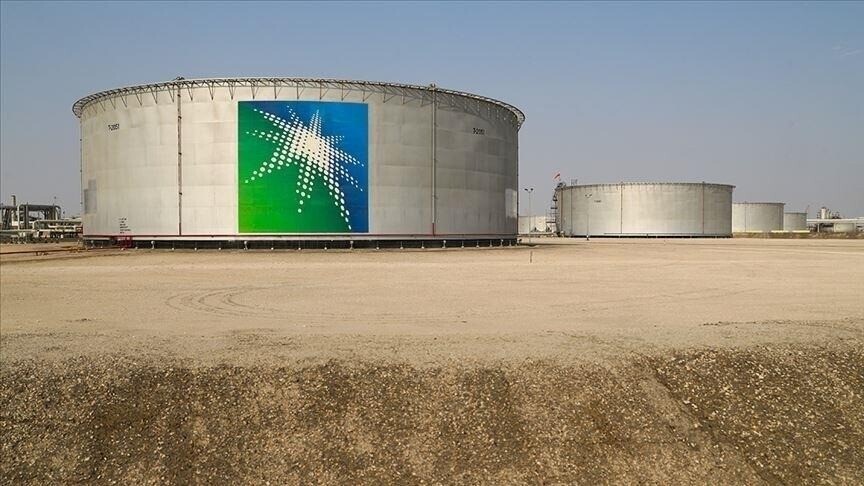
Saudi Aramco reported second-quarter adjusted net income of 33.4 billion dollars on 4 August 2026.
Source: Anadolu Agency

Tehran gold and coin market rates for Tuesday 4 August 2026, a day when the domestic market was closed for Arbaeen.
Source: اقتصاد آنلاین