On Wednesday, 29 July 2026 (7 Mordad 1405), Iran's gold market produced two very different numbers on the same day. According to the Sahmino price feed at 19:59, the Emami coin premium reached 4,990,000 tomans, meaning it grew 65.56% in a single day. On that same day, a unit of the Lotus gold fund (ticker: Tala) rose just 1.44% as of 13:20, and the Jam Gold fund rose 1.27%.
The gap between those two numbers is the short answer to a bigger question: why, over roughly seven months, hundreds of trillions of tomans of Iranian gold demand have changed the place they live.
Background
According to a Tasnim News Agency report on 28 Tir 1405 (19 July 2026), the net asset value of capital market gold funds passed the 670 trillion toman mark at the end of the week ending 26 Tir 1405 (17 July 2026), rising 4.4% from the previous week to reach 670,418 billion tomans.
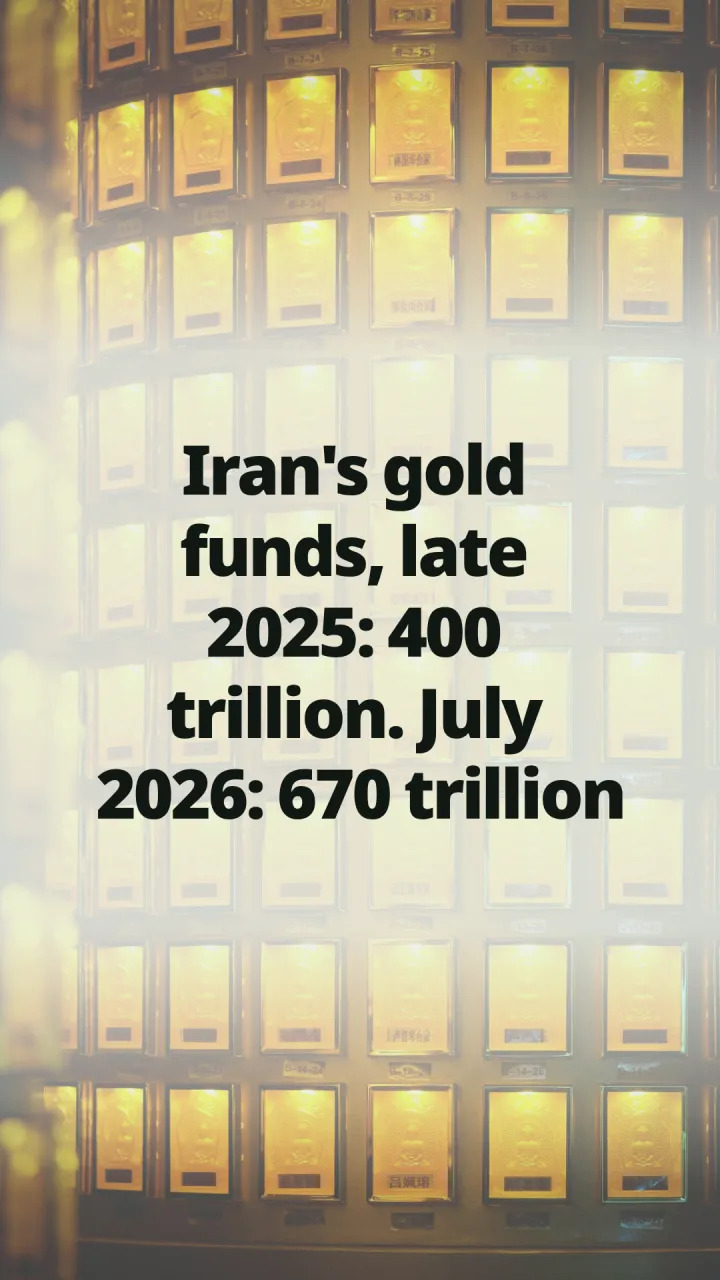
The comparison figure matters: in Azar 1404 (late 2025) the same number was about 400 trillion tomans. Over roughly seven months, the asset value of these funds has grown close to 68%. That growth is not only a reflection of gold getting more expensive; part of it is fresh money arriving.
Signs of the same flow appear in recent sessions. On Sunday, 4 Mordad 1405 (26 July 2026), the trading value of gold funds passed 2,325 billion tomans, and just 30 minutes after the opening, buy orders exceeded sell orders by 144 billion tomans. The effect is visible at the level of a single fund too: the assets under management of the Rose Toranj gold fund grew 900% over one year to reach 10,000 billion tomans on 6 Mordad 1405 (28 July 2026).
The numbers, as of Wednesday, 29 July 2026
| Indicator | Value | Day change | Time |
|---|
| Emami coin premium | 4,990,000 tomans | 65.56% | 19:59 |
| Emami coin | 187,985,000 tomans | 2.17% | 19:59 |
| 18 karat gold (per gram) | 18,810,200 tomans | 2.56% | 19:59 |
| Lotus gold fund (ticker: Tala) | 131,755 tomans | 1.44% | 13:20 |
| Jam Gold fund | 1,679.9 tomans | 1.27% | 13:20 |
| Global gold ounce | $4,043.23 | 0.39% | 21:29 |
The source for every row above is the Sahmino price feed on that day. The coin premium stood at 3,014,000 tomans the previous day, so 1,976,000 tomans were added to it in a single session.
Drivers
One: the premium, where the mechanism shows itself. A physical coin normally trades above the intrinsic value of the gold inside it, and on emotional days that gap can swing violently. The 29 July data is exactly that: the global ounce moved 0.39%, 18 karat melted gold rose 2.56%, but the coin premium alone grew 65.56%. A gold fund unit can also drift from its net asset value, but because units are issued and redeemed against coin and bullion deposit certificates on the Iran Mercantile Exchange, that gap normally stays narrower. We explained the full mechanism of that gap in the lesson Gold Funds: How They Work, What They Cost, and Why the Board Price Drifts From NAV.
Two: the size of the entry ticket. Buying one Emami coin on 29 July 2026 meant 187,985,000 tomans in cash. A Lotus gold fund unit on the same day was 131,755 tomans. Divisibility is the single most practical difference for a household with a few million tomans of savings rather than a few hundred million.
Three: three old risks removed. Storage, authenticity and the cost of a safe deposit box are three hidden costs of buying physical gold that disappear when you buy a fund unit. These are not price risks; they are ownership risks.
Four: tax exemption and price transparency. Under current rules, trades in these fund units are exempt from transfer tax. The price is also live and public, which removes haggling with a jeweller from the equation.
Outlook
The most important point that marketing for this instrument tends to leave quiet is this: the price risk of gold remains completely untouched. A fund changes how you hold the asset, not the direction of the market. A recent example came on Sunday, 26 July 2026, when a fall in the dollar rate closed most gold based funds in negative territory. Any drop in the global ounce or the exchange rate lands directly on the value of a fund unit.
Three further risks are not removed. First, the premium on the units themselves: in emotional sessions the board price can drift meaningfully from NAV, and buying at that moment means overpaying. Second, the management fee, a small number that is nonetheless not zero over the long run. Third, liquidity in a one way market, where selling at your preferred price becomes difficult.
One point deserves to be said plainly: no official national statistic on the total number of gold fund unit holders is available. Figures that some brokerages publish about the number of investors in their own funds are self reported and have not been confirmed by the regulator, so the population size of this migration cannot be stated with certainty. What is reliable is the asset figures themselves.
Conclusion
Growth from about 400 trillion tomans in Azar 1404 (late 2025) to 670,418 billion tomans in the week ending 17 July 2026 is not merely a big number, it is a relocation: part of Iran's traditional gold demand has moved from physical form into capital market instruments. The 29 July data shows what that move buys and what it does not buy. A 65% premium jump on the coin against a fund unit that moved 1.4% means the fund buyer has stepped away from premium volatility, not from gold volatility.
If only one thing survives this report, let it be this: choosing between a physical coin and a gold fund is not a choice between "safer" and "riskier". It is a choice between two ways of owning the same asset, with different costs and different conveniences.
What to watch
Three numbers will be telling in the coming weeks. First, whether the coin premium returns to its earlier range after the 29 July jump or settles at a new level. Second, the weekly gold fund net asset value reports, and whether the 4.4% weekly growth rate continues. Third, the gap between fund board prices and NAV on volatile days, which is the practical quality gauge for this instrument. You can follow related gold and coin market events on the Sahmino market calendar.
This article is not a buy or sell recommendation. It describes the structure, figures and risks of a financial instrument.