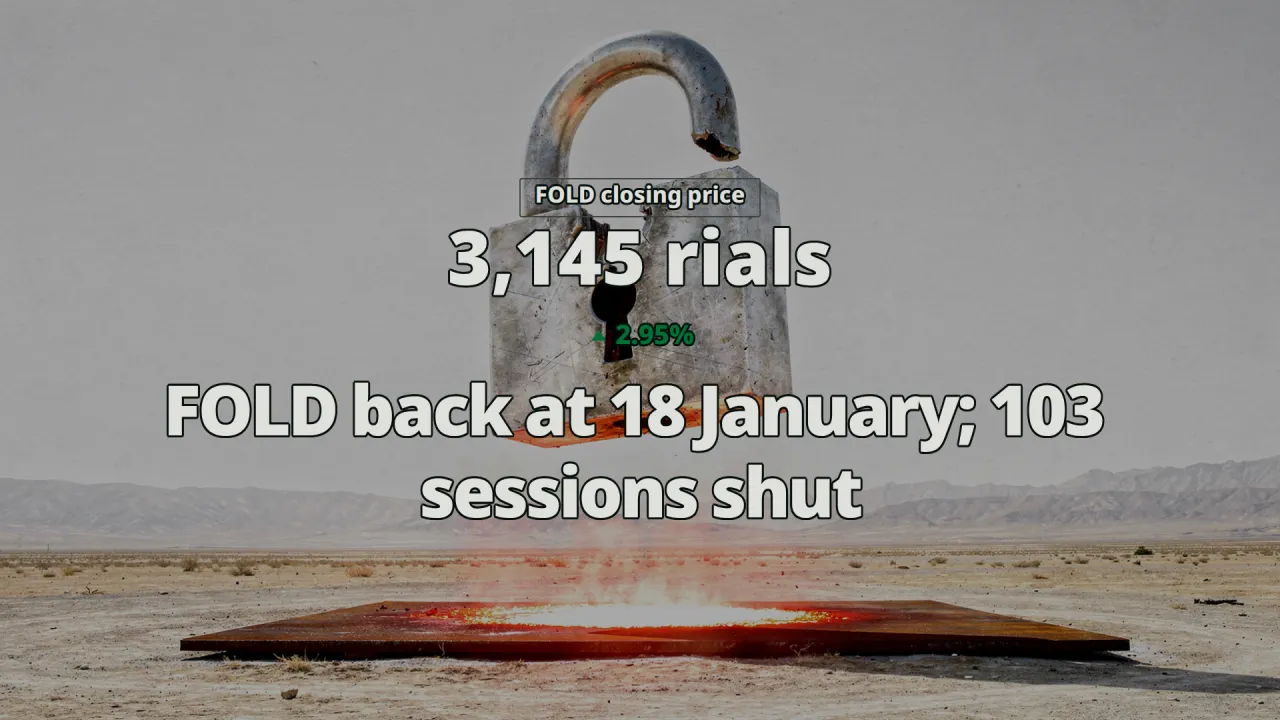
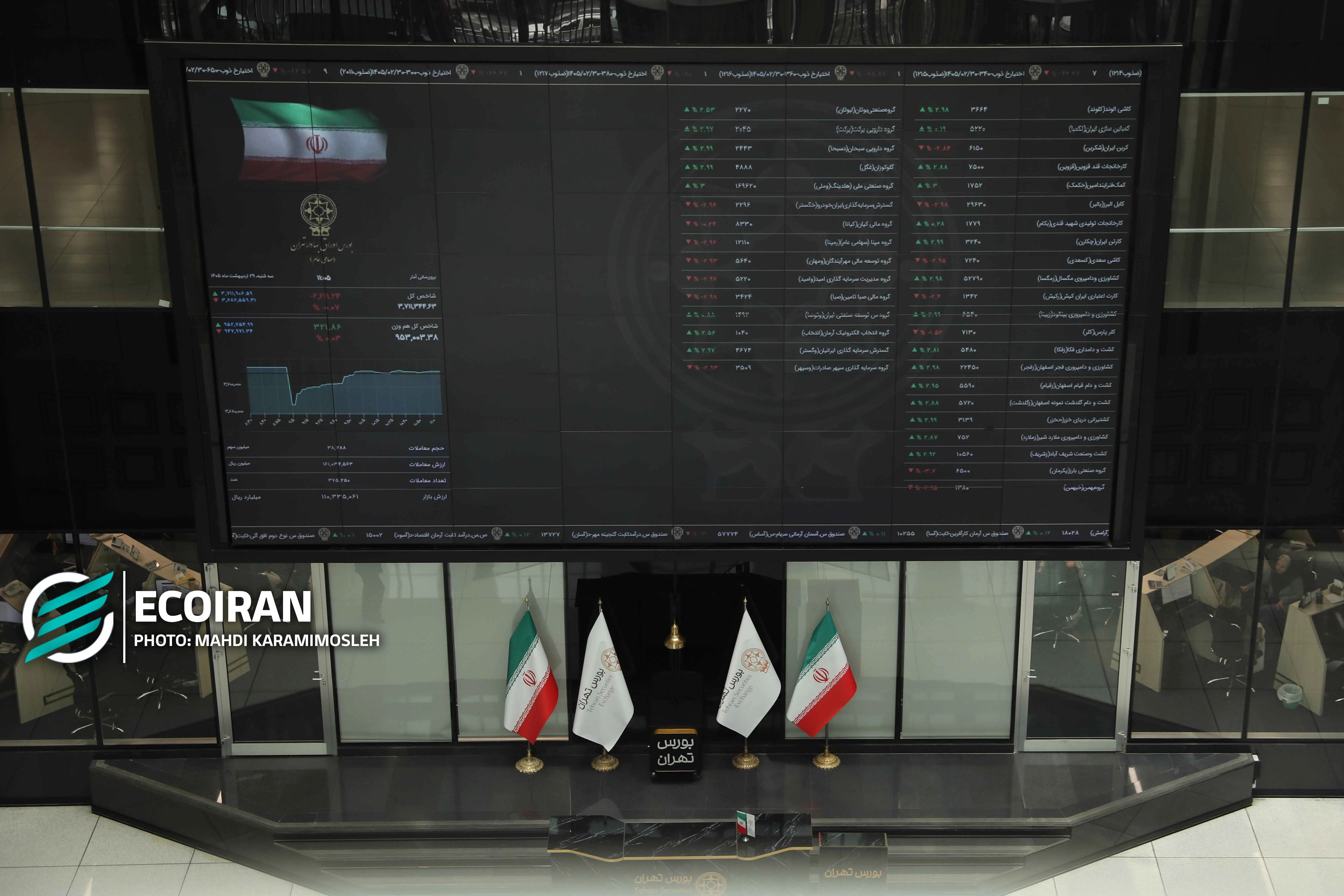
On Monday, 14 September 2026 (23 Shahrivar 1405 in the Iranian calendar), FOLD, the symbol of Mobarakeh Steel of Isfahan in the basic metals group of the Tehran Stock Exchange's main board, closed at 3,145 rials. That is the symbol's highest closing price since 18 January 2026. The two dates are 239 calendar days apart, but the more telling number is the session count: across 103 trading sessions in that span, FOLD did not trade at all. The symbol set this mark on a day when Tehran's main index itself closed red.
Background
Both ends of this calculation come from Sahmino's own daily price series for the symbol. The first end is 18 January 2026, the last session on which FOLD's closing price stood above today's level, at 3,174.3 rials. The second end is the 3,145-rial close of Monday, 14 September 2026. Subtracting the dates gives 239 calendar days, and counting this symbol's non-trading sessions in the same span gives 103.
Those 103 sessions have two causes, not one, and separating them matters. The first is the interruption of the whole market: according to Donya-e-Eqtesad, the Tehran Stock Exchange resumed trading on 19 May 2026 after a roughly 80-day break. But FOLD did not come back on that date. The second cause was the suspension of the symbol itself: FOLD was one of the 42 war-damaged symbols making up about 35 percent of the Tehran exchange's value that stayed closed even after the market reopened. FOLD finally resumed trading on Saturday, 8 August 2026; according to Eco Iran, that was the single most important event in that day's session.
FOLD's last closing price before the halt was 2,549 rials on 25 February 2026. In the first session after it reopened, on 8 August 2026, the share closed at 2,332 rials, below where it had been left. From that close to today's, the series records a 34.9 percent gain, and against the pre-halt 2,549 rials it is 596 rials and 23.4 percent higher. Put plainly, the share has just recovered everything it lost over the period its symbol was closed, and moved a little beyond it.
The numbers from Monday's session
The following figures are from the Tehran Stock Exchange board for the session of Monday, 14 September 2026:
| Item | Value |
|---|
| Closing price (قیمت پایانی, the volume weighted close) | 3,145 rials, 2.95 percent above the previous close of 3,055 rials |
| Last traded price | 3,128 rials, 2.39 percent higher |
| Opening price | 3,146 rials, equal to the day's permitted band ceiling |
| Permitted price band | 2,964 to 3,146 rials |
| Volume | 7,686,967,037 shares across 29,950 trades |
| Traded value | 24,178,475,931,629 rials |
| Volume against the 20-session average | 2.23 times |
Three further board facts from the same session: the share opened 2.98 percent above the previous close, this was its seventh consecutive higher close, and its 20-session moving average (2,704.05) had crossed above its 50-session average (2,580.34) on 8 September 2026.
Underneath the gain, though, the money ran against the price. In this session retail investors (حقیقی) bought 4,085,972,101 shares and sold 4,754,261,199, making them net sellers of 668,289,098 shares, worth approximately 2,101 billion rials (an estimate, derived from volume times that day's closing price). Average retail buying per participant was 1,947,617,802 rials against average selling of 2,599,470,005 rials, and buyer strength stood at 0.87. On the other side were the institutions (حقوقی): 3,600,994,936 shares bought against 2,932,705,838 sold. These figures state the sides only and pass no judgment on either party's motive.
On valuation, per Sahmino's nightly reading dated 14 September 2026, FOLD's price to earnings ratio is 6.07 against 14.15 for the whole basic metals group, less than half its own sector. Its trailing twelve-month earnings per share is 518 rials, its price to sales ratio 1.47, and its free float 36 percent.
The fundamental figures come from the company's latest audited consolidated financial statements for the fiscal year ended 20 March 2026, published on codal on 29 July 2026: operating revenue of roughly 3,668.9 trillion rials, net profit of roughly 1,003.0 trillion rials, a net margin of 27.3 percent and a return on equity of 30.8 percent. Revenue grew 27.9 percent year on year, but net profit grew only 0.65 percent; the two numbers belong side by side.
Drivers
Three drivers can be named behind this session, and none of them is the whole story on its own.
First, the exchange rate. The free-market dollar stood at 231,315 tomans on the evening of Monday, 14 September 2026, 1.19 percent above the previous day. Mobarakeh Steel sells a product whose domestic price is tied to global benchmarks and the conversion rate, so a rising dollar enlarges its rial revenue. Eco Iran likewise named dollar volatility, alongside political risk, among the factors steering that day's trading.
Second, a raw-material contract. In a group B material disclosure with an event date of 15 August 2026 (published on codal on 16 August 2026), Mobarakeh Steel reported a contract to buy 1,500,000 tons of slab from Hormozgan Steel, at an estimated 975,000,000 million rials, settled by barter against the sale of 1,000,000 tons of pellets and 200,000 tons of sponge iron. The unit of these figures is million rials and they must be read in that unit.
Third, the market itself. Donya-e-Eqtesad described Monday's trading as a retreat in the main indicators, and Eco Iran attributed the return of caution to the postponement of the meeting between Iran and the Persian Gulf states over the Strait of Hormuz, together with dollar volatility. In a session like that, a large symbol staying green on double its normal volume is itself a divergence, not a continuation of the market trend. That morning's Market Pulse had reported the index setting a seventh consecutive record; Monday's session broke that run.
Outlook
This section is interpretation, not reporting. Donya-e-Eqtesad has written that the main index, after its recent records, has reached one of the most sensitive junctures of its rally, and that the market's price to earnings ratio passing the 9 mark has increased concern about a possible short-term correction; the same report sets out two scenarios, breaking through resistance or a temporary pause in the rally. FOLD's 6.07 against the group's 14.15 is a valuation gap, not a promise of return, and a gap like that can stay open for years. On the other side, the share today sits 6.7 percent below its 52-week high in the Sahmino series. Current rates for other assets are updated on Sahmino's prices page.
Conclusion
The main point is this: on Monday, 14 September 2026, FOLD reached its highest closing price since 18 January 2026, which means the entire decline the shareholder carried through the 103 sessions the symbol was closed has now been recovered. It matters because that recovery was completed on a day when the main index closed red and retail investors were net sellers of this very symbol, meaning the price's return was not driven by retail money. The one thing to remember is our own reading: FOLD's closing price stays above 3,000 rials, as long as institutions remain net buyers as they were today, through the end of this week; and that reading is invalidated by two consecutive closes below 3,000 rials (reading dated 14 September 2026).
What to watch
- Whether the run of higher closes continues or breaks, and whether volume returns to its 20-session average.
- The direction of net retail and institutional flow in this symbol over the coming sessions.
- The gap between FOLD's price to earnings ratio and the basic metals group average.
- The free-market dollar and global steel prices, to which the company's rial revenue is tied.
- The company's subsequent disclosures on codal, particularly raw-material supply contracts.
- Market breadth in the sessions ahead, which shows whether the advance stays confined to the large symbols.